Relative outcomes of climate change mitigation related to global temperature versus sea-level rise (original) (raw)
- Perspective
- Published: 01 July 2012
- Aixue Hu1,
- Claudia Tebaldi2,
- Julie M. Arblaster1,3,
- Warren M. Washington1,
- Haiyan Teng1,
- Benjamin M. Sanderson1,
- Toby Ault1,
- Warren G. Strand1 &
- …
- James B. White III1
Nature Climate Change volume 2, pages 576–580 (2012) Cite this article
- 3303 Accesses
- 92 Citations
- 81 Altmetric
- Metrics details
Subjects
Abstract
There is a common perception that, if human societies make the significant adjustments necessary to substantively cut emissions of greenhouse gases, global temperature increases could be stabilized, and the most dangerous consequences of climate change could be avoided. Here we show results from global coupled climate model simulations with the new representative concentration pathway mitigation scenarios to 2300 to illustrate that, with aggressive mitigation in two of the scenarios, globally averaged temperature increase indeed could be stabilized either below 2 °C or near 3 °C above pre-industrial values. However, even as temperatures stabilize, sea level would continue to rise. With little mitigation, future sea-level rise would be large and continue unabated for centuries. Though sea-level rise cannot be stopped for at least the next several hundred years, with aggressive mitigation it can be slowed down, and this would buy time for adaptation measures to be adopted.
This is a preview of subscription content, access via your institution
Access options
Subscribe to this journal
Receive 12 print issues and online access
$259.00 per year
only $21.58 per issue
Buy this article
- Purchase on SpringerLink
- Instant access to the full article PDF.
USD 39.95
Prices may be subject to local taxes which are calculated during checkout
Additional access options:
Figure 1: Globally averaged surface air temperature.

The alternative text for this image may have been generated using AI.
Figure 2: Global sea-level rise anomaly due to thermal expansion and ocean-temperature anomalies.
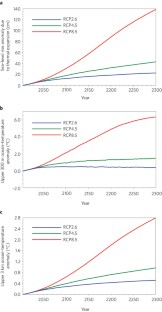
The alternative text for this image may have been generated using AI.
Figure 3: Global sea-level anomalies.
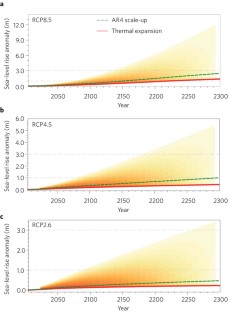
The alternative text for this image may have been generated using AI.
References
- Lowe, J. A. & Gregory, J. M. A sea of uncertainty. Nature Rep. Clim. Change http://dx.doi.org/10.1038/climate.2010.30 (2010).
- Meinshausen, M. et al. Greenhouse-gas emission targets for limiting global warming to 2 °C. Nature 458, 1158–1162 (2009).
Article CAS Google Scholar - Moss, R. H. et al. The next generation of scenarios for climate change research and assessment. Nature 463, 747–756 (2010).
Article CAS Google Scholar - Van Vuuren, D. P. et al. The representative concentration pathways: An overview. Climatic Change 109, 5–31 (2011).
Article Google Scholar - Washington, W. M. et al. How much climate change can be avoided by mitigation? Geophys. Res. Lett. 36, L08703 (2009).
Article Google Scholar - Meehl, G. A. et al. Climate system response to external forcings and climate change projections in CCSM4. J. Clim. http://dx.doi.org/10.1175/JCLI-D-11-00240.1 (2012).
- Pardaens, A. K. et al. Sea-level rise and impacts projections under a future scenario with large greenhouse gas emission reductions. Geophys. Res. Lett. 38, L12604 (2011).
Article Google Scholar - Meehl, G. A. et al. How much more global warming and sea level rise? Science 307, 1769–1772 (2005).
Article CAS Google Scholar - Meehl, G. A. et al. in IPCC Climate Change 2007: The Physical Science Basis (eds Solomon, S. et al.) 747–845 (Cambridge Univ. Press, 2007).
Google Scholar - Meehl, G. A. et al. Model-based evidence of deep-ocean heat uptake during surface-temperature hiatus periods. Nature Clim. Change, 1, 360–364 (2011).
Article Google Scholar - O'Neill, B. C. & Oppenheimer, M. Climate change: Dangerous climate impacts and the Kyoto Protocol. Science 296, 1971–1972 (2002).
Article CAS Google Scholar - Oppenheimer, M. Global warming and the stability of the West Antarctic ice sheet. Nature 393, 325–332 (1998).
Article CAS Google Scholar - Oppenheimer, M. & Alley, R. B. The West Antarctic ice sheet and long term climate policy. Climatic Change 64, 1–10 (2004).
Article Google Scholar - Rignot, E. et al. Acceleration of the contribution of the Greenland and Antarctic ice sheets to sea level rise. Geophys. Res. Lett. 38, L05503 (2011).
Article Google Scholar - Kerr, R. Galloping glaciers of Greenland have reined themselves in. Science 323, 458 (2009).
CAS Google Scholar - Church, J. et al. Revisiting the Earth's sea-level and energy budgets from 1961 to 2008. Geophys. Res. Lett. 38, L18601 (2011).
Article Google Scholar - Konikow, L. F. Contribution of global groundwater depletion since 1900 to sea level rise. Geophys. Res. Lett. 38, L17401 (2011).
Article Google Scholar - Wada, Y. et al. Global depletion of groundwater resources. Geophys. Res. Lett. 37, L20402 (2010).
Article Google Scholar - Kaser, G. et al. Mass balance of glaciers and ice caps: Consensus estimates for 1961–2004. Geophys. Res. Lett. 33, L19501 (2006).
Article Google Scholar - Meier, M. et al. Glaciers dominate eustatic sea level rise in the 21st century. Science 317, 1064–1067 (2007).
Article CAS Google Scholar - Pritchard, H. D. et al. Extensive dynamic thinning on the margins of the Greenland and Antarctic ice sheets. Nature 461, 971–975 (2009).
Article CAS Google Scholar - Velicogna, I. Increasing rates of ice mass loss from the Greenland and Antarctic ice sheets revealed by GRACE. Geophys. Res. Lett. 36, L19503 (2009).
Article Google Scholar - McKay, N. P., Overpeck, J. T. & Otto-Bliesner, B. L. The role of ocean thermal expansion in the last interglacial sea level rise. Geophys. Res. Lett. 38, L14605 (2011).
Article Google Scholar - Rahmstorf, S. A semi-empirical approach to projecting future sea-level rise. Science 315, 368–370 (2007).
Article CAS Google Scholar - Vermeer, M. & Rahmstorf, S. Global sea level linked to global temperature. Proc. Natl Acad. Sci. USA 106, 21527–21532 (2009).
Article CAS Google Scholar - Pfeffer, W. T., Harper, J. T., & O'Neel, S. Kinematic constraints on glacier contributions to 21st-century sea-level rise. Science 321, 1340–1343 (2008).
Article CAS Google Scholar - Nakashiki, N. et al. Recovery of thermohaline circulation under CO2 stabilization and overshoot scenarios. Ocean Model. 15, 200–217 (2006).
Article Google Scholar - Yoshida, Y. et al. Multi-century ensemble global warming projections using the Community Climate System Model (CCSM3). J. Earth Simulator 3, 2–10 (2005).
Google Scholar - Gillett, N. P. et al. Ongoing climate change following a complete cessation of carbon dioxide emissions. Nature Geosci. 4, 83–87 (2011).
Article CAS Google Scholar - Schewe, J., Levermann, A. & Meinshausen, M. Climate change under a scenario near 1.5 °C of global warming: Monsoon intensification, ocean warming and steric sea level rise. Earth Syst. Dynam. 2, 25–35 (2011).
Article Google Scholar - Gent, P. et al. The Community Climate System Model version 4. J. Clim. 24, 4973–4991 (2011).
Article Google Scholar
Acknowledgements
This research used computing resources of the Climate Simulation Laboratory at the National Center for Atmospheric Research (NCAR), which is sponsored by the National Science Foundation; the Oak Ridge Leadership Computing Facility, which is supported by the Office of Science of the US Department of Energy under Contract DE-AC05-00OR22725; and the National Energy Research Scientific Computing Center, which is supported by the Office of Science of the US Department of Energy under Contract DE-AC02-05CH11231. The authors acknowledge helpful input from B. O'Neill at NCAR. Portions of this study were supported by the Office of Science (BER), US Department of Energy, Cooperative Agreement No. DE-FC02-97ER62402, and the National Science Foundation. We acknowledge the World Climate Research Programme's Working Group on Coupled Modelling, which is responsible for CMIP5, and we thank the climate modelling groups (listed in Supplementary Table S2) for producing and making available their model output. For CMIP5, the US Department of Energy's Program for Climate Model Diagnosis and Intercomparison provided coordinating support and led development of software infrastructure in partnership with the Global Organization for Earth System Science Portals.
Author information
Authors and Affiliations
- National Center for Atmospheric Research, PO Box 3000, Boulder, 80307, Colorado, USA
Gerald A. Meehl, Aixue Hu, Julie M. Arblaster, Warren M. Washington, Haiyan Teng, Benjamin M. Sanderson, Toby Ault, Warren G. Strand & James B. White III - Climate Central, One Palmer Square, Suite 330, Princeton, 08542, New Jersey, USA
Claudia Tebaldi - Center for Australian Weather and Climate Research, Bureau of Meteorology, GPO Box 1289, Melbourne, 3001, Australia
Julie M. Arblaster
Authors
- Gerald A. Meehl
- Aixue Hu
- Claudia Tebaldi
- Julie M. Arblaster
- Warren M. Washington
- Haiyan Teng
- Benjamin M. Sanderson
- Toby Ault
- Warren G. Strand
- James B. White III
Corresponding author
Correspondence toGerald A. Meehl.
Ethics declarations
Competing interests
The authors declare no competing financial interests.
Supplementary information
Rights and permissions
About this article
Cite this article
Meehl, G., Hu, A., Tebaldi, C. et al. Relative outcomes of climate change mitigation related to global temperature versus sea-level rise.Nature Clim Change 2, 576–580 (2012). https://doi.org/10.1038/nclimate1529
- Published: 01 July 2012
- Issue date: August 2012
- DOI: https://doi.org/10.1038/nclimate1529