Eco-evolutionary responses of biodiversity to climate change (original) (raw)
- Letter
- Published: 15 July 2012
Nature Climate Change volume 2, pages 747–751 (2012) Cite this article
- 5799 Accesses
- 304 Citations
- 29 Altmetric
- Metrics details
Subjects
Abstract
Climate change is predicted to alter global species diversity1, the distribution of human pathogens2 and ecosystem services3. Forecasting these changes and designing adequate management of future ecosystem services will require predictive models encompassing the most fundamental biotic responses. However, most present models omit important processes such as evolution and competition4,5. Here we develop a spatially explicit eco-evolutionary model of multi-species responses to climate change. We demonstrate that both dispersal and evolution differentially mediate extinction risks and biodiversity alterations through time and across climate gradients. Together, high genetic variance and low dispersal best minimized extinction risks. Surprisingly, high dispersal did not reduce extinctions, because the shifting ranges of some species hastened the decline of others. Evolutionary responses dominated during the later stages of climatic changes and in hot regions. No extinctions occurred without competition, which highlights the importance of including species interactions in global biodiversity models. Most notably, climate change created extinction and evolutionary debts, with changes in species richness and traits occurring long after climate stabilization. Therefore, even if we halt anthropogenic climate change today, transient eco-evolutionary dynamics would ensure centuries of additional alterations in global biodiversity.
This is a preview of subscription content, access via your institution
Access options
Subscribe to this journal
Receive 12 print issues and online access
$259.00 per year
only $21.58 per issue
Buy this article
- Purchase on SpringerLink
- Instant access to the full article PDF.
USD 39.95
Prices may be subject to local taxes which are calculated during checkout
Additional access options:
Figure 1: Relative contribution of evolutionary and ecological processes to change in the mean community trait  (guide, lower left panel) over time (y axis, ranging from 0 to 500 generations) and space (x axis) in communities with competition.

The alternative text for this image may have been generated using AI.
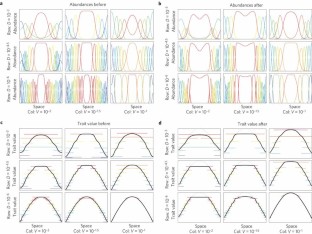
Figure 2: Species (indicated by different coloured lines) abundances and traits over space (x axis for each panel) for different values of D (rows) and V (columns) before and after climate change has taken place in communities with competition.
The alternative text for this image may have been generated using AI.
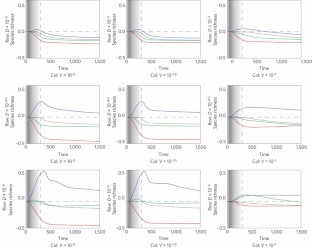
Figure 3: Time development of the change in species richness during climate change (rate of change in temperature shown as grey shading rate is zero after time=300 indicated by the dashed vertical line, see also figure guide of Fig. 1, panel for climate change) for the hump-shaped environmental cline.
The alternative text for this image may have been generated using AI.
References
- Parmesan, C. & Yohe, G. A globally coherent fingerprint of climate change impacts across natural systems. Nature 421, 37–42 (2003).
Article CAS Google Scholar - Gregory, P. J, Johnson, S. N, Newton, A. C. & Ingram, J. S. I Integrating pests and pathogens into the climate change/food security debate. J. Exp. Bot. 60, 2827–2009 (2009).
Article CAS Google Scholar - Millenium Ecosystem Assessment: Ecosystems and Human Well-Being: Synthesis (Island Press, 2005).
- Thomas, C. D. et al. Extinction risk from climate change. Nature 427, 145–148 (2004).
Article CAS Google Scholar - Urban, M. C., De Meester, L., Vellend, M., Stoks, R. & Vanoverbeke, J. A crucial step toward realism: Responses to climate change from an evolving metacommunity perspective. Evol. Appl. 5, 154–167 (2012).
Article Google Scholar - Tylianakis, J. M., Didham, R. K., Bascompte, J. & Wardle, D. A. Global change and species interactions in terrestrial ecosystems. Ecol. Lett. 11, 1351–1363 (2008).
Article Google Scholar - Franks, S. J., Sim, S. & Weis, A. E. Rapid evolution of flowering time by an annual plant in response to a climate fluctuation. Proc. Natl Acad. Sci. USA 104, 1278–1282 (2007).
Article CAS Google Scholar - Balanya, J., Oller, J. M., Huey, R. B., Gilchrist, G. W. & Serra, L. Global genetic change tracks global climate warming in Drosophila subobscura. Science 313, 1773–1775 (2006).
Article CAS Google Scholar - Skelly, D. K. et al. Evolutionary responses to climate change. Conserv. Biol. 21, 1353–1355 (2007).
Article Google Scholar - Brooker, R. W. et al. Modelling species’ range shifts in a changing climate: The impacts of biotic interactions, dispersal distance and the rate of climate change. J. Theoret. Biol. 245, 59–65 (2007).
Article Google Scholar - Münkemüller, T. & Bello, F. de From diversity indices to community assembly processes: A test with simulated data. Ecography 34, 1–13 (2011).
Article Google Scholar - Gienapp, P., Teplitsky, C., Alho, J. S., Mills, J. A. & Merila, J. Climate change and evolution: Disentangling environmental and genetic responses. Mol. Ecol. 17, 167–178 (2008).
Article CAS Google Scholar - Pelletier, F., Garant, D. & Hendry, A. P. Eco-evolutionary dynamics. Phil. Trans. R. Soc. Lond. B. 364, 1483–1489 (2009).
Article CAS Google Scholar - De Mazancourt, C., Johnson, E. & Barraclough, T. G. Biodiversity inhibits species’ evolutionary responses to changing environments. Ecol. Lett. 11, 380–388 (2008).
Article CAS Google Scholar - Holt, R. D. Bringing the Hutchinsonian niche into the 21st century: Ecological and evolutionary perspectives. Proc. Natl Acad. Sci. USA 106, 19659–19665 (2009).
Article CAS Google Scholar - Lenormand, G. Gene flow and the limits to natural selection. Trends Ecol. Evol. 17, 183–189 (2002).
Article Google Scholar - Case, T. J. & Taper, M. L. Interspecific competition, environmental gradients, gene flow, and the coevolution of species’ borders. Am. Nature 155, 583–605 (2000).
Article CAS Google Scholar - Ackerly, D. D. Community assembly, niche conservatims, and adaptive evolution in changing environments. Int. J. Plant Sci. 164, S165–S184 (2003).
Article Google Scholar - Leibold, M. A., Holt, R. D. & Holyoak, M. in Metacommunities: Spatial Dynamics and Ecological Communities (eds Holyoak, M., Leibold, M. A. & Holt, R.) (Univ. Chicago Press, 2005).
Google Scholar - Collins, S. & Gardner, A. Integrating physiological, ecological and evolutionary change: A Price equation approach. Ecol. Lett. 12, 744–757 (2009).
Article Google Scholar - Kubisch, A. et al. On the elasticity of range limits during periods of expansion. Ecology 91, 3094–3099 (2010).
Article Google Scholar - Burton, O. J. et al. Trade-offs and the evolution of life-histories during range expansion. Ecol. Lett. 13, 1210–1220 (2010).
Article Google Scholar - Mousseau, T. A. & Roff, D. A. Natural selection and the heritability of fitness components. Heredity 59, 181–197 (1987).
Article Google Scholar - Hoffman, A. A. & Sgrò, C. M. Climate change and evolutionary adaptation. Nature 470, 479–485 (2011).
Article Google Scholar - Chen, I. et al. Rapid range shifts of species associated with high levels of climate warming. Science 333, 1024–1026 (2011).
Article CAS Google Scholar - Willis, K. J. & MacDonald, G. M. Long-term ecological records and their relevance to climate change predictions for a warmer world. Annu. Rev. Ecol. Evol. Syst. 42, 267–287 (2011).
Article Google Scholar - Bell, G. & Gonzalez, A. Adaptation and evolutionary rescue in metapopulations experiencing environmental deterioration. Science 332, 1327–1330 (2011).
Article CAS Google Scholar - Brockhurst, M. A. et al. Niche occupation limits adaptive radiation in experimental microcosms. PLoS ONE 2, e193 (2007).
Article Google Scholar - Lau, J. A. et al. Species interactions in a changing environment: Elevated CO2 alters the ecological and potential evolutionary consequences of competition. Evol. Ecol. Res. 12, 435–455 (2010).
Google Scholar
Acknowledgements
This work was conducted as part of the Evolution in Meta-Communities Working Group supported by the National Center for Ecological Analysis and Synthesis, a centre financially supported by the NSF (grant EF-0553768), the University of California, Santa Barbara and the State of California. Additional support was also provided for M. Urban, the NCEAS postdoctoral associate in the group. J.N. was supported by the Swedish Research Council and the Strategic Research Program EkoKlim at Stockholm University. M.C.U. was supported by NSF award DEB-1119877 and a J. F. McDonnell foundation grant. M.V. was supported by the Natural Sciences and Engineering Research Council, Canada. N.L. received financial support from Université Pierre & Marie Curie and from CNRS. C.A.K. was supported by grants from the J. S. McDonnell Foundation and NSF awards DEB-0845825, OCE-0928819 and DEB-1136710. C. de Mazancourt provided insights for the partitioning of the change in mean trait. This is contribution 1700 of the Kellogg Biological Station.
Author information
Authors and Affiliations
- Department of Systems Ecology, Stockholm University, 10697 Kräftriket 9a, 11429 Stockholm, Sweden
Jon Norberg - Stockholm Resilience Centre, Stockholm University, Kräftriket 2b, 11429 Stockholm, Sweden
Jon Norberg - Department of Ecology and Evolutionary Biology, University of Connecticut, Biopharm building Room 200A, 75 N. Eagleville Rd., Unit 3043, Storrs, Connecticut 06269-3043, USA
Mark C. Urban - Département de biologie, Université de Sherbrooke, Sherbrooke, Québec J1K 2R1, Canada
Mark Vellend - W. K. Kellogg Biological Station and Department of Plant Biology, Michigan State University, Hickory Corners, Michigan 49060, USA
Christopher A. Klausmeier - Université Pierre et Marie Curie, Laboratoire Ecologie et Evolution, UMR 7625, Ecologie des populations et communautés (USC2031, INRA), Batiment A, 7eme etage, case 237, 7 quai st Bernard, 75252 Paris Cedex 05, France
Nicolas Loeuille
Authors
- Jon Norberg
- Mark C. Urban
- Mark Vellend
- Christopher A. Klausmeier
- Nicolas Loeuille
Contributions
All authors conceived the problem and formulated the model. C.A.K. and J.N. coded the model. J.N. ran the simulations. All authors contributed to interpretation of results and writing the paper.
Corresponding author
Correspondence toJon Norberg.
Ethics declarations
Competing interests
The authors declare no competing financial interests.
Supplementary information
Rights and permissions
About this article
Cite this article
Norberg, J., Urban, M., Vellend, M. et al. Eco-evolutionary responses of biodiversity to climate change.Nature Clim Change 2, 747–751 (2012). https://doi.org/10.1038/nclimate1588
- Received: 11 July 2011
- Accepted: 15 May 2012
- Published: 15 July 2012
- Issue date: October 2012
- DOI: https://doi.org/10.1038/nclimate1588