Reductions in labour capacity from heat stress under climate warming (original) (raw)
- Letter
- Published: 24 February 2013
Nature Climate Change volume 3, pages 563–566 (2013) Cite this article
- 10k Accesses
- 571 Citations
- 545 Altmetric
- Metrics details
Subjects
Abstract
A fundamental aspect of greenhouse-gas-induced warming is a global-scale increase in absolute humidity1,2. Under continued warming, this response has been shown to pose increasingly severe limitations on human activity in tropical and mid-latitudes during peak months of heat stress3. One heat-stress metric with broad occupational health applications4,5,6 is wet-bulb globe temperature. We combine wet-bulb globe temperatures from global climate historical reanalysis7 and Earth System Model (ESM2M) projections8,9,10 with industrial4 and military5 guidelines for an acclimated individual’s occupational capacity to safely perform sustained labour under environmental heat stress (labour capacity)—here defined as a global population-weighted metric temporally fixed at the 2010 distribution. We estimate that environmental heat stress has reduced labour capacity to 90% in peak months over the past few decades. ESM2M projects labour capacity reduction to 80% in peak months by 2050. Under the highest scenario considered (Representative Concentration Pathway 8.5), ESM2M projects labour capacity reduction to less than 40% by 2200 in peak months, with most tropical and mid-latitudes experiencing extreme climatological heat stress. Uncertainties and caveats associated with these projections include climate sensitivity, climate warming patterns, CO2 emissions, future population distributions, and technological and societal change.
This is a preview of subscription content, access via your institution
Access options
Subscribe to this journal
Receive 12 print issues and online access
$259.00 per year
only $21.58 per issue
Buy this article
- Purchase on SpringerLink
- Instant access to the full article PDF.
USD 39.95
Prices may be subject to local taxes which are calculated during checkout
Additional access options:
Figure 1: Ten-year maximum monthly mean WBGT from WBT and 2 m reference temperature (_T_ref) as a proxy for globe temperature (WBGT = 0.7×WBT+0.3×_T_ref; °C) from ESM2M _T_ref, 2 m reference relative humidity, and surface pressure after mean and variance bias correction to reanalysis.
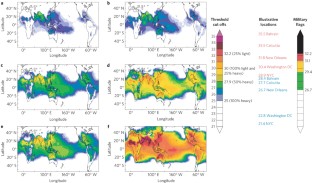
The alternative text for this image may have been generated using AI.
Figure 2: Population-weighted individual labour capacity (%) during annual mimimum (upper lines) and maximum (lower lines) heat stress months.

The alternative text for this image may have been generated using AI.
References
- Manabe, S. & Wetherald, R. T. The effects of doubling CO2 concentration on the climate of a general circulation model. J. Atmos. Sci. 32, 3–15 (1975).
Article CAS Google Scholar - Manabe, S. & Stouffer, R. J. A CO2-climate sensitivity study with a mathematical model of the global climate. Nature 282, 491–493 (1979).
Article CAS Google Scholar - Delworth, T. L., Mahlman, J. D. & Knutson, T. R. Changes in heat index associated with CO2-induced global warming. Climatic Change 43, 369–386 (1999).
Article CAS Google Scholar - American Conference of Governmental Industrial Hygienists Threshold Limit Values for Chemical Substances and Physical Agents. Biological Exposure Indices (ACGIH, 1996).
- Heat Stress Control and Heat Casualty Management Technical Bulletin Medical 507/Air Force Pamphlet 48-152 (US Army, 2003).
- Parsons, K. Heat stress standard ISO 7243 and its global application. Ind. Health 44, 368–379 (2006).
Article Google Scholar - Kalnay, E. et al. The NCEP/NCAR 40-Year Reanalysis Project. BAMS 77, 437–470 (1996).
Article Google Scholar - Dunne, J. P. et al. GFDL’s ESM2 global coupled climate-carbon Earth System Models Part I: Physical formulation and baseline simulation characteristics. J. Clim. 25, 6646–6665 (2012).
Article Google Scholar - Moss, R. H. et al. The next generation of scenarios for climate change research and assessment. Nature 463, 747–756 (2010).
Article CAS Google Scholar - Meinshausen, M. et al. The RCP greenhouse gas concentrations and their extensions from 1765 to 2300. Climatic Change 109, 213–241 (2011).
Article CAS Google Scholar - Cubasch, U. et al. in IPCC Climate Change 2001: The Scientific Basis (eds Houghton, J. T. et al.) 525–582 (Cambridge Univ. Press, 2001).
Google Scholar - Confalonieri, U. et al. in IPCC Climate Change 2007: Impacts, Adaptation and Vulnerability (eds Parry, M. L. et al.) 391–431 (Cambridge Univ. Press, 2007).
Google Scholar - Steadman, R. G. The assessment of sultriness. Part I: A temperature–humidity index based on human physiology and clothing science. J. Appl. Meteorol. 18, 861–873 (1979).
Article Google Scholar - Willett, K. M. & Sherwood, S. C. Exceedance of heat index thresholds for 15 regions under a warming climate using the wet-bulb globe temperature. Int. J. Climatol. 32, 161–177 (2012).
Article Google Scholar - Jendritzky, G. & Tinz, B. The thermal environment of the human being on the global scale. Glob. Health Action 2 (Special volume), 10–21 (2009).
Google Scholar - Sherwood, S. C. & Huber, M. An adaptability limit to climate change due to heat stress. Proc. Natl Acad. Sci. USA 107, 9552–9555 (2010).
Article CAS Google Scholar - Kjellstrom, T., Holmer, I. & Lemke, B. Workplace heat stress, health and productivity—an increasing challenge for low and middle-income countries during climate change. Glob. Health Action 2 (Special volume), 46–51 (2009).
Google Scholar - Epstein, Y. & Moran, D. S. Thermal comfort and the heat stress indices. Ind. Health 44, 388–398 (2006).
Article Google Scholar - Davies-Jones, R. An efficient and accurate method for computing the wet-bulb temperature along pseudoadiabats. Mon. Weath. Rev. 136, 2764–2785 (2008).
Article Google Scholar - Taylor, K. E., Stouffer, R. J. & Meehl, G. A. An overview of CMIP5 and the experiment design. BAMS 93, 485–498 (2012).
Article Google Scholar - Delworth, T. L. et al. GFDL’s CM2 global coupled climate models. Part I: Formulation and simulation characteristics. J. Clim. 19, 643–674 (2006).
Article Google Scholar - Winton, M. et al. Influence of ocean and atmosphere components on simulated climate sensitivities. J. Clim. 26, 231–245 (2013).
Article Google Scholar - Meehl, G. A. et al. in IPCC Climate Change 2007: The Physical Science Basis (eds S., Solomon et al.) 747–845 (Cambridge Univ. Press, 2007).
Google Scholar - Reichler, T. & Kim, J. How well do coupled models simulate today’s climate? BAMS 89, 303–311 (2008).
Article Google Scholar - Guilyardi, E. et al. Understanding El Niño in ocean–atmosphere general circulation models. BAMS 90, 325–340 (2009).
Article Google Scholar - Hegerl, G. C. et al. in IPCC Climate Change 2007: The Physical Science Basis (eds Solomon, S. et al.) 663–745 (Cambridge Univ. Press, 2007).
Google Scholar - Meinshausen, M. et al. Greenhouse-gas emission targets for limiting global warming to 2 °C. Nature 458, 1158–1162 (2009).
Article CAS Google Scholar - McCarthy, M. P., Best, M. J. & Betts, R. A. Climate change in cities due to global warming and urban effects. Geophys. Res. Lett. 37, L09705 (2010).
Article Google Scholar - Fischer, E. M., Oleson, K. W. & Lawrence, D. M. Contrasting urban and rural heat stress responses to climate change. Geophys. Res. Lett. 39, L03705 (2012).
Google Scholar - Rogner, H-H. et al. Global Energy Assessment—Toward a Sustainable Future 425–512 (Cambridge Univ. Press and IIASA, 2012).
Book Google Scholar - Schindler, J. & Wittel, Z. Crude Oil: The Supply Outlook Report to the Energy Watch Group EWG Series No 3/2007 (Energy Watch Group, 2007).
- Rutledge, D. Estimating long-term world coal production with logit and probit transforms. Int. J. Coal Geol. 85, 23–33 (2011).
Article CAS Google Scholar - Christensen, J. H. et al. in IPCC Climate Change 2001: The Scientific Basis (eds Houghton, J. T. et al.) 847–865 (Cambridge Univ. Press, 2001).
Google Scholar - Fischer, E. M. & Knutti, R. Robust projections of combined humidity and temperature extremes. Nature Clim. Change 3, 126–130 (2013).
Article Google Scholar - Bolton, D. The computation of equivalent potential temperature. Mon. Weath. Rev. 108, 1046–1053 (1980).
Article Google Scholar - Wexler, A. Vapor pressure formulation for water in range 0 to 100C. A revision. J. Res. Nat. Bur. Stand. 80A, 775–785 (1976).
Article CAS Google Scholar
Acknowledgements
The scientific results and conclusions, as well as any views or opinions expressed herein, are those of the authors and do not necessarily reflect the views of NOAA or the US Department of Commerce. The authors thank I. Held, T. Delworth, T. Knutson and V. Ramaswamy for constructive criticisms to improve the manuscript.
Author information
Authors and Affiliations
- Geophysical Fluid Dynamics Laboratory/National Oceanic and Atmospheric Administration, Princeton, New Jersey 08540-6649, USA
John P. Dunne, Ronald J. Stouffer & Jasmin G. John
Authors
- John P. Dunne
- Ronald J. Stouffer
- Jasmin G. John
Contributions
J.P.D. designed the study, conducted the analysis and wrote the manuscript. J.G.J. performed experiments and gave technical advice. R.J.S. provided technical and conceptual advice.
Corresponding author
Correspondence toJohn P. Dunne.
Ethics declarations
Competing interests
The authors declare no competing financial interests.
Supplementary information
Rights and permissions
About this article
Cite this article
Dunne, J., Stouffer, R. & John, J. Reductions in labour capacity from heat stress under climate warming.Nature Clim Change 3, 563–566 (2013). https://doi.org/10.1038/nclimate1827
- Received: 08 August 2012
- Accepted: 15 January 2013
- Published: 24 February 2013
- Issue date: June 2013
- DOI: https://doi.org/10.1038/nclimate1827