Effects of double cropping on summer climate of the North China Plain and neighbouring regions (original) (raw)
- Letter
- Published: 08 June 2014
- Chang-Hoi Ho2,
- Shilong Piao3,4,
- Jinwon Kim5,
- Philippe Ciais6,
- Yun-Bok Lee2,
- Jong-Ghap Jhun2 &
- …
- Seon Ki Park7,8,9
Nature Climate Change volume 4, pages 615–619 (2014) Cite this article
- 3597 Accesses
- 102 Citations
- 21 Altmetric
- Metrics details
Subjects
Abstract
The North China Plain (NCP) is one of the most important agricultural regions in Asia and produces up to 50% of the cereal consumed in China each year1,2. To meet increasing food demands without expanding croplands, annual agricultural practice in much of the NCP has changed from single to double cropping3,4. The impact of double cropping on the regional climate, through biophysical feedbacks caused by changes in land surface conditions, remains largely unknown. Here we show that observed surface air temperatures during the inter-cropping season (June and July) are 0.40 °C higher over double cropping regions (DCRs) than over single cropping regions (SCRs), with increases in the daily maximum temperature as large as 1.02 °C. Using regional climate modelling, we attribute the higher temperatures in DCRs to reduced evapotranspiration during the inter-cropping period. The higher surface temperatures in June and July affect low-level circulation and, in turn, rainfall associated with the East Asian monsoon over the NCP and neighbouring countries. These findings suggest that double cropping in the NCP can amplify the magnitude of summertime climate changes over East Asia.
This is a preview of subscription content, access via your institution
Access options
Subscribe to this journal
Receive 12 print issues and online access
$259.00 per year
only $21.58 per issue
Buy this article
- Purchase on SpringerLink
- Instant access to the full article PDF.
USD 39.95
Prices may be subject to local taxes which are calculated during checkout
Additional access options:
Figure 1: Changes in crop area and yield.

The alternative text for this image may have been generated using AI.
Figure 2: Warming in double cropping regions during the inter-cropping period (June and July).

The alternative text for this image may have been generated using AI.
Figure 3: Differences of simulated temperatures and surface fluxes between control (CTR) and experiment (EXP) over the double cropping regions (DCRs) and single cropping regions (SCRs) on the NCP.
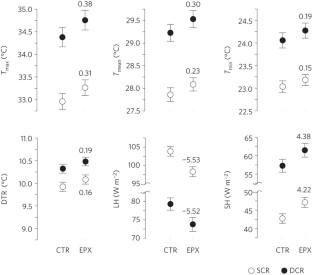
The alternative text for this image may have been generated using AI.
Figure 4: Simulated impacts of double cropping on the NCP on precipitation and circulation over East Asia.
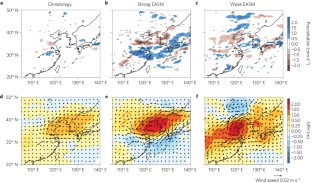
The alternative text for this image may have been generated using AI.
References
- Godfray, H. C. J. et al. Food security: The challenge of feeding 9 billion people. Science 327, 812–818 (2010).
Article CAS Google Scholar - Piao, S. L. et al. The impacts of climate change on water resources and agriculture in China. Nature 467, 43–51 (2010).
Article CAS Google Scholar - Cook, R. J. Toward cropping system that enhance productivity and sustainability. Proc. Natl Acad. Sci. USA 103, 18389–18394 (2006).
Article CAS Google Scholar - Liu, Y., Wang, E. L., Yang, X. G. & Wang, J. Contributions of climatic and crop varietal changes to crop production in the North China Plain, since the 1980s. Glob. Change Biol. 16, 2287–2299 (2010).
Article Google Scholar - Ramankutty, N. & Foley, J. A. Estimating historical changes in global land cover: Croplands from 1700 to 1992. Glob. Biogeochem. Cycles 13, 997–1027 (1999).
Article CAS Google Scholar - Xu, Z. et al. Grain for green versus grain: Conflict between food security and conservation set aside in China. World Dev. 34, 130–148 (2006).
Article Google Scholar - Rudel, T. K. et al. Agricultural intensification and changes in cultivated areas, 1970–2005. Proc. Natl Acad. Sci. USA 106, 20675–20680 (2009).
Article CAS Google Scholar - National Bureau of Statistics of China, China Statistical Year Book 1995–2010 (China Statistics Press, 2010).
- Ho, C. H., Park, S. J., Jeong, S. J., Kim, J. & Jhun, J. G. Observational evidences of double cropping impacts on the climate in the northern China plains. J. Clim. 25, 4721–4728 (2012).
Article Google Scholar - Gong, D. Y. & Ho, C. H. Shift in the summer rainfall over the Yangtze River valley in the late 1970s. Geophys. Res. Lett. 29, 1436 (2002).
Article Google Scholar - Bonan, G. B. Observational evidence for reduction of daily maximum temperature by croplands in the Midwest United States. J. Clim. 14, 2430–2442 (2001).
Article Google Scholar - Jeong, S. J., Ho, C. H. & Jeong, J. H. Increase in vegetation greenness and decrease in springtime warming over East Asia. Geophys. Res. Lett. 36, L02710 (2009).
Article Google Scholar - Pielke, R. A. et al. Interactions between the atmosphere and terrestrial ecosystems: Influence on weather and climate. Glob. Change Biol. 4, 461–475 (1998).
Article Google Scholar - Xue, Y. et al. Role of land surface processes in monsoon development: East Asia and West Africa. J. Geophys. Res. 109, D03105 (2004)
Google Scholar - Wang, B., Jhun, J. G. & Moon, B. K. Variability and singularity of Seoul, South Korea, rainy season (1778–2004). J. Clim. 20, 2572–2580 (2007).
Article Google Scholar - Koster, R. D. et al. Regions of strong coupling between soil moisture and precipitation. Science 305, 1138–1140 (2004).
Article CAS Google Scholar - Seneviratne, S. I., Luthi, D., Litschi, M. & Schar, C. Land–atmosphere coupling and climate change in Europe. Nature 443, 205–209 (2006).
Article CAS Google Scholar - Myong, B., Choi, Y. S., Choi, S. J. & Park, S. K. Impact of vegetation on land–atmosphere coupling strength and its implication for desertification over East Asia. J. Geophys. Res. 115, D12113 (2012)
Google Scholar - Portmann, F. T., Siebert, S. & Doll, P. MIRCA2000–Global monthly irrigated and rainfed crop areas around the year 2000: A new high-resolution data set for agricultural and hydrological modeling. Glob. Biogeochem. Cycles 24, GB1011 (2010).
Article Google Scholar - Fu, C. B. et al. Regional Climate Model Intercomparison Project for Asia. Bull. Am. Meteorol. Soc. 86, 257–266 (2005).
Article Google Scholar - Hansen, M. C., Defries, R. S., Townshend, J. R. G. & Sohlberg, R. Global land cover classification at 1 km spatial resolution using a classification tree approach. Int. J. Remote Sens. 21, 1331–1364 (2000).
Article Google Scholar - Ganguly, S. et al. Generating vegetation leaf area index earth system data records from multiple sensors. Part 1 – Theory. Remote Sens. Environ. 112, 4333–4343 (2008).
Article Google Scholar - Ramankutty, N. & Foley, J. A. Estimating historical changes in global land cover: Croplands from 1700 to 1992. Glob. Biogeochem. Cycles 13, 997–1027 (1999).
Article CAS Google Scholar - Skamarock, W. C. et al. A description of the Advanced Research WRF version 3 NCAR Tech. Note, NCAR/TN-4751STR 88 (2008)
- Kanamitsu, M. et al. NCEP-DOE AMIP-II Reanalysis (R-2). Bull. Am. Meteorol. Soc. 83, 1631–1643 (2002).
Article Google Scholar - Wang, B., Wu, R. & Lau, K. M. Interannual variability of Asian summer monsoon: Contrast between the Indian and western North Pacific-East Asian monsoons. J. Clim. 14, 4073–4090 (2001).
Article Google Scholar - Adler, R. F. et al. The Version 2 Global Precipitation Climatology Project (GPCP) monthly precipitation analysis (1979–present). J. Hydrometeor. 4, 1147–1167 (2003).
Article Google Scholar
Acknowledgements
This work was funded by the Korea Ministry of Environment as ‘Climate Change Correspondence R&D Program’, CATER 2012–2040, and NRF 2009-0083527. The funders had no role in the study design, data collection and analysis, decision to publish, or presentation of the manuscript. Part of the research was carried out at the Jet Propulsion Laboratory, California Institute of Technology, under a contract with the National Aeronautics and Space Administration.
Author information
Authors and Affiliations
- Jet Propulsion Laboratory, California Institute of Technology, Pasadena, California 91011, USA
Su-Jong Jeong - School of Earth and Environmental Sciences, Seoul National University, Seoul 151-747, Korea
Chang-Hoi Ho, Yun-Bok Lee & Jong-Ghap Jhun - Sino-French Institute for Earth System Science, College of Urban and Environmental Sciences, Peking University, Beijing 100871, China
Shilong Piao - Laboratory of Alpine Ecology and Biodiversity, Institute of Tibetan Plateau Research, Chinese Academy of Sciences, Beijing 100101, China
Shilong Piao - JIFRESSE and Department of Atmospheric and Oceanic Sciences, University of California, Los Angeles, California 90095, USA
Jinwon Kim - Laboratoire des Sciences du Climat et de l’Environnement, CEA-CNRS-UVSQ, CE l’Orme des Merisiers, 91191 Gif sur Yvette Cedex, France
Philippe Ciais - Department of Environmental Sciences and Engineering, Ewha Womans University, Seoul 120-750, Korea
Seon Ki Park - Department of Atmospheric Science and Engineering, Ewha Womans University, Seoul 120-750, Korea
Seon Ki Park - Center for Climate/Environment Change Prediction Research, Ewha Womans University, Seoul 120-750, Korea
Seon Ki Park
Authors
- Su-Jong Jeong
- Chang-Hoi Ho
- Shilong Piao
- Jinwon Kim
- Philippe Ciais
- Yun-Bok Lee
- Jong-Ghap Jhun
- Seon Ki Park
Contributions
S-J.J. and C-H.H. designed the study. S-J.J., C-H.H. and Y-B.L. analysed the data and performed model simulations. All authors wrote the manuscript, discussed the results and implications, and commented on the manuscript at all stages.
Corresponding author
Correspondence toChang-Hoi Ho.
Ethics declarations
Competing interests
The authors declare no competing financial interests.
Supplementary information
Rights and permissions
About this article
Cite this article
Jeong, SJ., Ho, CH., Piao, S. et al. Effects of double cropping on summer climate of the North China Plain and neighbouring regions.Nature Clim Change 4, 615–619 (2014). https://doi.org/10.1038/nclimate2266
- Received: 04 November 2013
- Accepted: 25 April 2014
- Published: 08 June 2014
- Issue date: July 2014
- DOI: https://doi.org/10.1038/nclimate2266