The potential of Indonesian mangrove forests for global climate change mitigation (original) (raw)
- Letter
- Published: 27 July 2015
- Joko Purbopuspito1,3,
- J. Boone Kauffman4,
- Matthew W. Warren5,
- Sigit D. Sasmito1,
- Daniel C. Donato6,
- Solichin Manuri7,
- Haruni Krisnawati8,
- Sartji Taberima9 &
- …
- Sofyan Kurnianto1,4
Nature Climate Change volume 5, pages 1089–1092 (2015)Cite this article
- 10k Accesses
- 726 Citations
- 178 Altmetric
- Metrics details
Subjects
Abstract
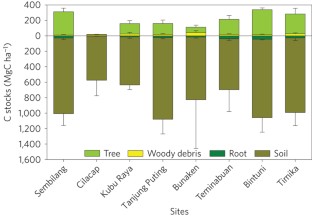
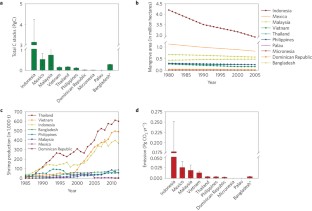
Mangroves provide a wide range of ecosystem services, including nutrient cycling, soil formation, wood production, fish spawning grounds, ecotourism and carbon (C) storage1. High rates of tree and plant growth, coupled with anaerobic, water-logged soils that slow decomposition, result in large long-term C storage. Given their global significance as large sinks of C, preventing mangrove loss would be an effective climate change adaptation and mitigation strategy. It has been reported that C stocks in the Indo-Pacific region contain on average 1,023 MgC ha−1 (ref. 2). Here, we estimate that Indonesian mangrove C stocks are 1,083 ± 378 MgC ha−1. Scaled up to the country-level mangrove extent of 2.9 Mha (ref. 3), Indonesia’s mangroves contained on average 3.14 PgC. In three decades Indonesia has lost 40% of its mangroves4, mainly as a result of aquaculture development5. This has resulted in annual emissions of 0.07–0.21 Pg CO2e. Annual mangrove deforestation in Indonesia is only 6% of its total forest loss6; however, if this were halted, total emissions would be reduced by an amount equal to 10–31% of estimated annual emissions from land-use sectors at present. Conservation of carbon-rich mangroves in the Indonesian archipelago should be a high-priority component of strategies to mitigate climate change.
This is a preview of subscription content, access via your institution
Access options
Subscribe to this journal
Receive 12 print issues and online access
$259.00 per year
only $21.58 per issue
Buy this article
- Purchase on SpringerLink
- Instant access to the full article PDF.
USD 39.95
Prices may be subject to local taxes which are calculated during checkout
Additional access options:
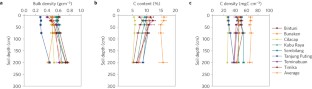
Figure 1: Averaged values of soil properties.
The alternative text for this image may have been generated using AI.
Figure 2: Ecosystem C stocks of mangroves partitioned into dominant pools from eight regions of Indonesia.
The alternative text for this image may have been generated using AI.
Figure 3: Mangrove carbon dynamics in 10 selected countries.
The alternative text for this image may have been generated using AI.
References
- The Importance of Mangroves to People: A Call to Action (UNEP, World Conservation Monitoring Centre, 2014).
- Donato, D. C. et al. Mangroves among the most carbon-rich forests in the tropics. Nature Geosci. 4, 293–297 (2011).
Article CAS Google Scholar - The World’s Mangroves 1980–2005 89 (FAO Forestry Paper 153, FAO, 2007).
- Digital Land Cover and Land Use Map of Indonesia for Years 2000, 2003, 2006 and 2009 (Spatial Planning Agency, Ministry of Forestry of the Republic of Indonesia, 2009).
- Giri, C. et al. Mangrove forest distributions and dynamics (1975–2005) of the tsunami-affected region of Asia. J. Biogeogr. 35, 519–528 (2008).
Article Google Scholar - Margono, B. A., Potapov, P. V., Turubanova, S., Stolle, F. & Hansen, M. C. Primary forest cover loss in Indonesia over 2000–2012. Nature Clim. Change 4, 730–735 (2014).
Article Google Scholar - Kauffman, J. B., Heider, C., Norfolk, J. & Payton, F. Carbon stocks of intact mangroves and carbon emissions arising from their conversion in the Dominican Republic. Ecol. Appl. 24, 518–527 (2014).
Article Google Scholar - Giri, C. et al. Status and distribution of mangrove forests of the world using Earth Observation Satellite data. Glob. Ecol. Biogeogr. 20, 154–159 (2011).
Article Google Scholar - Shrimp Farms: Area and Production During 2006–2012 (Center for Statistical Data and Information, Ministry of Marine Affairs and Fishery of the Republic of Indonesia, 2013).
- Export of Fishery Products (Ministry of Marine Affairs and Fishery of the Republic of Indonesia, 2014); http://statistik.kkp.go.id/index.php/statistik/c/430/0/0/0/0/Volume-dan-Nilai-Ekspor-Menurut-Komoditi-per-Provinsi-HS-2012
- Ministry of Environment Republic of Indonesia Indonesia Second National Communication Under the United Nations Framework Convention on Climate Change (Ministry of Environment Republic of Indonesia, 2010).
Google Scholar - IPCC 2013 Supplement to the 2006 IPCC Guidelines for National Greenhouse Gas Inventories: Wetlands (ed Hiraishi, T.et al.) (IPCC, 2014).
Google Scholar - Mcleod, E. et al. A blueprint for blue carbon: Toward an improved understanding of the role of vegetated coastal habitats in sequestering CO2 . Front. Ecol. Environ. 9, 552–560 (2011).
Article Google Scholar - IPCC 2006 IPCC Guidelines for National Greenhouse Gas Inventories—Volume 4: Agriculture, Forestry and Other Land Use (AFOLU) (IPCC, 2006)
- Penman, J. et al. Good Practice Guidance for Land Use, Land-Use Change and Forestry (Institute for Global Environmental Studies, 2003).
Google Scholar - Komiyama, A., Ong, J. E. & Poungparn, S. Allometry, biomass, and productivity of mangrove forests: A review. Aquat. Bot. 89, 128–137 (2008).
Article Google Scholar - Hinrichs, S., Nordhaus, I. & Geist, S. J. Status, diversity and distribution patterns of mangrove vegetation in the Segara Anakan lagoon, Java, Indonesia. Reg. Environ. Change 9, 275–289 (2009).
Article Google Scholar - Murdiyarso, D., Van Noordwijk, M., Wasrin, U. R., Tomich, T. P. & Gillison, A. N. Environmental benefits and sustainable land-use options in the Jambi transect, Sumatra. J. Veg. Sci. 13, 429–438 (2002).
Article Google Scholar - Kauffman, J. B., Hughes, R. F. & Heider, C. Carbon pool and biomass dynamics associated with deforestation, land use, and agricultural abandonment in the neotropics. Ecol. Appl. 19, 1211–1222 (2009).
Article Google Scholar - Adame, M. F. et al. Carbon stocks of tropical coastal wetlands within the karstic landscape of the Mexican Caribbean. PLoS ONE 8, e56569 (2013).
Article CAS Google Scholar - Kauffman, J. B., Heider, C., Cole, T. G., Dwire, K. A. & Donato, D. C. Ecosystem carbon stocks of micronesian mangrove forests. Wetlands 31, 343–352 (2011).
Article Google Scholar - Ministry of Forestry Republic of Indonesia Recalculation of Indonesia’s Land Cover in 2013 (Direktorat Jenderal Planologi Kehutanan, 2014) (in Indonesian)
- Pendleton, L. et al. Estimating global “Blue Carbon” emissions from conversion and degradation of vegetated coastal ecosystems. PLoS ONE 7, e43542 (2012).
Article CAS Google Scholar - Siikamaki, J., Sanchirico, J. N. & Jardine, S. L. Global economic potential for reducing carbon dioxide emissions from mangrove loss. Proc. Natl Acad. Sci. USA 109, 14369–14374 (2012).
Article CAS Google Scholar - Global Aquaculture Production (FishStat) Dataset (Food and Agriculture Organisation, 2014)
- Lebel, L. et al. Industrial transformation and shrimp aquaculture in Thailand and Vietnam: Pathways to ecological, social, and economic sustainability? Ambio 31, 311–323 (2002).
Article Google Scholar - Kongkeo, H. Comparison of intensive shrimp farming systems in Indonesia, Philippines, Taiwan and Thailand. Aquac. Res. 28, 789–796 (1997).
Article Google Scholar - Alongi, D. M. Carbon sequestration in mangrove forests. Carbon Manag. 3, 313–322 (2012).
Article CAS Google Scholar - Thompson, B. S., Clubbe, C. P., Primavera, J. H., Curnick, D. & Koldewey, H. J. Locally assessing the economic viability of blue carbon: A case study from Panay Island, the Philippines. Ecosyst. Serv. 8, 128–140 (2014).
Article Google Scholar
Acknowledgements
This work is supported by the US Agency for International Development (USAID). D. Sheil provided useful comments on an earlier draft. We are also grateful to officials from Sembilang, Bunaken and Tanjung Puting National Parks for their assistance, without which the field work could have not been performed. We would also like to thank the many technicians, students and villagers who assisted in data collection in the field.
Author information
Authors and Affiliations
- Center for International Forestry Research (CIFOR), Jl. CIFOR, Situgede, Bogor 16115, Indonesia
Daniel Murdiyarso, Joko Purbopuspito, Sigit D. Sasmito & Sofyan Kurnianto - Department of Geophysics and Meteorology, Bogor Agricultural University, Kampus Darmaga, Bogor 16680, Indonesia
Daniel Murdiyarso - Department of Soil Science, Sam Ratulangi University, Kampus Kleak—Bahu, Manado 95115, Indonesia
Joko Purbopuspito - Department of Fisheries and Wildlife, Oregon State University, Nash Hall Rm 104, Corvallis, Oregon 97331, USA
J. Boone Kauffman & Sofyan Kurnianto - USDA Forest Service, 271 Mast Rd, Durham, New Hampshire 03824, USA
Matthew W. Warren - School of Environmental and Forest Science, University of Washington, Seattle, Washington 98195, USA
Daniel C. Donato - Fenner School of Environment and Society, Australian National University, Canberra, ACT 0200, Australia
Solichin Manuri - Research and Development Center for Conservation and Rehabilitation, Forestry Research and Development Agency, Jl. Gunung Batu 5, Bogor 16610, Indonesia
Haruni Krisnawati - University of Papua, Manokwari 98314, Indonesia
Sartji Taberima
Authors
- Daniel Murdiyarso
- Joko Purbopuspito
- J. Boone Kauffman
- Matthew W. Warren
- Sigit D. Sasmito
- Daniel C. Donato
- Solichin Manuri
- Haruni Krisnawati
- Sartji Taberima
- Sofyan Kurnianto
Contributions
D.M. conceived and designed the study, collected field data, performed data analyses and led the writing of the paper. J.P. collected field data, performed data analyses and contributed to writing. J.B.K. also conceived and designed the study, collected field data and contributed to analysis and writing. M.W.W. collected field data and contributed to writing. S.D.S. contributed to data collection, data analysis and writing. D.C.D. contributed to data collection and writing. S.M. collected field data and contributed to writing. H.K. collected field data and contributed to writing. S.T. collected field data and contributed to writing. S.K. contributed to data collection and writing.
Corresponding author
Correspondence toDaniel Murdiyarso.
Ethics declarations
Competing interests
The authors declare no competing financial interests.
Supplementary information
Rights and permissions
About this article
Cite this article
Murdiyarso, D., Purbopuspito, J., Kauffman, J. et al. The potential of Indonesian mangrove forests for global climate change mitigation.Nature Clim Change 5, 1089–1092 (2015). https://doi.org/10.1038/nclimate2734
- Received: 08 October 2014
- Accepted: 25 June 2015
- Published: 27 July 2015
- Issue date: December 2015
- DOI: https://doi.org/10.1038/nclimate2734