Multi-scale predictions of massive conifer mortality due to chronic temperature rise (original) (raw)
- Letter
- Published: 21 December 2015
- A. P. Williams1,2,
- C. Xu1,
- W. T. Pockman3,
- L. T. Dickman1,
- S. Sevanto1,
- R. Pangle3,
- J. Limousin3,
- J. Plaut3,
- D. S. Mackay ORCID: orcid.org/0000-0003-0477-97554,
- J. Ogee5,
- J. C. Domec5,6,
- C. D. Allen7,
- R. A. Fisher8,
- X. Jiang8 nAff12,
- J. D. Muss1,
- D. D. Breshears9,
- S. A. Rauscher10 &
- …
- C. Koven11
Nature Climate Change volume 6, pages 295–300 (2016) Cite this article
- 7511 Accesses
- 353 Citations
- 206 Altmetric
- Metrics details
Subjects
An Addendum to this article was published on 26 October 2016
This article has been updated
Abstract
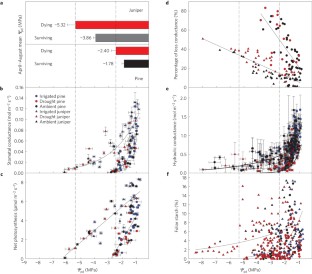
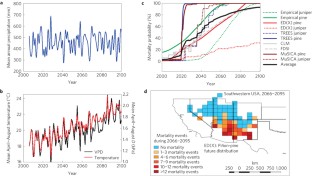
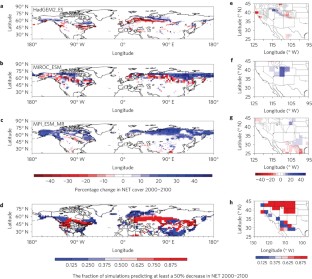
Global temperature rise and extremes accompanying drought threaten forests1,2 and their associated climatic feedbacks3,4. Our ability to accurately simulate drought-induced forest impacts remains highly uncertain5,6 in part owing to our failure to integrate physiological measurements, regional-scale models, and dynamic global vegetation models (DGVMs). Here we show consistent predictions of widespread mortality of needleleaf evergreen trees (NET) within Southwest USA by 2100 using state-of-the-art models evaluated against empirical data sets. Experimentally, dominant Southwest USA NET species died when they fell below predawn water potential (_Ψ_pd) thresholds (April–August mean) beyond which photosynthesis, hydraulic and stomatal conductance, and carbohydrate availability approached zero. The evaluated regional models accurately predicted NET _Ψ_pd, and 91% of predictions (10 out of 11) exceeded mortality thresholds within the twenty-first century due to temperature rise. The independent DGVMs predicted ≥50% loss of Northern Hemisphere NET by 2100, consistent with the NET findings for Southwest USA. Notably, the global models underestimated future mortality within Southwest USA, highlighting that predictions of future mortality within global models may be underestimates. Taken together, the validated regional predictions and the global simulations predict widespread conifer loss in coming decades under projected global warming.
This is a preview of subscription content, access via your institution
Access options
Subscribe to this journal
Receive 12 print issues and online access
$259.00 per year
only $21.58 per issue
Buy this article
- Purchase on SpringerLink
- Instant access to the full article PDF.
USD 39.95
Prices may be subject to local taxes which are calculated during checkout
Additional access options:
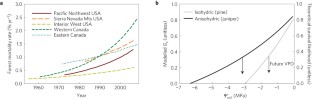
Figure 1: Observations and theoretical drivers of increasing conifer mortality.
The alternative text for this image may have been generated using AI.
Figure 2: Predawn Ψ measurements are strongly correlated with the mechanisms of mortality6.
The alternative text for this image may have been generated using AI.
Figure 3: Predictions of climate and forest mortality for Southwestern USA to AD 2100.
The alternative text for this image may have been generated using AI.
Figure 4: Dynamic global vegetation models predictions of NET percentage losses between 2000 and 2100.
The alternative text for this image may have been generated using AI.
Change history
07 October 2016
This Letter has an addendum associated with it, for details see pdf.
References
- Allen, C. D. et al. A global overview of drought and heat-induced tree mortality reveals emerging climate change risks for forests. For. Ecol. Manage. 259, 660–684 (2010).
Article Google Scholar - Peng, S. et al. A drought-induced pervasive increase in tree mortality across Canada’s boreal forest. Nature Clim. Change 1, 467–471 (2011).
Article Google Scholar - Bonan, G. B. Forests and climate change: Forcings, feedbacks, and the climate benefits of forests. Science 320, 1444–1449 (2008).
Article CAS Google Scholar - Maness, H., Kushner, P. J. & Fung, I. Summertime climate response to mountain pine beetle disturbance in British Columbia. Nature Geosci. 6, 65–70 (2012).
Article Google Scholar - Friedlingstein, P. et al. Uncertainties in CMIP5 climate projections due to carbon cycle feedbacks. J. Clim. 27, 511–526 (2014).
Article Google Scholar - McDowell, N. G. et al. Interdependence of mechanisms underlying climate-driven vegetation mortality. Trends Ecol. Evol. 26, 523–532 (2011).
Article Google Scholar - Van Mantgem, P. J. et al. Widespread increase of tree mortality rates in the western United States. Science 323, 521–524 (2009).
Article CAS Google Scholar - Phillips, O. L. et al. Drought sensitivity of the Amazon rainforest. Science 323, 1344–1347 (2009).
Article CAS Google Scholar - Reichstein, M. et al. Climate extremes and the carbon cycle. Nature 500, 287–295 (2013).
Article CAS Google Scholar - Kurz, W. A. et al. Mountain pine beetle and forest carbon feedback to climate change. Nature 452, 987–990 (2008).
Article CAS Google Scholar - Plaut, J. et al. Hydraulic limits preceding mortality in a piñon-juniper woodland under experimental drought. Plant Cell Environ. 35, 1601–1617 (2012).
Article Google Scholar - Cowan, I. R. & Givnish, T. J. On the Economy of Plant Form and Function 133–170 (Cambridge Univ. Press, 1986).
Google Scholar - McDowell, N. G. et al. Evaluating theories of drought-induced vegetation mortality using a multi-model-experiment framework. New Phytol. 200, 304–321 (2013).
Article CAS Google Scholar - Mitchell, P. J. et al. Drought response strategies define the relative contributions of hydraulic dysfunction and carbohydrate depletion during tree mortality. New Phytol. 197, 862–872 (2013).
Article CAS Google Scholar - Poyatos, R. et al. Drought induced defoliation and long periods of near zero gas exchange play a key role in accentuating metabolic decline of Scots pine. New Phytol. 200, 388–401 (2013).
Article CAS Google Scholar - Sevanto, S. et al. How do trees die? A test of the hydraulic failure and carbon starvation hypotheses. Plant Cell Environ. 37, 153–161 (2013).
Article Google Scholar - McDowell, N. & Allen, C. Darcy’s law predicts widespread forest loss due to climate warming. Nature Clim. Change 5, 669–672 (2015).
Article Google Scholar - Martínez-Vilalta, J. et al. A new look at water transport regulation in plants. New Phytol. 204, 105–115 (2014).
Article Google Scholar - Whitehead, D. & Jarvis, P. G. in Water Deficits and Growth Vol. 6 (ed. Kozlowski, T. T.) 49–152 (Academic, 1981).
Google Scholar - Williams, A. P. et al. Temperature as a potent driver of regional forest drought stress and tree mortality. Nature Clim. Change 3, 292–297 (2013).
Article Google Scholar - Gaylord, M. L. et al. Drought predisposes piñon-juniper woodlands. New Phytol. 198, 567–568 (2012).
Article Google Scholar - McDowell, N. G. et al. Mechanisms of plant survival and mortality during drought: Why do some plants survive while others succumb? New Phytol. 178, 719–739 (2008).
Article Google Scholar - Breshears, D. D. et al. Tree die-off in response to global-change-type drought: Mortality insights from a decade of plant water potential measurements. Front. Ecol. Environ. 7, 185–189 (2009).
Article Google Scholar - Jiang, X. et al. Projected future changes in vegetation in western North America in the 21st century. J. Clim. 26, 3671–3687 (2013).
Article Google Scholar - Choat, B. et al. Global convergence in the vulnerability of forests to drought. Nature 491, 752–755 (2012).
Article CAS Google Scholar - Gerald, A. et al. The WCRP CMIP3 multimodel dataset: A new era in climate change research. Bull. Am. Meteorol. Soc. 88, 1383–1394 (2007).
Article Google Scholar - Rauscher, S. A., Kucharski, F. & Enfield, D. B. The role of regional SST warming variations in the drying of meso-America in future climate projections. J. Clim. 24, 2003–2016 (2011).
Article Google Scholar - Allen, C. D., Breshears, D. D. & McDowell, N. G. On underestimation of global vulnerability to tree mortality and forest die-off from hotter drought in the Anthropocene. Ecosphere 6, 129 (2015).
Article Google Scholar - Carnicer, J. et al. Widespread crown condition decline, food web disruption, and amplified tree mortality with increased climate change-type drought. Proc. Natl Acad. Sci. USA 108, 1474–1478 (2011).
Article CAS Google Scholar - Koven, C. D. Boreal carbon loss due to poleward shift in low-carbon ecosystems. Nature Geosci. 6, 452–456 (2013).
Article CAS Google Scholar - Settele, J. et al. in Climate Change 2014: Impacts, Adaptation, and Vulnerability (eds Field, C. B. et al.) 271–359 (IPCC, Cambridge Univ. Press, 2014).
Google Scholar
Acknowledgements
This work was financially supported by the Department of Energy, Office of Science, by Los Alamos National Lab’s Lab Directed Research and Development programme, by NSF-EAR-0724958 and NSF-EF-1340624, and also by ANR-13-AGRO-MACACC, and NSF-IOS-1549959, by the Department of Agriculture AFRI-NIFA programme, by the U.S.G.S. Climate and Land Use Program, and by a National Science Foundation grant to the University of New Mexico for Long Term Ecological Research.
Author information
Author notes
- X. Jiang
Present address: Present address: Department of Earth System Science, University of California, Irvine 92697, USA.,
Authors and Affiliations
- Earth and Environmental Sciences Division, MS-J495, Los Alamos National Lab, Los Alamos, New Mexico 87545, USA
N. G. McDowell, A. P. Williams, C. Xu, L. T. Dickman, S. Sevanto & J. D. Muss - Lamont-Doherty Earth Observatory, Columbia University, Palisades, New York 10964, USA
A. P. Williams - Biology Department, University of New Mexico, Albuquerque, New Mexico 87131, USA
W. T. Pockman, R. Pangle, J. Limousin & J. Plaut - Department of Geography, University at Buffalo, Buffalo, New York 14260, USA
D. S. Mackay - UMR 1391 ISPA, INRA-Bordeaux Sciences Agro, Villenave d’Ornon 33140, France
J. Ogee & J. C. Domec - Nicholas School of the Environment, Duke University, Durham, North Carolina 27708, USA
J. C. Domec - US Geological Survey, Fort Collins Science Center, Jemez Mountains Field Station, Los Alamos, New Mexico 87544, USA
C. D. Allen - National Center for Atmospheric Research, Boulder, Colorado 80305, USA
R. A. Fisher & X. Jiang - and Department of Ecology and Evolutionary Biology, School of Natural Resources and the Environment, University of Arizona, Tucson, Arizona 85721, USA
D. D. Breshears - Department of Geography, University of Delaware, Newark, Delaware 19716, USA
S. A. Rauscher - Earth Sciences Division, Lawrence Berkeley National Lab, 1 Cyclotron Road, Berkeley, California 94720, USA
C. Koven
Authors
- N. G. McDowell
- A. P. Williams
- C. Xu
- W. T. Pockman
- L. T. Dickman
- S. Sevanto
- R. Pangle
- J. Limousin
- J. Plaut
- D. S. Mackay
- J. Ogee
- J. C. Domec
- C. D. Allen
- R. A. Fisher
- X. Jiang
- J. D. Muss
- D. D. Breshears
- S. A. Rauscher
- C. Koven
Contributions
N.G.M. and W.T.P. designed the experiment. A.P.W., C.X., D.S.M., J.O., J.C.D., R.A.F., X.J., J.D.M., S.A.R. and C.K. performed model simulations. N.G.M. performed measurements. L.T.D., S.S., R.P., J.L., J.P. and N.G.M. collected measurements. All authors contributed to the writing of the paper.
Corresponding author
Correspondence toN. G. McDowell.
Ethics declarations
Competing interests
The authors declare no competing financial interests.
Supplementary information
Rights and permissions
About this article
Cite this article
McDowell, N., Williams, A., Xu, C. et al. Multi-scale predictions of massive conifer mortality due to chronic temperature rise.Nature Clim Change 6, 295–300 (2016). https://doi.org/10.1038/nclimate2873
- Received: 15 September 2014
- Accepted: 25 September 2015
- Published: 21 December 2015
- Issue date: March 2016
- DOI: https://doi.org/10.1038/nclimate2873