Foliar temperature acclimation reduces simulated carbon sensitivity to climate (original) (raw)
- Letter
- Published: 07 December 2015
- Sergey L. Malyshev2,
- Elena Shevliakova2,
- Jens Kattge3,4 &
- …
- Jeffrey S. Dukes ORCID: orcid.org/0000-0001-9482-77431,5
Nature Climate Change volume 6, pages 407–411 (2016) Cite this article
- 3099 Accesses
- 111 Citations
- 65 Altmetric
- Metrics details
Subjects
Abstract
Plant photosynthesis and respiration are the largest carbon fluxes between the terrestrial biosphere and the atmosphere1, and their parameterizations represent large sources of uncertainty in projections of land carbon uptake in Earth system models2,3 (ESMs). The incorporation of temperature acclimation of photosynthesis and foliar respiration, commonly observed processes, into ESMs has been proposed as a way to reduce this uncertainty2. Here we show that, across 15 flux tower sites spanning multiple biomes at various locations worldwide (10° S–67° N), acclimation parameterizations4,5 improve a model’s ability to reproduce observed net ecosystem exchange of CO2. This improvement is most notable in tropical biomes, where photosynthetic acclimation increased model performance by 36%. The consequences of acclimation for simulated terrestrial carbon uptake depend on the process, region and time period evaluated. Globally, including acclimation has a net effect of increasing carbon assimilation and storage, an effect that diminishes with time, but persists well into the future. Our results suggest that land models omitting foliar temperature acclimation are likely to overestimate the temperature sensitivity of terrestrial carbon exchange, thus biasing projections of future carbon storage and estimates of policy indicators such as the transient climate response to cumulative carbon emissions1.
This is a preview of subscription content, access via your institution
Access options
Subscribe to this journal
Receive 12 print issues and online access
$259.00 per year
only $21.58 per issue
Buy this article
- Purchase on SpringerLink
- Instant access to the full article PDF.
USD 39.95
Prices may be subject to local taxes which are calculated during checkout
Additional access options:
Figure 1: Model improvement by acclimation.
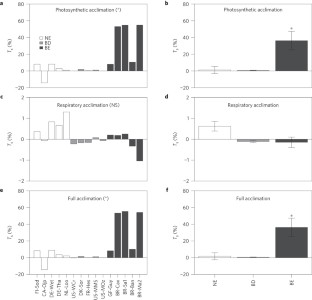
The alternative text for this image may have been generated using AI.
Figure 2: Global influence of acclimation on photosynthesis and foliar respiration.
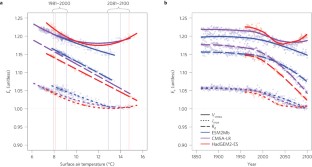
The alternative text for this image may have been generated using AI.
Figure 3: Global maps of the influence of acclimation on each process at the ends of the nineteenth, twentieth and twenty-first centuries.
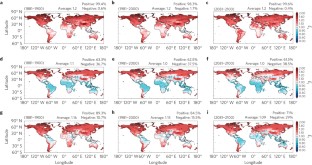
The alternative text for this image may have been generated using AI.
Figure 4: Effect of acclimation on global simulated vegetation carbon in LM3.
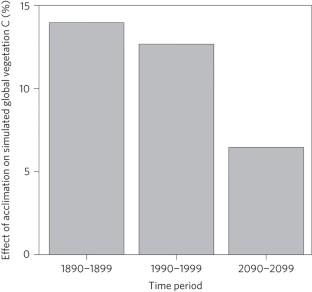
The alternative text for this image may have been generated using AI.
References
- IPCC in Climate Change 2013: The Physical Science Basis (eds Stocker, T. F. et al.) (Cambridge Univ. Press, 2013).
Google Scholar - Booth, B. B. et al. High sensitivity of future global warming to land carbon cycle processes. Environ. Res. Lett. 7, 024002 (2012).
Article Google Scholar - Ziehn, T., Kattge, J., Knorr, W. & Scholze, M. Improving the predictability of global CO2 assimilation rates under climate change. Geophys. Res. Lett. 38, L10404 (2011).
Article Google Scholar - Kattge, J. & Knorr, W. Temperature acclimation in a biochemical model of photosynthesis: a reanalysis of data from 36 species. Plant Cell Environ. 30, 1176–1190 (2007).
Article CAS Google Scholar - Atkin, O. K. et al. Using temperature-dependent changes in leaf scaling relationships to quantitatively account for thermal acclimation of respiration in a coupled global climate-vegetation model. Glob. Change Biol. 14, 2709–2726 (2008).
Google Scholar - Arneth, A., Mercado, L., Kattge, J. & Booth, B. Future challenges of representing land-processes in studies on land-atmosphere interactions. Biogeosciences 9, 3587–3599 (2012).
Article Google Scholar - Shevliakova, E. et al. Historical warming reduced due to enhanced land carbon uptake. Proc. Natl Acad. Sci. USA 110, 16730–16735 (2013).
Article CAS Google Scholar - Taylor, K. E., Stouffer, R. J. & Meehl, G. A. An overview of CMIP5 and the experiment design. Bull. Am. Meteorol. Soc. 93, 485–498 (2011).
Article Google Scholar - Berry, J. & Björkman, O. Photosynthetic response and adaptation to temperature in higher plants. Annu. Rev. Plant Physiol. Plant Mol. Biol. 31, 491–543 (1980).
Article Google Scholar - Atkin, O. K., Bruhn, D., Hurry, V. M. & Tjoelker, M. G. The hot and the cold: unravelling the variable response of plant respiration to temperature. Funct. Plant Biol. 32, 87–105 (2005).
Article Google Scholar - Way, D. A. & Yamori, W. Thermal acclimation of photosynthesis: on the importance of adjusting our definitions and accounting for thermal acclimation of respiration. Photosynth. Res. 119, 89–100 (2014).
Article CAS Google Scholar - Galbraith, D. et al. Multiple mechanisms of Amazonian forest biomass losses in three dynamic global vegetation models under climate change. New Phytol. 187, 647–665 (2010).
Article Google Scholar - King, A. W., Gunderson, C. A., Post, W. M., Weston, D. J. & Wullschleger, S. D. Photosynthesis in balance with respiration? Response. Science 313, 917–918 (2006).
Article CAS Google Scholar - Smith, N. G. & Dukes, J. S. Plant respiration and photosynthesis in global-scale models: incorporating acclimation to temperature and CO2 . Glob. Change Biol. 19, 45–63 (2013).
Article Google Scholar - Slot, M. & Kitajima, K. General patterns of acclimation of leaf respiration to elevated temperatures across biomes and plant types. Oecologia 177, 885–900 (2014).
Article Google Scholar - Farquhar, G., von Caemmerer, S. & Berry, J. A biochemical model of photosynthetic CO2 assimilation in leaves of C3 species. Planta 149, 78–90 (1980).
Article CAS Google Scholar - Atkin, O. K., Meir, P. & Turnbull, M. H. Improving representation of leaf respiration in large-scale predictive climate–vegetation models. New Phytol. 202, 743–748 (2014).
Article Google Scholar - Shevliakova, E. et al. Carbon cycling under 300 years of land use change: importance of the secondary vegetation sink. Glob. Biogeochem. Cycles 23, GB2022 (2009).
Article Google Scholar - Sheffield, J., Goteti, G. & Wood, E. F. Development of a 50-year high-resolution global dataset of meteorological forcings for land surface modeling. J. Clim. 19, 3088–3111 (2006).
Article Google Scholar - Taylor, K. E. Summarizing multiple aspects of model performance in a single diagram. J. Geophys. Res. 106, 7183–7192 (2001).
Article Google Scholar - Kruschke, J. K. Bayesian estimation supersedes the t test. J. Exp. Psychol. 142, 573–603 (2013).
Article Google Scholar - Riahi, K. et al. RCP 8.5—A scenario of comparatively high greenhouse gas emissions. Climatic Change 109, 33–57 (2011).
Article CAS Google Scholar - Dunne, J. P. et al. GFDL’s ESM2 global coupled climate–carbon Earth system models. Part I: physical formulation and baseline simulation characteristics. J. Clim. 25, 6646–6665 (2012).
Article Google Scholar - Dunne, J. P. et al. GFDL’s ESM2 global coupled climate–carbon Earth system models. Part II: carbon system formulation and baseline simulation characteristics. J. Clim. 26, 2247–2267 (2012).
Article Google Scholar - Dufresne, J. L. et al. Climate change projections using the IPSL-CM5 Earth system model: from CMIP3 to CMIP5. Clim. Dynam. 40, 2123–2165 (2013).
Article Google Scholar - Collins, W. J. et al. Development and evaluation of an Earth-system model—HadGEM2. Geosci. Model Dev. Discuss. 4, 997–1062 (2011).
Article Google Scholar - Medlyn, B. E. et al. Temperature response of parameters of a biochemically based model of photosynthesis. II. A review of experimental data. Plant Cell Environ. 25, 1167–1179 (2002).
Article CAS Google Scholar - IPCC in Managing the Risks of Extreme Events and Disasters to Advance Climate Change Adaptation (eds Field, C. B. et al.) (Cambridge Univ. Press, 2012).
Google Scholar - Collatz, G. J., Ball, J. T., Grivet, C. & Berry, J. A. Physiological and environmental regulation of stomatal conductance, photosynthesis, and transpiration—a model that includes a laminar boundary layer. Agric. For. Meteorol. 54, 107–136 (1991).
Article Google Scholar - Moffat, A. M. et al. Comprehensive comparison of gap-filling techniques for eddy covariance net carbon fluxes. Agric. For. Meteorol. 147, 209–232 (2007).
Article Google Scholar - Papale, D. et al. Towards a standardized processing of Net Ecosystem Exchange measured with eddy covariance technique: algorithms and uncertainty estimation. Biogeosciences 3, 571–583 (2006).
Article CAS Google Scholar - Papale, D. & Valentini, R. A new assessment of European forests carbon exchanges by eddy fluxes and artificial neural network spatialization. Glob. Change Biol. 9, 525–535 (2003).
Article Google Scholar - Reichstein, M. et al. On the separation of net ecosystem exchange into assimilation and ecosystem respiration: review and improved algorithm. Glob. Change Biol. 11, 1424–1439 (2005).
Article Google Scholar
Acknowledgements
This project was supported by student exchange funding for N.G.S. provided by the INTERFACE RCN (NSF DEB-0955771), a Purdue Climate Change Research Center graduate fellowship to N.G.S., and a NASA Earth and Space Science fellowship to N.G.S. (NNX13AN65H). S.L.M. acknowledges support from the National Oceanic and Atmospheric (US Department of Commerce) Grant NAOSOAR4320752. This work used eddy-covariance data acquired by the FLUXNET community and in particular by the following networks: AmeriFlux (US Department of Energy, Biological and Environmental Research, Terrestrial Carbon Program (DE-FG02-04ER63917 and DE-FG02-04ER63911)), CarboEuropeIP, Fluxnet-Canada (supported by CFCAS, NSERC, BIOCAP, Environment Canada, and NRCan), and LBA. We acknowledge the financial support to the eddy-covariance data harmonization provided by CarboEuropeIP, FAO-GTOS-TCO, iLEAPS, Max Planck Institute for Biogeochemistry, National Science Foundation, University of Tuscia, Université Laval, Environment Canada and US Department of Energy and the database development and technical support from Berkeley Water Center, Lawrence Berkeley National Laboratory, Microsoft Research eScience, Oak Ridge National Laboratory, University of California—Berkeley and the University of Virginia. This is publication 1605 of the Purdue Climate Change Research Center.
Author information
Authors and Affiliations
- Department of Biological Sciences, Purdue University, West Lafayette, Indiana 47907, USA
Nicholas G. Smith & Jeffrey S. Dukes - Princeton University & Geophysical Fluid Dynamics Laboratory Cooperative Institute for Climate Studies, Princeton, New Jersey 08540, USA
Sergey L. Malyshev & Elena Shevliakova - Max Planck Institute for Biogeochemistry, Jena 07745, Germany
Jens Kattge - German Centre for Integrative Biodiversity Research Halle-Jena-Leipzig, Leipzig 04103, Germany
Jens Kattge - Department of Forestry and Natural Resources, Purdue University, West Lafayette, Indiana 47907, USA
Jeffrey S. Dukes
Authors
- Nicholas G. Smith
- Sergey L. Malyshev
- Elena Shevliakova
- Jens Kattge
- Jeffrey S. Dukes
Contributions
N.G.S., S.L.M., E.S. and J.S.D. designed the study. N.G.S. and S.L.M. performed the model simulations and analyses. All authors contributed to the interpretation of the results and writing of the manuscript.
Corresponding author
Correspondence toNicholas G. Smith.
Ethics declarations
Competing interests
The authors declare no competing financial interests.
Supplementary information
Rights and permissions
About this article
Cite this article
Smith, N., Malyshev, S., Shevliakova, E. et al. Foliar temperature acclimation reduces simulated carbon sensitivity to climate.Nature Clim Change 6, 407–411 (2016). https://doi.org/10.1038/nclimate2878
- Received: 16 September 2014
- Accepted: 08 October 2015
- Published: 07 December 2015
- Issue date: April 2016
- DOI: https://doi.org/10.1038/nclimate2878
This article is cited by
Night-time decline in plant respiration is consistent with substrate depletion
- Simon Jones
- Lina M. Mercado
- Peter M. Cox
Communications Earth & Environment (2024)
Boreal conifers maintain carbon uptake with warming despite failure to track optimal temperatures
- Mirindi Eric Dusenge
- Jeffrey M. Warren
- Danielle A. Way
Nature Communications (2023)
Evidence for widespread thermal optimality of ecosystem respiration
- Weinan Chen
- Song Wang
- Shuli Niu
Nature Ecology & Evolution (2023)
Trait-Based Modeling of Terrestrial Ecosystems: Advances and Challenges Under Global Change
- Xiangtao Xu
- Anna T. Trugman
Current Climate Change Reports (2021)
Advances in Land Surface Modelling
- Eleanor M. Blyth
- Vivek K. Arora
- Hua Yuan
Current Climate Change Reports (2021)