Global drivers of future river flood risk (original) (raw)
- Letter
- Published: 21 December 2015
- Jeroen C. J. H. Aerts2,3,
- Ludovicus P. H. van Beek4,
- Marc F. P. Bierkens1,4,
- Arno Bouwman5,
- Brenden Jongman2,3,
- Jaap C. J. Kwadijk1,6,
- Willem Ligtvoet5,
- Paul L. Lucas ORCID: orcid.org/0000-0003-0292-78305,
- Detlef P. van Vuuren5,7 &
- …
- Philip J. Ward2,3
Nature Climate Change volume 6, pages 381–385 (2016) Cite this article
- 18k Accesses
- 1033 Citations
- 69 Altmetric
- Metrics details
Subjects
Abstract
Understanding global future river flood risk is a prerequisite for the quantification of climate change impacts and planning effective adaptation strategies[1](/articles/nclimate2893#ref-CR1 "IPCC Managing the Risks of Extreme Events and Disasters to Advance Climate Change Adaptation (Cambridge Univ. Press, 2012); http://ipcc-wg2.gov/SREX/report
            "). Existing global flood risk projections fail to integrate the combined dynamics of expected socio-economic development and climate change. We present the first global future river flood risk projections that separate the impacts of climate change and socio-economic development. The projections are based on an ensemble of climate model outputs[2](/articles/nclimate2893#ref-CR2 "Hempel, S., Frieler, K., Warszawski, L., Schewe, J. & Piontek, F. A trend-preserving bias correction—the ISI-MIP approach. Earth Syst. Dynam. 4, 219–236 (2013)."), socio-economic scenarios[3](/articles/nclimate2893#ref-CR3 "O’Neill, B. C. et al. Meeting Report of the Workshop on The Nature and Use of New Socioeconomic Pathways for Climate Change Research (NCAR, 2012);
              https://www2.cgd.ucar.edu/sites/default/files/iconics/Boulder-Workshop-Report.pdf

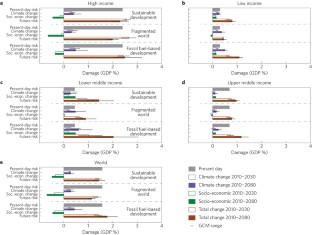
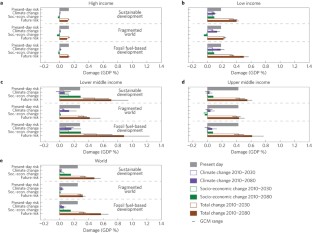
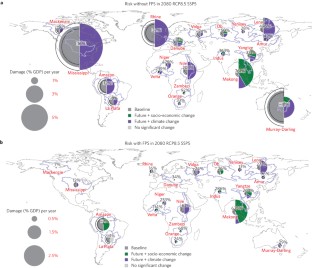
            "), and a state-of-the-art hydrologic river flood model combined with socio-economic impact models[4](/articles/nclimate2893#ref-CR4 "Winsemius, H. C., Van Beek, L. P. H., Jongman, B., Ward, P. J. & Bouwman, A. A framework for global river flood risk assessments. Hydrol. Earth Syst. Sci. 17, 1871–1892 (2013)."),[5](/articles/nclimate2893#ref-CR5 "Ward, P. J. et al. Assessing flood risk at the global scale: Model setup, results, and sensitivity. Environ. Res. Lett. 8, 044019 (2013)."). Globally, absolute damage may increase by up to a factor of 20 by the end of the century without action. Countries in Southeast Asia face a severe increase in flood risk. Although climate change contributes significantly to the increase in risk in Southeast Asia[6](/articles/nclimate2893#ref-CR6 "Hirabayashi, Y. et al. Global flood risk under climate change. Nature Clim. Change 3, 816–821 (2013)."), we show that it is dwarfed by the effect of socio-economic growth, even after normalization for gross domestic product (GDP) growth. African countries face a strong increase in risk mainly due to socio-economic change. However, when normalized to GDP, climate change becomes by far the strongest driver. Both high- and low-income countries may benefit greatly from investing in adaptation measures, for which our analysis provides a basis.
This is a preview of subscription content, access via your institution
Access options
Subscribe to this journal
Receive 12 print issues and online access
$259.00 per year
only $21.58 per issue
Buy this article
- Purchase on SpringerLink
- Instant access to the full article PDF.
USD 39.95
Prices may be subject to local taxes which are calculated during checkout
Additional access options:
Figure 1: Changes in economic risk under ‘No FPS’ conditions, expressed as annual average urban damage as a percentage of GDP.
The alternative text for this image may have been generated using AI.
Figure 2: Same as Fig. 1 but under ‘Partial FPS’ conditions.
The alternative text for this image may have been generated using AI.
Figure 3: Projected change in economic risk until 2080 in the ‘Fossil fuel-based development’ projection.
The alternative text for this image may have been generated using AI.
References
- IPCC Managing the Risks of Extreme Events and Disasters to Advance Climate Change Adaptation (Cambridge Univ. Press, 2012); http://ipcc-wg2.gov/SREX/report
- Hempel, S., Frieler, K., Warszawski, L., Schewe, J. & Piontek, F. A trend-preserving bias correction—the ISI-MIP approach. Earth Syst. Dynam. 4, 219–236 (2013).
Article Google Scholar - O’Neill, B. C. et al. Meeting Report of the Workshop on The Nature and Use of New Socioeconomic Pathways for Climate Change Research (NCAR, 2012); https://www2.cgd.ucar.edu/sites/default/files/iconics/Boulder-Workshop-Report.pdf
Google Scholar - Winsemius, H. C., Van Beek, L. P. H., Jongman, B., Ward, P. J. & Bouwman, A. A framework for global river flood risk assessments. Hydrol. Earth Syst. Sci. 17, 1871–1892 (2013).
Article Google Scholar - Ward, P. J. et al. Assessing flood risk at the global scale: Model setup, results, and sensitivity. Environ. Res. Lett. 8, 044019 (2013).
Article Google Scholar - Hirabayashi, Y. et al. Global flood risk under climate change. Nature Clim. Change 3, 816–821 (2013).
Article Google Scholar - NatCatSERVICE (Munich RE, accessed 15 August 2013).
- Jongman, B., Ward, P. J. & Aerts, J. C. J. H. Global exposure to river and coastal flooding—long term trends and changes. Glob. Environ. Change 22, 823–835 (2012).
Article Google Scholar - Visser, H., Petersen, A. C. & Ligtvoet, W. On the relation between weather-related disaster impacts, vulnerability and climate change. Climatic Change 125, 461–477 (2014).
Article Google Scholar - Jongman, B. et al. Increasing stress on disaster-risk finance due to large floods. Nature Clim. Change 4, 264–268 (2014).
Article Google Scholar - Brown, C., Meeks, R., Ghile, Y. & Hunu, K. Is water security necessary? An empirical analysis of the effects of climate hazards on national-level economic growth. Phil. Trans. A 371, 20120416 (2013).
Article Google Scholar - Pappenberger, F., Dutra, E., Wetterhall, F. & Cloke, H. Deriving global flood hazard maps of fluvial floods through a physical model cascade. Hydrol. Earth Syst. Sci. 16, 4143–4156 (2012).
Article Google Scholar - Sampson, C. C. et al. A high-resolution global flood hazard model. Wat. Resour. Res. 51, 7358–7381 (2015).
Article Google Scholar - Ward, P. J. et al. Usefulness and limitations of global flood risk models. Nature Clim. Change 5, 712–715 (2015).
Article Google Scholar - Milly, P. C. D., Wetherald, R. T., Dunne, K. A. & Delworth, T. L. Increasing risk of great floods in a changing climate. Nature 415, 514–517 (2002).
Article CAS Google Scholar - Arnell, N. W. & Gosling, S. N. The impacts of climate change on river flood risk at the global scale. Climatic Change http://dx.doi.org/10.1007/s10584-014-1084-5 (2014).
- Ceola, S., Laio, F. & Montanari, A. Satellite nighttime lights reveal increasing human exposure to floods worldwide. Geophys. Res. Lett. 41, 7184–7190 (2014).
Article Google Scholar - Jongman, B. et al. Declining vulnerability to river floods and the global benefits of adaptation. Proc. Natl Acad. Sci. USA 112, E2271–E2280 (2015).
Article CAS Google Scholar - Hall, J. W. et al. Quantified scenarios analysis of drivers and impacts of changing flood risk in England and Wales: 2030–2100. Glob. Environ. Change 5, 51–65 (2003).
Google Scholar - De Moel, H., Aerts, J. C. J. H. & Koomen, E. Development of flood exposure in the Netherlands during the 20th and 21st century. Glob. Environ. Change 21, 620–627 (2011).
Article Google Scholar - Taylor, K. E., Stouffer, R. J. & Meehl, G. A. An overview of CMIP5 and the experiment design. Bull. Am. Meteorol. Soc. 93, 485–498 (2012).
Article Google Scholar - Van Vuuren, D. P. et al. The representative concentration pathways: An overview. Climatic Change 109, 5–31 (2011).
Article Google Scholar - Kron, W., Steuer, M., Löw, P. & Wirtz, A. How to deal properly with a natural catastrophe database—analysis of flood losses. Nature Hazards Earth Syst. Sci. 12, 535–550 (2012).
Article Google Scholar - Climate Change is Global Mega-Trend for Sovereign Risk, S&P Report Says. Standard and Poor’s Ratings Service (15 May 2014); http://www.standardandpoors.com/prot/ratings/articles/en/us/?articleType=HTML&assetID=1245368455822
- Hallegatte, S., Green, C., Nicholls, R. J. & Corfee-Morlot, J. Future flood losses in major coastal cities. Nature Clim. Change 3, 802–806 (2013).
Article Google Scholar - Kellett, J. & Caravani, A. Financing Disaster Risk Reduction: A 20 Year Story of International Aid (Global Facility for Disaster Reduction and Recovery and Overseas Development Institute, 2013); http://www.odi.org/sites/odi.org.uk/files/odi-assets/publications-opinion-files/8574.pdf
Google Scholar - World Bank List of Economies July 2011 (World Bank, 2011)
Acknowledgements
We are grateful for the co-funding from the EC FP7 funded project BASE (grant agreement number 308337). The research was also funded by a VENI grant from the Netherlands Organisation for Scientific Research (NWO), awarded to P.J.W. (grant no. 863.11.011). Finally, the research was funded as part of the Aqueduct Global Flood Analyzer project, via grant 5000002722 from the Netherlands Ministry of Infrastructure and the Environment. The project is convened by the World Resources Institute. Furthermore, we are grateful to the ISIMIP project team for making available the ISIMIP forcing data set. Finally, the authors wish to thank the Environment Agency of England and Wales and the Saxony State Office for Environment, Agriculture and Geology for the provision of the regional flood hazard maps, used for model benchmarking.
Author information
Authors and Affiliations
- Deltares, 2629 HV Delft, The Netherlands
Hessel C. Winsemius, Marc F. P. Bierkens & Jaap C. J. Kwadijk - Institute for Environmental Studies (IVM), Vrije Universiteit Amsterdam, 1081 HV Amsterdam, The Netherlands
Jeroen C. J. H. Aerts, Brenden Jongman & Philip J. Ward - Amsterdam Global Change Institute (AGCI), Vrije Universiteit Amsterdam, 1081 HV Amsterdam, The Netherlands
Jeroen C. J. H. Aerts, Brenden Jongman & Philip J. Ward - Department of Physical Geography, Utrecht University, 3508 TC Utrecht, The Netherlands
Ludovicus P. H. van Beek & Marc F. P. Bierkens - PBL Netherlands Environmental Assessment Agency, 3721 MA Bilthoven, The Netherlands
Arno Bouwman, Willem Ligtvoet, Paul L. Lucas & Detlef P. van Vuuren - Twente Water Centre, University of Twente, 7500 AE Enschede, The Netherlands
Jaap C. J. Kwadijk - Copernicus Institute for Sustainable Development, Utrecht University, 3508 TC Utrecht, The Netherlands
Detlef P. van Vuuren
Authors
- Hessel C. Winsemius
- Jeroen C. J. H. Aerts
- Ludovicus P. H. van Beek
- Marc F. P. Bierkens
- Arno Bouwman
- Brenden Jongman
- Jaap C. J. Kwadijk
- Willem Ligtvoet
- Paul L. Lucas
- Detlef P. van Vuuren
- Philip J. Ward
Contributions
H.C.W. was responsible for computation of the flood hazard maps for all projections. H.C.W., M.F.P.B., L.P.H.B., B.J., P.J.W., A.B. and W.L. have established the global flood risk modelling framework used to perform the flood risk computations performed in the scope of this paper. A.B., J.C.J.H.A., W.L. and P.L.L. have derived the future exposure maps (population and GDP), B.J. and P.J.W. computed socio-economic risk. H.C.W. produced all graphs. All authors have contributed to the conceptualization and writing of the manuscript text.
Corresponding author
Correspondence toHessel C. Winsemius.
Ethics declarations
Competing interests
The authors declare no competing financial interests.
Supplementary information
Rights and permissions
About this article
Cite this article
Winsemius, H., Aerts, J., van Beek, L. et al. Global drivers of future river flood risk.Nature Clim Change 6, 381–385 (2016). https://doi.org/10.1038/nclimate2893
- Received: 12 November 2014
- Accepted: 11 November 2015
- Published: 21 December 2015
- Issue date: April 2016
- DOI: https://doi.org/10.1038/nclimate2893