Steps to overcome the North–South divide in research relevant to climate change policy and practice (original) (raw)
- Perspective
- Published: 04 January 2017
- Richard J. Smithers3 na1,
- Magdalena Kuchler1,
- Ganesh K. Agrawal4,
- José M. Gutiérrez5,
- Ahmed Hassanali6,
- Saleemul Huq7,
- Silvia H. Koller ORCID: orcid.org/0000-0001-9109-66748,
- Sugata Marjit9,
- Hassan M. Mshinda10,
- Hj Hassan Masjuki11,
- Noel W. Solomons12,
- Johannes Van Staden13 &
- …
- Grzegorz Mikusiński14
Nature Climate Change volume 7, pages 21–27 (2017) Cite this article
- 8519 Accesses
- 136 Citations
- 86 Altmetric
- Metrics details
Subjects
Abstract
A global North–South divide in research, and its negative consequences, has been highlighted in various scientific disciplines. Northern domination of science relevant to climate change policy and practice, and limited research led by Southern researchers in Southern countries, may hinder further development and implementation of global climate change agreements and nationally appropriate actions. Despite efforts to address the North–South divide, progress has been slow. In this Perspective, we illustrate the extent of the divide, review underlying issues and analyse their consequences for climate change policy development and implementation. We propose a set of practical steps in both Northern and Southern countries that a wide range of actors should take at global, regional and national scales to span the North–South divide, with examples of some actions already being implemented.
This is a preview of subscription content, access via your institution
Access options
Access Nature and 54 other Nature Portfolio journals
Get Nature+, our best-value online-access subscription
$32.99 / 30 days
cancel any time
Subscribe to this journal
Receive 12 print issues and online access
$259.00 per year
only $21.58 per issue
Buy this article
- Purchase on SpringerLink
- Instant access to the full article PDF.
USD 39.95
Prices may be subject to local taxes which are calculated during checkout
Additional access options:
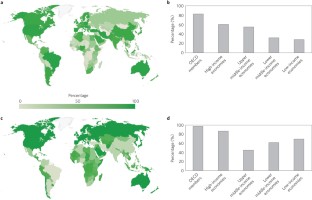
Figure 1: Affiliations of first authors of scientific papers published in 2000–2014 in relation to countries' economic status and by country.
The alternative text for this image may have been generated using AI.
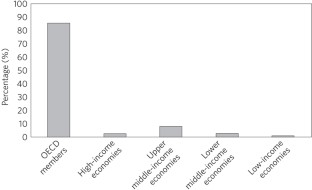
Figure 2: Affiliations of authors of scientific articles about climate change in relation to countries' economic status.
The alternative text for this image may have been generated using AI.
References
- Wollfers, I., Adjei, S. & van der Drift, R. Health research in the tropics. Lancet 351, 1652–1654 (1995).
Article Google Scholar - Jeffery, R. Authorship in multi-disciplinary, multi-national North-South research projects: issues of equity, capacity and accountability. J. Comp. Int. Educ. 44, 208–229 (2014).
Google Scholar - Karlsson, S. in Global Environmental Governance: Options and Opportunities (eds Esty, D. C. & Ivanova, M. H.) 53–76 (Yale School of Forestry & Environmental Studies, 2002).
Google Scholar - Karlsson, S., Srebotnjak, T. & Gonzales, P. Understanding the North–South knowledge divide and its implications for policy: a quantitative analysis of the generation of scientific knowledge in the environmental sciences. Environ. Sci. Policy 10, 668–684 (2007).
Article Google Scholar - Cash, D. W. et al. Knowledge systems for sustainable development. Proc. Natl Acad. Sci. USA 100, 8086–8091 (2003).
Article CAS Google Scholar - Pasgaard, M. & Strange, N. A quantitative analysis of the causes of the global climate change research distribution. Global Environ. Change 23, 1684–1693 (2013).
Article Google Scholar - Corbera, E., Calvet-Mir, L., Hughes, H. & Paterson, M. Patterns of authorship in the IPCC Working Group III report. Nat. Clim. Change 6, 94–100 (2016).
Article Google Scholar - Hulme, M. & Mahony, M. Climate change: what do we know about the IPCC? Prog. Phys. Geog. 34, 705–718 (2010).
Article Google Scholar - Agarwal, A., Narain, S. & Sharma, A. (eds) Green Politics: Global Environmental Negotiations (Centre for Science and Environment, 1999).
Google Scholar - Crossley, M. & Sprague, T. Education for sustainable development: Implications for small island developing states (SIDS). Int. J. Edu. Dev. 35, 86–95 (2014).
Article Google Scholar - Butler, D. Call for North/South code of research ethics. Nature 406, 337 (2000).
Article CAS Google Scholar - KFPE Guidelines for Research in Partnership with Developing Countries. 11 principles. (Swiss Commission for Research Partnership with Developing Countries, 1998).
- Binka, F. North–South research collaborations: a move towards a true partnership? Trop. Med. Int. Health 10, 207–209 (2005).
Article Google Scholar - Transforming Our World: the 2030 Agenda for Sustainable Development A/RES/70/1 (United Nations, 2015).
- World Development Indicators (World Bank, accessed 28 May 2016); http://go.nature.com/2hgoiqz
- Research Co-operation Between Developed and Developing Countries in the Area of Climate Change Adaptation and Biodiversity (OECD, 2014).
- Jentsch, B. & Pilley, C. Research relationships between the South and the North: Cinderella and the ugly sisters? Soc. Sci. Med. 57, 1957–1967 (2003).
Article Google Scholar - Teferra, D. & Altbach, P. G. African higher education: challenges for the 21st century. High. Edu. 47, 21–50 (2004).
Article Google Scholar - Glänzel, W., Leta, J. & Thus, B. Science in Brazil Part 1: a macro-level comparative study. Scientometrics 67, 67–86 (2006).
Article Google Scholar - Forero-Pineda, C. & Jaramillo-Salazar, H. The access of researchers from developing countries to international science and technology. Int. Soc. Sci. J. 171, 129–140 (2002).
Article Google Scholar - Barrett, M., Crossley, H. & Dachi, A. International collaboration and research capacity building: learning from the EdQual experience, Comp. Educ. 47, 25–43 (2011).
Article Google Scholar - Aviles, L. A. Epidemiology as discourse: the politics of development institutions in the epidemiological profile of El Salvador. J. Epidemiol. Community Health 55, 164–171 (2001).
Article CAS Google Scholar - Hassan, M. H. A. Can science save Africa? Science 292, 12–13 (2001).
Article Google Scholar - Mullan, F. The metrics of the physician brain drain. N. Engl. J. Med. 353, 1850–1852 (2005).
Article Google Scholar - Seguin B., Singer, P. A. & Daar, A. S. Scientific diasporas. Science 312, 1602–1603 (2006).
Article CAS Google Scholar - Landau, L. B. Communities of knowledge or tyrannies of partnership: reflections on North–South research networks and the dual imperative. J. Refugee Stud. 25, 555–570 (2012).
Article Google Scholar - Edejer, T. T.-T. North-South research partnerships: the ethics of carrying out research in developing countries. BMJ 319, 438–441 (1999).
Article CAS Google Scholar - Steinberg, P. F. in Transnational Relations and Biodiversity Policy in Costa Rica and Bolivia Ch. 1, 3–26 (MIT Press, 2001).
Google Scholar - Karlsson, S. I. Institutionalized knowledge challenges in pesticide governance: the end of knowledge and beginning of values in governing globalized environmental issues. Int. Environ. Agreements Polit. Law Econ. 4, 195–213 (2004).
Article Google Scholar - Kandlikar, M. & Sagar, A. Climate change research and analysis in India: an integrated assessment of a South-North divide. Global Environ. Change 9, 119–138 (1999).
Article Google Scholar - Sarewitz, D., Pielke R. A. Jr The neglected heart of science policy: reconciling supply of and demand for science. Environ. Sci. Policy 10, 5–16 (2007).
Article Google Scholar - Moreno, E., Gutiérrez, J. M. & Chaves-Olarte, E. The struggle of neglected scientific groups: ten years of NeTropica efforts to promote research in tropical diseases in Central America. PLoS Negl. Trop. Dis. 5, e1055 (2011).
Article Google Scholar - Swartz, S. Navigational capacities in contexts of adversity: establishing a consortium of global South youth scholars (COGSYS) (HSRC, 2016).
Google Scholar - World Bank Country and Lending Groups (World Bank, accessed 28 May 2016); http://go.nature.com/2gpbHhv
Acknowledgements
We would like to thank A. Engelmann and M. Stråhle from the SLU University Library for the help with the bibliographic analysis.
Author information
Author notes
- Malgorzata Blicharska and Richard J. Smithers: These authors contributed equally to this work
Authors and Affiliations
- Department of Earth Sciences, Natural Resources and Sustainable Development, Uppsala University, Uppsala, 75236, Sweden
Malgorzata Blicharska & Magdalena Kuchler - Swedish Biodiversity Centre, Swedish University of Agricultural Sciences, Uppsala, Sweden
Malgorzata Blicharska - Ricardo Energy & Environment, Harwell, Didcot, UK
Richard J. Smithers - GRADE (Global Research Arch for Developing Education) Academy, Pvt. Ltd, Birguni, Nepal
Ganesh K. Agrawal - Universidad de Costa Rica, Instituto Clodomiro Picado, Facultad de Microbiología, San José, Costa Rica
José M. Gutiérrez - Department of Chemistry, Kenyatta University, Nairobi, Kenya
Ahmed Hassanali - International Centre for Climate Change & Development, Independent University, Bangladesh, Dhaka, Bangladesh
Saleemul Huq - Department of Psychology, Universidade Federal do Rio Grande do Sul, Porto Alegre, Brazil
Silvia H. Koller - Centre for Studies in Social Sciences Calcutta, Calcutta, India
Sugata Marjit - Tanzania Commission for Science and Technology, Dar Es Salaam, Tanzania
Hassan M. Mshinda - University of Malaya, Faculty of Engineering, Kuala Lumpur, Malaysia
Hj Hassan Masjuki - Center for Studies of Sensory Impairment, Aging and Metabolism, Guatemala City, 01011, Guatemala
Noel W. Solomons - Research Centre for Plant Growth and Development, School of Life Sciences, University of KwaZulu-Natal Pietermaritzburg, South Africa
Johannes Van Staden - School for Forest Management, Swedish University of Agricultural Sciences, Skinnskatteberg, 73921, Sweden
Grzegorz Mikusiński
Authors
- Malgorzata Blicharska
- Richard J. Smithers
- Magdalena Kuchler
- Ganesh K. Agrawal
- José M. Gutiérrez
- Ahmed Hassanali
- Saleemul Huq
- Silvia H. Koller
- Sugata Marjit
- Hassan M. Mshinda
- Hj Hassan Masjuki
- Noel W. Solomons
- Johannes Van Staden
- Grzegorz Mikusiński
Contributions
M.B., R.J.S., G.M. initiated the study; G.M. conducted the analysis with help of M.B. and R.J.S.; M.B. and R.J.S. wrote the paper and contributed equally to this work. All other authors contributed to the text, and provided practical examples for inclusion in the article.
Corresponding author
Correspondence toGrzegorz Mikusiński.
Ethics declarations
Competing interests
The authors declare no competing financial interests.
Supplementary information
Rights and permissions
About this article
Cite this article
Blicharska, M., Smithers, R., Kuchler, M. et al. Steps to overcome the North–South divide in research relevant to climate change policy and practice.Nature Clim Change 7, 21–27 (2017). https://doi.org/10.1038/nclimate3163
- Received: 01 July 2016
- Accepted: 26 October 2016
- Published: 04 January 2017
- Issue date: January 2017
- DOI: https://doi.org/10.1038/nclimate3163