Australian climate extremes at 1.5 °C and 2 °C of global warming (original) (raw)
Abstract
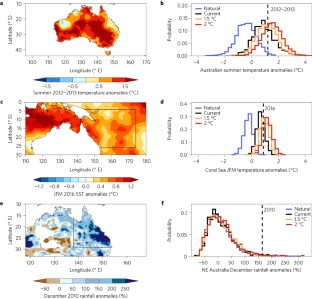
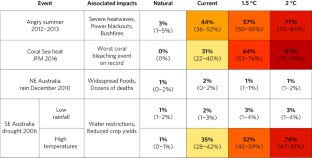
To avoid more severe impacts from climate change, there is international agreement to strive to limit warming to below 1.5 °C. However, there is a lack of literature assessing climate change at 1.5 °C and the potential benefits in terms of reduced frequency of extreme events1,2,3. Here, we demonstrate that existing model simulations provide a basis for rapid and rigorous analysis of the effects of different levels of warming on large-scale climate extremes, using Australia as a case study. We show that limiting warming to 1.5 °C, relative to 2 °C, would perceptibly reduce the frequency of extreme heat events in Australia. The Australian continent experiences a variety of high-impact climate extremes that result in loss of life, and economic and environmental damage. Events similar to the record-hot summer of 2012–2013 and warm seas associated with bleaching of the Great Barrier Reef in 2016 would be substantially less likely, by about 25% in both cases, if warming is kept to lower levels. The benefits of limiting warming on hydrometeorological extremes are less clear. This study provides a framework for analysing climate extremes at 1.5 °C global warming.
This is a preview of subscription content, access via your institution
Access options
Access Nature and 54 other Nature Portfolio journals
Get Nature+, our best-value online-access subscription
$32.99 / 30 days
cancel any time
Subscribe to this journal
Receive 12 print issues and online access
$259.00 per year
only $21.58 per issue
Buy this article
- Purchase on SpringerLink
- Instant access to the full article PDF.
USD 39.95
Prices may be subject to local taxes which are calculated during checkout
Additional access options:
Figure 1: Australian climate under varying levels of human-induced climate change.
The alternative text for this image may have been generated using AI.
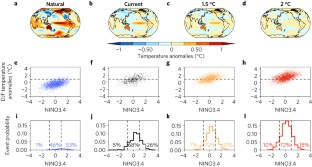
Figure 2: ENSO conditions associated with historically hot Australian summers.
The alternative text for this image may have been generated using AI.
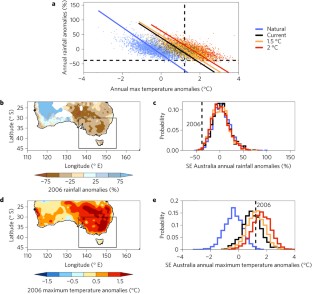
Figure 3: Changing Australian one-year drought under varying levels of human-induced climate change.
The alternative text for this image may have been generated using AI.
Figure 4: The changing likelihood of Australian extreme events.
The alternative text for this image may have been generated using AI.
References
- Hulme, M. 1.5 °C and climate research after the Paris Agreement. Nat. Clim. Change 6, 222–224 (2016).
Article Google Scholar - Mitchell, D. et al. Realizing the impacts of a 1.5 °C warmer world. Nat. Clim. Change 6, 735–737 (2016).
Article Google Scholar - The maximum climate ambition needs a firm research backing. Nature 537, 585–586 (2016).
- Seneviratne, S. I., Donat, M. G., Pitman, A. J., Knutti, R. & Wilby, R. L. Allowable CO2 emissions based on regional and impact-related climate targets. Nature 529, 477–483 (2016).
Article CAS Google Scholar - Schleussner, C.-F. et al. Differential climate impacts for policy-relevant limits to global warming: the case of 1.5 °C and 2 °C. Earth Syst. Dyn. 7, 327–351 (2016).
Article Google Scholar - Taylor, K. E., Stouffer, R. J. & Meehl, G. A. An overview of CMIP5 and the experiment design. Bull. Am. Meteorol. Soc. 93, 485–98 (2012).
Article Google Scholar - Stott, P. A., Stone, D. A. & Allen, M. R. Human contribution to the European heatwave of 2003. Nature 432, 610–614 (2004).
Article CAS Google Scholar - Peterson, T. C., Stott, P. A. & Herring, S. Explaining extreme events of 2011 from a climate perspective. Bull. Am. Meteorol. Soc. 93, 1041–1067 (2012).
Article Google Scholar - Lewis, S. C. & Karoly, D. J. Anthropogenic contributions to Australia’s record summer temperatures of 2013. Geophys. Res. Lett. 40, 3705–3709 (2013).
Article Google Scholar - Lewis, S. C. & Karoly, D. J. Are estimates of anthropogenic and natural influences on Australia’s extreme 2010–2012 rainfall model-dependent? Clim. Dynam. 45, 679–695 (2014).
Article Google Scholar - Coumou, D., Robinson, A. & Rahmstorf, S. Global increase in record-breaking monthly-mean temperatures. Climatic Change 118, 771–782 (2013).
Article Google Scholar - Lehner, F., Deser, C. & Sanderson, B. M. Future risk of record-breaking summer temperatures and its mitigation. Climatic Change http://dx.doi.org/10.1007/s10584-016-1616-2 (2016).
- Hughes, T. P. et al. Global warming and recurrent mass bleaching of corals. Nature 543, 373–377 (2017).
Article CAS Google Scholar - Collins, M. et al. The impact of global warming on the tropical Pacific Ocean and El Niño. Nat. Geosci. 3, 391–397 (2010).
Article CAS Google Scholar - Karoly, D. J. & Braganza, K. A new approach to detection of anthropogenic temperature changes in the Australian region. Meteorol. Atmos. Phys. 89, 57–67 (2005).
Article Google Scholar - Nicholls, N. The changing nature of Australian droughts. Climatic Change 63, 323–336 (2004).
Article Google Scholar - King, A. D., Karoly, D. J., Donat, M. G. & Alexander, L. V. Climate Change turns Australia’s 2013 Big Dry into a year of record-breaking heat. Bull. Amer. Meteorol. Soc. 95, S41–S45 (2014).
Google Scholar - King, A. D. et al. Limited evidence of anthropogenic influence on the 2011–12 extreme rainfall over Southeast Australia. Bull. Amer. Meteorol. Soc. 94, S55–S58 (2013).
Google Scholar - Dai, A. Increasing drought under global warming in observations and models. Nat. Clim. Change 3, 52–58 (2013).
Article Google Scholar - IPCC Managing the Risks of Extreme Events and Disasters to Advance Climate Change Adaptation (eds Field, C. B. et al.) (Cambridge Univ. Press, 2012).
- Schleussner, C.-F. et al. Science and policy characteristics of the Paris Agreement temperature goal. Nat. Clim. Change 6, 827–835 (2016).
Article Google Scholar - Morice, C. P., Kennedy, J. J., Rayner, N. A. & Jones, P. D. Quantifying uncertainties in global and regional temperature change using an ensemble of observational estimates: The HadCRUT4 data set. J. Geophys. Res. 117, D08101 (2012).
Article Google Scholar - Jones, D. A., Wang, W. & Fawcett, R. High-quality spatial climate data-sets for Australia. Aust. Meteorol. Ocean J. 58, 233–248 (2009).
Article Google Scholar - Huang, B. et al. Extended reconstructed sea surface temperature version 4 (ERSST.v4): Part I. Upgrades and intercomparisons. J. Clim. 28, 911–930 (2015).
Article Google Scholar - Liu, W. et al. Extended reconstructed sea surface temperature version 4 (ERSST.v4): Part II. Parametric and structural uncertainty estimations. J. Clim. 28, 931–951 (2015).
Article Google Scholar - Huang, B. et al. Further exploring and quantifying uncertainties for Extended Reconstructed Sea Surface Temperature (ERSST) version 4 (v4). J. Clim. 29, 3119–3142 (2016).
Article Google Scholar - Knutti, R., Rogelj, J., Sedláček, J. & Fischer, E. M. A scientific critique of the two-degree climate change target. Nat. Geosci. 9, 13–19 (2015).
Article Google Scholar - Herger, N., Sanderson, B. M. & Knutti, R. Improved pattern scaling approaches for the use in climate impact studies. Geophys. Res. Lett. 42, 3486–3494 (2015).
Article Google Scholar - King, A. D. et al. Emergence of heat extremes attributable to anthropogenic influences. Geophys. Res. Lett. 43, 3438–3443 (2016).
Article Google Scholar - Rayner, N. et al. Global analyses of sea surface temperature, sea ice, and night marine air temperature since the late nineteenth century. J. Geophys. Res. 108, 4407 (2003).
Article Google Scholar
Acknowledgements
We acknowledge the support of the NCI facility in Australia and we acknowledge the World Climate Research Programme’s Working Group on Coupled Modelling, which is responsible for CMIP, and we thank the climate modelling groups for producing and making available their model output. For CMIP the US Department of Energy’s Program for Climate Model Diagnosis and Intercomparison provides coordinating support and led development of software infrastructure in partnership with the Global Organization for Earth System Science Portals. We thank the Bureau of Meteorology, the Bureau of Rural Sciences and CSIRO for providing the Australian Water Availability Project data. A.D.K. and D.J.K. are funded through the Australian Research Council Centre of Excellence for Climate System Science (CE110001028). B.J.H. is funded through an Australian Research Council Linkage Project (LP150100062).
Author information
Authors and Affiliations
- ARC Centre of Excellence for Climate System Science, School of Earth Sciences, University of Melbourne, Melbourne 3010, Australia
Andrew D. King, David J. Karoly & Benjamin J. Henley
Authors
- Andrew D. King
- David J. Karoly
- Benjamin J. Henley
Contributions
A.D.K. conceived the study and performed the analysis. All authors developed the methodology, discussed the results, and contributed to the preparation of the manuscript.
Corresponding author
Correspondence toAndrew D. King.
Ethics declarations
Competing interests
The authors declare no competing financial interests.
Supplementary information
Rights and permissions
About this article
Cite this article
King, A., Karoly, D. & Henley, B. Australian climate extremes at 1.5 °C and 2 °C of global warming.Nature Clim Change 7, 412–416 (2017). https://doi.org/10.1038/nclimate3296
- Received: 20 January 2017
- Accepted: 12 April 2017
- Published: 15 May 2017
- Issue date: June 2017
- DOI: https://doi.org/10.1038/nclimate3296