Probability of afternoon precipitation in eastern United States and Mexico enhanced by high evaporation (original) (raw)
- Letter
- Published: 05 June 2011
Nature Geoscience volume 4, pages 434–439 (2011) Cite this article
- 4549 Accesses
- 244 Citations
- 3 Altmetric
- Metrics details
Subjects
Abstract
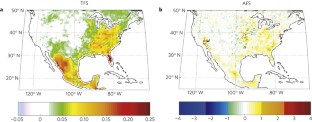
Moisture and heat fluxes from the land surface to the atmosphere form a critical nexus between surface hydrology and atmospheric processes, particularly those relevant to precipitation. Although current theory suggests that soil moisture generally has a positive impact on subsequent precipitation, individual studies have shown support both for1,2,3,4 and against5,6,7 this positive feedback. Broad assessment of the coupling between soil moisture and evapotranspiration, and evapotranspiration and precipitation, has been limited by a lack of large-scale observations. Quantification of the influence of evapotranspiration on precipitation remains particularly uncertain. Here, we develop and apply physically based, objective metrics for quantifying the impacts of surface evaporative and sensible heat fluxes on the frequency and intensity of convective rainfall during summer, using North American reanalysis data. We show that high evaporation enhances the probability of afternoon rainfall east of the Mississippi and in Mexico. Indeed, variations in surface fluxes lead to changes in afternoon rainfall probability of between 10 and 25% in these regions. The intensity of rainfall, by contrast, is largely insensitive to surface fluxes. We suggest that local surface fluxes represent an important trigger for convective rainfall in the eastern United States and Mexico during the summer, leading to a positive evaporation–precipitation feedback.
This is a preview of subscription content, access via your institution
Access options
Subscribe to this journal
Receive 12 print issues and online access
$259.00 per year
only $21.58 per issue
Buy this article
- Purchase on SpringerLink
- Instant access to the full article PDF.
USD 39.95
Prices may be subject to local taxes which are calculated during checkout
Additional access options:
Figure 1: The sensitivity of convective triggering and rainfall depth to evaporative fraction.
The alternative text for this image may have been generated using AI.
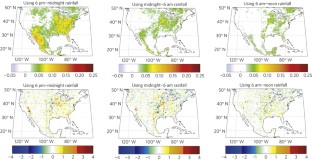
Figure 2: The sensitivity of TFS and AFS to rainfall time period.
The alternative text for this image may have been generated using AI.
Figure 3: Normalized, non-dimensional versions of sensitivity maps.

The alternative text for this image may have been generated using AI.
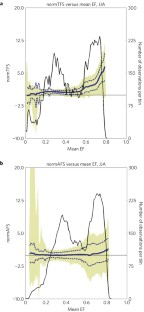
Figure 4: Functional relationships between normalized metrics and mean evaporative fraction.
The alternative text for this image may have been generated using AI.
References
- Koster, R. D., Suarez, M. J., Higgins, R. W. & Van den Dool, H. M. Observational evidence that soil moisture variations affect precipitation. Geophys. Res. Lett. 30, 1241 (2003).
Article Google Scholar - Findell, K. L. & Eltahir, E. A. B. An analysis of the soil moisture-rainfall feedback, based on direct observations from Illinois. Water Resour. Res. 33, 725–735 (1997).
Article Google Scholar - D’Odorico, P. & Porporato, A. Preferential states in soil moisture and climate dynamics. Proc. Natl Acad. Sci. USA 101, 8848–8851 (2004).
Article Google Scholar - Clark, D. B., Taylor, C. M. & Thorpe, A. J. Feedback between the land surface and rainfall at convective length scales. J. Hydrometeorol. 5, 625–639 (2004).
Article Google Scholar - Georgakakos, K. P., Bae, D-H. & Cayan, D. R. Hydroclimatology of continental watersheds, 1. Temporal analysis. Water Resour. Res. 31, 655–675 (1995).
Article Google Scholar - Cook, B. I., Bonan, G. B. & Levis, S. Soil moisture feedbacks to precipitation in southern Africa. J. Clim. 19, 4198–4206 (2006).
Article Google Scholar - Giorgi, F., Mearns, L. O., Shields, C. & Mayer, L. A regional model study of the importance of local versus remote controls of the 1988 drought and the 1993 flood over the central United States. J. Clim. 9, 1150–1162 (1996).
Article Google Scholar - Guo, Z. et al. GLACE: The global land–atmosphere coupling experiment. Part II: Analysis. J. Hydrometeorol. 7, 611–625 (2006).
Article Google Scholar - Mahanama, S. P. P. & Koster, R. D. AGCM biases in evaporation regime: Impacts on soil moisture memory and land–atmosphere feedback. J. Hydrometeorol. 6, 656–669 (2005).
Article Google Scholar - Hohenegger, C., Brockhaus, P., Bretherton, C. S. & Schär, C. The soil moisture-precipitation feedback in simulations with explicit and parameterized convection. J. Clim. 22, 5003–5020 (2009).
Article Google Scholar - Koster, R. D. & Suarez, M. J. Impact of land surface initialization on seasonal precipitation and temperature prediction. J. Hydrometeorol. 4, 408–423 (2003).
Article Google Scholar - Mesinger, F. et al. North American regional reanalysis. Bull. Am. Meteorol. Soc. 87, 343–360 (2006).
Article Google Scholar - Seneviratne, S. I. et al. Investigating soil moisture–climate interactions in a changing climate: A review. Earth Sci. Rev. 99, 125–161 (2010).
Article Google Scholar - Mahfouf, J-F. Analysis of soil moisture from near-surface parameters—a feasibility study. J. Appl. Meteorol. 30, 1534–1547 (1991).
Article Google Scholar - Findell, K. L. & Eltahir, E. A. B. Atmospheric controls on soil moisture-boundary layer interactions: Part I: Framework development. J. Hydrometeorol. 4, 552–569 (2003).
Article Google Scholar - Betts, A. K. Land–surface–atmosphere coupling in observations and models. J. Adv. Model. Earth Syst. 1, 4 (2009).
Article Google Scholar - Alfieri, L., Claps, P., D’Odorico, P., Laio, F. & Over, T. M. An analysis of the soil moisture feedback on convective and stratiform precipitation. J. Hydrometeorol. 9, 280–291 (2008).
Article Google Scholar - Von Storch, H. & Zwiers, F. W. Statistical Analysis in Climate Research (Cambridge Univ. Press, 1999).
Book Google Scholar - Findell, K. L. & Eltahir, E. A. B. Atmospheric controls on soil moisture-boundary layer interactions: Part II: Feedbacks within the continental United States. J. Hydrometeorol. 4, 570–583 (2003).
Article Google Scholar - Zhang, Y. & Klein, S. A. Mechanisms affecting the transition from shallow to deep convection over land: Inferences from observations of the diurnal cycle collected at the ARM Southern Great Plains site. J. Atmos. Sci. 67, 2943–2959 (2010).
Article Google Scholar - Romps, D. M. & Kuang, Z. Nature versus Nurture in Shallow Convection. J. Atmos. Sci. 67, 1655–1666 (2010).
Article Google Scholar - Schär, C., Lüthi, D., Beyerle, U. & Heise, E. The soil-preciptation feedback: A process study with a regional climate model. J. Clim. 12, 722–741 (1999).
Article Google Scholar - Koster, R. et al. Regions of strong coupling between soil moisture and precipitation. Science 305, 1138–1140 (2004).
Article Google Scholar - Lintner, B. R. & Neelin, J. D. Soil moisture impacts on convective margins. J. Hydrometeorol. 10, 1026–1039 (2009).
Article Google Scholar - R, Koster et al. GLACE: The global land–atmosphere coupling experiment. Part I: Overview. J. Hydrometeorol. 7, 590–610 (2006).
Article Google Scholar - De Ridder, K. Land surface processes and the potential for convective precipitation. J. Geophys. Res. 102, 30085–30090 (1997).
Article Google Scholar - Lin, J. W. B. & Neelin, J. D. Toward stochastic deep convective parameterization in general circulation models. Geophys. Res. Lett. 30, 1162 (2003).
Google Scholar - Milly, P. C. D. et al. Stationarity is dead: Whither water management? Science 319, 573–574 (2007).
Article Google Scholar - Seneviratne, S. I., Lüthi, D., Litschi, M. & Schär, C. Land–atmosphere coupling and climate change in Europe. Nature 443, 205–209 (2006).
Article Google Scholar - Cragoa, R. & Brutsaert., W. Daytime evaporation and the self-preservation of the evaporative fraction and the Bowen ratio. J. Hydrolol. 178, 241–255 (1996).
Article Google Scholar
Acknowledgements
We thank R. Stouffer, S. Malyshev, F. D’Andrea, S. Seneviratne and A. Berg for providing comments on the manuscript. We thank A. Wittenberg for help with the determination of ENSO years. P.G. and B.R.L. are supported by an NSF grant and B.R.L. is also supported by a NOAA grant and an NJAES Hatch grant. National Centers for Environmental Prediction (NCEP) North American Regional Reanalysis (NARR) data provided by the National Climatic Data Center from their website: http://nomads.ncdc.noaa.gov/data.php.
Author information
Author notes
- Pierre Gentine and Benjamin R. Lintner: These authors contributed equally to this work
Authors and Affiliations
- Geophysical Fluid Dynamics Laboratory, 201 Forrestal Road, Princeton, New Jersey 08540, USA
Kirsten L. Findell - Department of Applied Physics and Applied Mathematics, Columbia University, 203 SW Mudd, 500 120th Street, New York, New York 10027, USA
Pierre Gentine - Department of Environmental Sciences, Rutgers, The State University of New Jersey, 14 College Farm Road, New Brunswick, New Jersey 08901, USA
Benjamin R. Lintner - University Corporation for Atmospheric Research/GFDL, 201 Forrestal Road, Princeton, New Jersey 08540, USA
Christopher Kerr
Authors
- Kirsten L. Findell
- Pierre Gentine
- Benjamin R. Lintner
- Christopher Kerr
Contributions
K.L.F. performed the analysis of the data and wrote the paper. K.L.F., P.G. and B.R.L. jointly designed and refined the study. P.G. and B.R.L. contributed equally to the work. C.K. converted the original data to netCDF format. All authors discussed the results and commented on the manuscript.
Corresponding author
Correspondence toKirsten L. Findell.
Ethics declarations
Competing interests
The authors declare no competing financial interests.
Supplementary information
Rights and permissions
About this article
Cite this article
Findell, K., Gentine, P., Lintner, B. et al. Probability of afternoon precipitation in eastern United States and Mexico enhanced by high evaporation.Nature Geosci 4, 434–439 (2011). https://doi.org/10.1038/ngeo1174
- Received: 08 October 2010
- Accepted: 05 May 2011
- Published: 05 June 2011
- Issue date: July 2011
- DOI: https://doi.org/10.1038/ngeo1174