China's carbon conundrum (original) (raw)
- Commentary
- Published: 27 June 2013
Nature Geoscience volume 6, pages 507–509 (2013) Cite this article
- 1786 Accesses
- 34 Citations
- 10 Altmetric
- Metrics details
Subjects
China's carbon dioxide emissions are rising fast. Yet, per capita, gross domestic product and energy use are only a fraction of their United States equivalents. With a growing urban middle class, the trend will continue, but there is progress on the path to a low-carbon economy.
This is a preview of subscription content, access via your institution
Access options
Subscribe to this journal
Receive 12 print issues and online access
$259.00 per year
only $21.58 per issue
Buy this article
- Purchase on SpringerLink
- Instant access to the full article PDF.
USD 39.95
Prices may be subject to local taxes which are calculated during checkout
Additional access options:
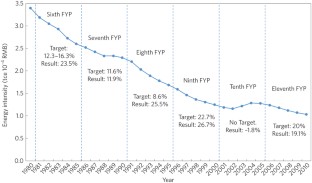
Figure 1: Long-term trend of energy intensity, showing energy-saving targets and results for each Five-Year Plan (FYP) period.
The alternative text for this image may have been generated using AI.
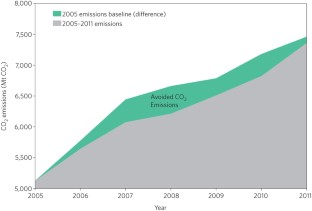
Figure 2: Effectiveness of low-carbon development policies.
The alternative text for this image may have been generated using AI.
References
- International Monetary Fund. World Economic Outlook Database 2013; http://go.nature.com/hjQecG
- Qi, Y. Annual Review of Low-Carbon Development in China (Tsinghua University, Beijing, China, 2013).
- Lin, J. Y. Demystifying the Chinese Economy (Cambridge Univ. Press, 2011).
Book Google Scholar - Kanbur, R. & Zhang, X. Rev. Dev. Econ. 9, 87–106 (2005).
Article Google Scholar - World Bank. World Development Indicators 2013; http://go.nature.com/5vSCSr
- Peng, X. Science 333, 581–587 (2011).
Article Google Scholar - U. S. Energy Information Administration 2013; http://www.eia.gov/
- Levine, M., Fridley, D., Lu, H. & Fino-Chen, C. Key China Energy Statistics 2012 (Lawrence Berkeley National Laboratory, 2012).
- State Council of Chinese Government 2009; http://go.nature.com/4g8Hy2
- McCrone, A., Usher, E., Sonntag-O'Brien, V., Moslener, U. & Grüning, C. Global Trends in Renewable Energy Investment 2012. (UNEP, 2012); http://go.nature.com/9c6nrT
- McElroy, M. B., Lu, X., Nielsen, C. P. & Wang, Y. Science 325, 1378–1380 (2009).
Article Google Scholar - Scott, V., Gilfillan, S., Markusson, N., Chalmers, H. & Haszeldine, R. S. Nature Clim. Change 3, 105–111 (2013).
Article Google Scholar - Piao, S. et al. Nature 458, 1009–1014 (2009).
Article Google Scholar - Food and Agriculture Organization of the UN. Global Forest Resources Assessment 2010 (United Nations, 2010); http://go.nature.com/5HR7x8
- Shen, B. et al. Wiley Interdiscip. Rev. Energy Environ. 2, 178–198 (2013).
Article Google Scholar
Author information
Authors and Affiliations
- Ye Qi and Tong Wu are at the Climate Policy Institute and School of Public Policy and Management, Tsinghua University, Beijing 100084, China,
Ye Qi & Tong Wu - Jiankun He is at the Institute for Low-Carbon Economy Research, Tsinghua University, Beijing 100084, China and the China National Advisory Council on Climate Change, Beijing 100084, China,
Jiankun He - David A. King is at the Department of Chemistry, University of Cambridge, Lensfield Road, Cambridge CB2 1EW, UK,
David A. King
Authors
- Ye Qi
- Tong Wu
- Jiankun He
- David A. King
Corresponding author
Correspondence toTong Wu.
Rights and permissions
About this article
Cite this article
Qi, Y., Wu, T., He, J. et al. China's carbon conundrum.Nature Geosci 6, 507–509 (2013). https://doi.org/10.1038/ngeo1870
- Published: 27 June 2013
- Issue date: July 2013
- DOI: https://doi.org/10.1038/ngeo1870
This article is cited by
Challenges and opportunities for carbon neutrality in China
- Zhu Liu
- Zhu Deng
- Xi Liang
Nature Reviews Earth & Environment (2021)
China’s CO2 peak before 2030 implied from characteristics and growth of cities
- Haikun Wang
- Xi Lu
- Michael B. McElroy
Nature Sustainability (2019)
China's post-coal growth
- Ye Qi
- Nicholas Stern
- Fergus Green
Nature Geoscience (2016)