Rising river flows throughout the twenty-first century in two Himalayan glacierized watersheds (original) (raw)
- Letter
- Published: 04 August 2013
- F. Pellicciotti2 &
- M. F. P. Bierkens1,3
Nature Geoscience volume 6, pages 742–745 (2013) Cite this article
- 6428 Accesses
- 494 Citations
- 54 Altmetric
- Metrics details
Subjects
Abstract
Greater Himalayan glaciers are retreating and losing mass at rates comparable to glaciers in other regions of the world1,2,3,4,5. Assessments of future changes and their associated hydrological impacts are scarce, oversimplify glacier dynamics or include a limited number of climate models6,7,8,9. Here, we use results from the latest ensemble of climate models in combination with a high-resolution glacio-hydrological model to assess the hydrological impact of climate change on two climatically contrasting watersheds in the Greater Himalaya, the Baltoro and Langtang watersheds that drain into the Indus and Ganges rivers, respectively. We show that the largest uncertainty in future runoff is a result of variations in projected precipitation between climate models. In both watersheds, strong, but highly variable, increases in future runoff are projected and, despite the different characteristics of the watersheds, their responses are surprisingly similar. In both cases, glaciers will recede but net glacier melt runoff is on a rising limb at least until 2050. In combination with a positive change in precipitation, water availability during this century is not likely to decline. We conclude that river basins that depend on monsoon rains and glacier melt will continue to sustain the increasing water demands expected in these areas10.
This is a preview of subscription content, access via your institution
Access options
Subscribe to this journal
Receive 12 print issues and online access
$259.00 per year
only $21.58 per issue
Buy this article
- Purchase on SpringerLink
- Instant access to the full article PDF.
USD 39.95
Prices may be subject to local taxes which are calculated during checkout
Additional access options:
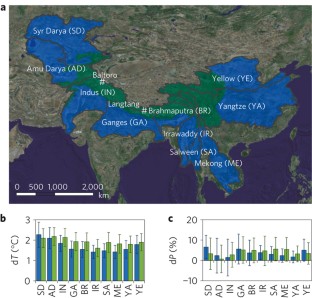
Figure 1: Overview of main Asian river basins and their projected changes in precipitation and temperature.
The alternative text for this image may have been generated using AI.
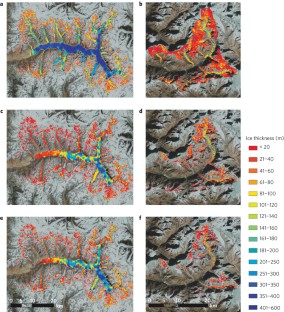
Figure 2: Present-day and future ice thickness for the Baltoro and Langtang watersheds.
The alternative text for this image may have been generated using AI.
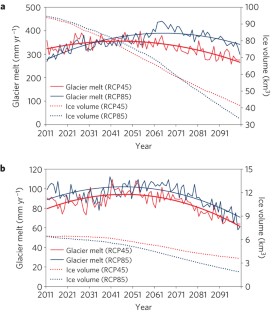
Figure 3: Future melt and ice volumes.
The alternative text for this image may have been generated using AI.
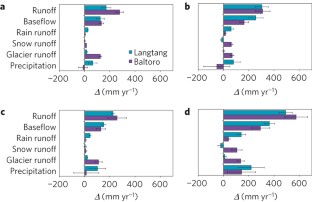
Figure 4: Projected future changes in water balance components for the Baltoro and Langtang watersheds.
The alternative text for this image may have been generated using AI.
References
- Kääb, A., Berthier, E., Nuth, C., Gardelle, J. & Arnaud, Y. Contrasting patterns of early twenty-first-century glacier mass change in the Himalayas. Nature 488, 495–498 (2012).
Article Google Scholar - Bolch, T. et al. The state and fate of Himalayan Glaciers. Science 336, 310–314 (2012).
Article Google Scholar - Gardelle, J., Berthier, E. & Arnaud, Y. Slight mass gain of Karakoram glaciers in the early twenty-first century. Nature Geosci. 5, 322–325 (2012).
Article Google Scholar - Scherler, D., Bookhagen, B. & Strecker, M. R. Spatially variable response of Himalayan glaciers to climate change affected by debris cover. Nature Geosci. 4, 156–159 (2011).
Article Google Scholar - Cogley, J. G. Present and future states of Himalaya and Karakoram glaciers. Ann. Glaciol. 52, 69–73 (2011).
Article Google Scholar - Immerzeel, W. W., Van Beek, L. P. H. & Bierkens, M. F. P. Climate change will affect the Asian water towers. Science 328, 1382–1385 (2010).
Article Google Scholar - Rees, H. G. & Collins, D. N. Regional differences in response of flow in glacier-fed Himalayan rivers to climatic warming. Hydrol. Process. 20, 2157–2169 (2006).
Article Google Scholar - Singh, P. & Kumar, N. Impact assessment of climate change on the hydrological response of a snow and glacier melt runoff dominated Himalayan river. J. Hydrol. 193, 316–350 (1997).
Article Google Scholar - Singh, P. & Bengtsson, L. Hydrological sensitivity of a large Himalayan basin to climate change. Hydrol. Process. 18, 2363–2385 (2004).
Article Google Scholar - Immerzeel, W. W. & Bierkens, M. F. P. Asia’s water balance. Nature Geosci. 5, 841–842 (2012).
Article Google Scholar - Bookhagen, B. Himalayan groundwater. Nature Geosci. 5, 97–98 (2012).
Article Google Scholar - Turner, A. G. & Annamalai, H. Climate change and the South Asian summer monsoon. Nature Clim. Change 2, 587–595 (2012).
Article Google Scholar - Bradley, R. S., Vuille, M., Diaz, H. F. & Vergara, W. Threats to water supplies in the tropical Andes. Science 312, 1755–1756 (2006).
Article Google Scholar - Shrestha, A. B., Wake, C. P., Mayewski, P. A. & Dibb, J. E. Maximum temperature trends in the himalaya and its vicinity: an analysis based on temperature records from nepal for the period 1971–94. J. Clim. 2775–2786 (1999).
- Immerzeel, W. W. Historical trends and future predictions of climate variability in the Brahmaputra basin. Int. J. Climatol. 28, 243–254 (2008).
Article Google Scholar - Meinshausen, M. et al. The RCP greenhouse gas concentrations and their extensions from 1765 to 2300. Climatic Change 213–241 (2011).
Article Google Scholar - Immerzeel, W. W., Beek, L. P. H., Konz, M., Shrestha, a. B. & Bierkens, M. F. P. Hydrological response to climate change in a glacierized catchment in the Himalayas. Climatic Change 110, 721–736 (2012).
Article Google Scholar - Radić, V. & Hock, R. Modeling future glacier mass balance and volume changes using ERA-40 reanalysis and climate models: A sensitivity study at Storglaciären, Sweden. J. Geophys. Res. 111, F03003 (2006).
Article Google Scholar - Hewitt, K. The Karakoram anomaly? Glacier expansion and the elevation effect, Karakoram Himalaya. Mount. Res. Dev. 25, 332–340 (2005).
Article Google Scholar - Uhlmann, B., Jordan, F. & Beniston, M. Modelling runoff in a Swiss glacierized catchment-Part II: Daily discharge and glacier evolution in the Findelen basin in a progressively warmer climate. Int. J. Climatol. 33, 1301–1307 (2012).
Article Google Scholar - Stahl, K., Moore, R. D., Shea, J. M., Hutchinson, D. & Cannon, A. J. Coupled modelling of glacier and streamflow response to future climate scenarios. Wat. Resour. Res. 44, W02422 (2008).
Article Google Scholar - Radić, V. & Hock, R. Regionally differentiated contribution of mountain glaciers and ice caps to future sea-level rise. Nature Geosci. 4, 91–94 (2011).
Article Google Scholar - Winiger, M., Gumpert, M. & Yamout, H. Karakorum-Hindukush-western Himalaya: Assessing high-altitude water resources. Hydrol. Process. 19, 2329–2338 (2005).
Article Google Scholar - Immerzeel, W. W., Pellicciotti, F. & Shrestha, A. B. Glaciers as a proxy to quantify the spatial distribution of precipitation in the Hunza basin. Mount. Res. Dev. 32, 30–38 (2012).
Article Google Scholar - Weertman, J. On the sliding of glaciers. J. Glaciol. 3, 33–38 (1957).
Article Google Scholar - Themeßl, M. J., Gobiet, A. & Heinrich, G. Empirical-statistical downscaling and error correction of regional climate models and its impact on the climate change signal. Climatic Change 112, 449–468 (2011).
Article Google Scholar
Acknowledgements
This work is part of the research programme VENI, which is (partly) financed by the Netherlands Organization for Scientific Research. We acknowledge the World Climate Research Program’s Working Group on Coupled Modeling, which is responsible for CMIP, and we thank the climate modelling groups for producing and making available their model output. For CMIP the US Department of Energy’s Program for Climate Model Diagnosis and Intercomparison provides coordinating support and led development of software infrastructure in partnership with the Global Organization for Earth System Science Portals. We thank D. Quincey for providing data on the velocity field of the Baltoro Glacier for validation. We thank ICIMOD, EV-K2-CNR and the Department of Hydrology and Meteorology of Nepal for making the hydro-meteorological data available.
Author information
Authors and Affiliations
- Department of Physical Geography, Utrecht University, PO Box 80115, Utrecht, The Netherlands
W. W. Immerzeel & M. F. P. Bierkens - ETH Zurich, Institute of Environmental Engineering, Hydrology and Water Resources Management, Wolfgang-Pauli-Str. 15, 8093 Zurich, Switzerland
W. W. Immerzeel & F. Pellicciotti - Deltares, PO Box 85467, 3508 AL Utrecht, The Netherlands
M. F. P. Bierkens
Authors
- W. W. Immerzeel
- F. Pellicciotti
- M. F. P. Bierkens
Contributions
All authors contributed significantly to this work. W.W.I. conceived the study, designed and implemented the glacio-hydrological model, conducted the analysis and prepared the manuscript. F.P. contributed to glacio-hydrological model and the writing. M.F.P.B. conceived the study together with W.W.I. and contributed to the writing.
Corresponding author
Correspondence toW. W. Immerzeel.
Ethics declarations
Competing interests
The authors declare no competing financial interests.
Supplementary information
Rights and permissions
About this article
Cite this article
Immerzeel, W., Pellicciotti, F. & Bierkens, M. Rising river flows throughout the twenty-first century in two Himalayan glacierized watersheds.Nature Geosci 6, 742–745 (2013). https://doi.org/10.1038/ngeo1896
- Received: 01 March 2013
- Accepted: 25 June 2013
- Published: 04 August 2013
- Issue date: September 2013
- DOI: https://doi.org/10.1038/ngeo1896