Delamination and recycling of Archaean crust caused by gravitational instabilities (original) (raw)
- Letter
- Published: 01 December 2013
Nature Geoscience volume 7, pages 47–52 (2014) Cite this article
- 8728 Accesses
- 415 Citations
- 130 Altmetric
- Metrics details
Subjects
Abstract
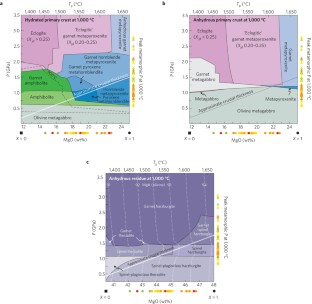
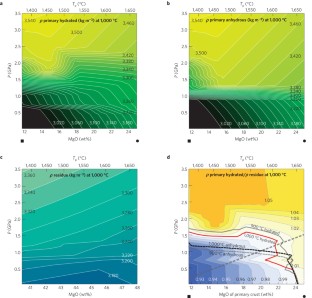
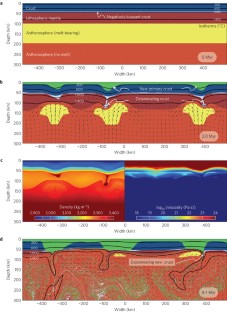
Mantle temperatures during the Archaean eon were higher than today. As a consequence, the primary crust formed at the time is thought to have been extensive, thick and magnesium rich, and underlain by a highly residual mantle1. However, the preserved volume of this crust today is low, implying that much of it was recycled back into the mantle2. Furthermore, Archaean crust exposed today is composed mostly of tonalite–trondhjemite–granodiorite, indicative of a hydrated, low-magnesium basalt source3, suggesting that they were not directly generated from a magnesium-rich primary crust. Here we present thermodynamic calculations that indicate that the stable mineral assemblages expected to form at the base of a 45-km-thick, fully hydrated and anhydrous magnesium-rich crust are denser than the underlying, complementary residual mantle. We use two-dimensional geodynamic models to show that the base of magmatically over-thickened magnesium-rich crust, whether fully hydrated or anhydrous, would have been gravitationally unstable at mantle temperatures greater than 1,500–1,550 °C. The dense crust would drip down into the mantle, generating a return flow of asthenospheric mantle that melts to create more primary crust. Continued melting of over-thickened and dripping magnesium-rich crust, combined with fractionation of primary magmas, may have produced the hydrated magnesium-poor basalts necessary to source tonalite–trondhjemite–granodiorite melts. The residues of these processes, with an ultramafic composition, must now reside in the mantle.
This is a preview of subscription content, access via your institution
Access options
Subscribe to this journal
Receive 12 print issues and online access
$259.00 per year
only $21.58 per issue
Buy this article
- Purchase on SpringerLink
- Instant access to the full article PDF.
USD 39.95
Prices may be subject to local taxes which are calculated during checkout
Additional access options:
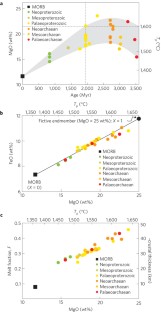
Figure 1: Calculated primary melt compositions for Precambrian non-arc basalts.
The alternative text for this image may have been generated using AI.
Figure 2: Results of thermodynamic modelling of primary crust and complementary residues at 1,000 °C.
The alternative text for this image may have been generated using AI.
Figure 3: Density (ρ) of primary crust and complementary residues.
The alternative text for this image may have been generated using AI.
Figure 4: Results of geodynamic modelling; snapshots from an experiment with 45-km-thick initial primary crust and _T_p of 1,600 °C.
The alternative text for this image may have been generated using AI.
References
- Herzberg, C., Condie, K. & Korenaga, J. Thermal history of the Earth and its petrological expression. Earth Planet. Sci. Lett. 292, 79–88 (2010).
Article Google Scholar - Herzberg, C. & Rudnick, R. Formation of cratonic lithosphere: An integrated thermal and petrological model. Lithos 149, 4–15 (2012).
Article Google Scholar - Foley, S., Tiepolo, M. & Vannucci, R. Growth of early continental crust controlled by melting of amphibolite in subduction zones. Nature 417, 837–840 (2002).
Article Google Scholar - Herzberg, C. et al. Temperatures in ambient mantle and plumes: Constraints from basalts, picrites and komatiites. Geochem. Geophys. Geosyst. 8, Q02006 (2007).
Article Google Scholar - Goodwin, A. Precambrian Geology: The Dynamic Evolution of the Continental Crust (Academic, 1991).
Google Scholar - Dhuime, B., Hawkesworth, C. J., Cawood, P. A. & Storey, C. D. A change in the geodynamics of continental growth 3 billion years ago. Science 335, 1334–1336 (2012).
Article Google Scholar - Davies, G. F. Effect of plate bending on the Urey ratio and the thermal evolution of the mantle. Earth Planet. Sci. Lett. 287, 513–518 (2009).
Article Google Scholar - Van Hunen, J. & Moyen, J-F. Archean subduction: Fact or fiction? Annu. Rev. Earth Planet. Sci. 40, 195–219 (2012).
Article Google Scholar - Arndt, N. T. & Lesher, C. M. in Komatiites (eds Selley, R. C., Cocks, L. R. M. & Plimer, I. R.) 260–267 (Encyclopedia of Geol., Vol. 3, Elsevier, 2005).
Google Scholar - Brown, M. Metamorphic conditions in orogenic belts: A record of secular change. Int. Geol. Rev. 49, 193–234 (2007).
Article Google Scholar - Sizova, E., Gerya, T., Brown, M. & Perchuk, L. Subduction styles in the Precambrian: Insight from numerical experiments. Lithos 116, 209–229 (2010).
Article Google Scholar - Mareschal, J-C. & Jaupart, C. 61–73 (Geophys. Monogr. Ser., Vol. 164, AGU, 2006).
- Niida, K. & Green, D. H. Stability and chemical composition of pargasitic amphibole in MORB pyrolite under upper mantle conditions. Contrib. Mineral. Petrol. 135, 18–40 (1999).
Article Google Scholar - Foley, S. F., Buhre, S. & Jacob, D. E. Evolution of the Archaean crust by delamination and shallow subduction. Nature 421, 249–252 (2003).
Article Google Scholar - Rushmer, T. Partial melting of two amphibolites: Contrasting experimental results under fluid-absent conditions. Contrib. Mineral. Petrol. 107, 41–59 (1991).
Article Google Scholar - Elkins-Tanton, L. T. Continental magmatism, volatile recycling, and a heterogeneous mantle caused by lithospheric gravitational instabilities. J. Geophys. Res. 112, B03405 (2007).
Article Google Scholar - Bedard, J. H. A catalytic delamination-driven model for coupled genesis of Archaean crust and sub-continental lithospheric mantle. Geochim. Cosmochim. Acta 70, 1188–1214 (2006).
Article Google Scholar - Jagoutz, O., Müntener, O., Schmidt, M. W. & Burg, J-P. The roles of flux- and decompression melting and their respective fractionation lines for continental crust formation: Evidence from the Kohistan arc. Earth Planet. Sci. Lett. 303, 25–36 (2011).
Article Google Scholar - Kerr, A. C., Tarney, J., Nivia, A., Marriner, G. F. & Saunders, A. D. The internal structure of oceanic plateaus: Inferences from obducted Cretaceous terranes in western Colombia and the Caribbean. Tectonophysics 292, 173–188 (1998).
Article Google Scholar - Fitton, J. G., Mahoney, J. J., Wallace, P. J. & Saunders, A. D. (eds) Origin and evolution of the ontong Java plateau. Geol. Soc. Spec. Publ. 229, 1–368 (2004).
- Kelemen, P. B., Koga, K. & Shimizu, N. Geochemistry of gabbro sills in the crust-mantle transition zone of the Oman ophiolite: Implications for the origin of the oceanic lower crust. Earth Planet. Sci. Lett. 146, 475–488 (1997).
Article Google Scholar - Gonzaga, R. et al. Eclogites and garnet pyroxenites: Similarities and differences. J. Volcanol. Geotherm. Res. 190, 235–247 (2010).
Article Google Scholar - Jacob, D. Nature and origin of eclogite xenoliths from kimberlites. Lithos 77, 295–316 (2004).
Article Google Scholar - Barth, M. G. et al. Geochemistry of xenolithic eclogites from West Africa, part 2: Origins of the high MgO eclogites. Geochim. Cosmochim. Acta 66, 4325–4345 (2002).
Article Google Scholar - Moyen, J-F. The composite Archaean grey gneisses: Petrological significance, and evidence for a non-unique tectonic setting for Archaean crustal growth. Lithos 123, 21–36 (2011).
Article Google Scholar - Connolly, J. A. D. Computation of phase equilibria by linear programming: A tool for geodynamic modeling and its application to subduction zone decarbonation. Earth Planet. Sci. Lett. 236, 524–541 (2005).
Article Google Scholar - Holland, T. J. B. & Powell, R. An internally consistent thermodynamic data set for phases of petrological interest. J. Metamorph. Geol. 16, 309–343 (1998).
Article Google Scholar - Diener, J. F. A. & Powell, R. Revised activity-composition relations for clinopyroxene and amphibole. J. Metamorph. Geol. 30, 131–142 (2012).
Article Google Scholar - Thielmann, M. & Kaus, B. Shear heating induced lithospheric-scale localization: Does it result in subduction? Earth Planet. Sci. Lett. 359-360, 1–13 (2012).
Article Google Scholar - Kaus, B. Factors that control the angle of shear bands in geodynamic numerical models of brittle deformation. Tectonophysics 484, 36–47 (2010).
Article Google Scholar
Acknowledgements
We thank S. Aulbach, J. Connolly, G. Davies, S. Fischer, S. F. Foley, E. C. R. Green, C. Herzberg, D. E. Jacob and R. W. White for comments. M.B. and T.E.J. acknowledge financial support from the Geocycles Earth Systems Research Centre, University of Mainz. B.J.P.K. was financially supported by ERC Starting Grant 258830.
Author information
Authors and Affiliations
- Institute for Geoscience, University of Mainz, Mainz 55099, Germany
Tim E. Johnson & Boris J. P. Kaus - Department of Geology, University of Maryland, College Park, Maryland 20742, USA
Michael Brown - Department of Earth Sciences, University of Southern California, Los Angeles, California 90089-0740, USA
Boris J. P. Kaus - Department of Geology & Geophysics, Yale University, New Haven, Connecticut 06511, USA
Jill A. VanTongeren
Authors
- Tim E. Johnson
- Michael Brown
- Boris J. P. Kaus
- Jill A. VanTongeren
Contributions
M.B. and T.E.J. developed the project; T.E.J. calculated the phase diagrams and B.J.P.K. developed and ran the numerical models. All authors discussed the results and were involved in writing the paper.
Corresponding author
Correspondence toTim E. Johnson.
Ethics declarations
Competing interests
The authors declare no competing financial interests.
Supplementary information
Rights and permissions
About this article
Cite this article
Johnson, T., Brown, M., Kaus, B. et al. Delamination and recycling of Archaean crust caused by gravitational instabilities.Nature Geosci 7, 47–52 (2014). https://doi.org/10.1038/ngeo2019
- Received: 20 March 2013
- Accepted: 29 October 2013
- Published: 01 December 2013
- Issue date: January 2014
- DOI: https://doi.org/10.1038/ngeo2019
This article is cited by
The reproduction process of Gram-positive protocells
- Dheeraj Kanaparthi
- Marko Lampe
- Tillmann Lueders
Scientific Reports (2024)
Diverse volcanism and crustal recycling on early Mars
- Joseph R. Michalski
- A. Deanne Rogers
- Long Xiao
Nature Astronomy (2024)
Archaean continental crust formed from mafic cumulates
- Matthijs A. Smit
- Kira A. Musiyachenko
- Jeroen Goumans
Nature Communications (2024)
The importance of continents, oceans and plate tectonics for the evolution of complex life: implications for finding extraterrestrial civilizations
- Robert J. Stern
- Taras V. Gerya
Scientific Reports (2024)
Volcanic and Tectonic Constraints on the Evolution of Venus
- Richard C. Ghail
- Suzanne E. Smrekar
- J. Gregory Shellnutt
Space Science Reviews (2024)
Associated content
Archaean drips
- Claude Herzberg
Nature Geoscience News & Views 01 Dec 2013