Earth’s earliest evolved crust generated in an Iceland-like setting (original) (raw)
- Letter
- Published: 25 May 2014
Nature Geoscience volume 7, pages 529–533 (2014) Cite this article
- 7499 Accesses
- 245 Citations
- 97 Altmetric
- Metrics details
Subjects
Abstract
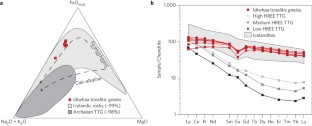
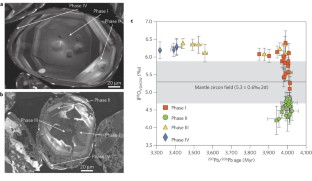
It is unclear how the earliest continental crust formed on an Earth that was probably originally surfaced with oceanic crust. Continental crust may have first formed in an ocean island-like setting, where upwelling mantle generates magmas that crystallize to form new crust. Of the oceanic plateaux, Iceland is closest in character to continental crust, because its crust is anomalously thick1 and contains a relatively high proportion of silica-rich (sialic) rocks2. Iceland has therefore been considered a suitable analogue for the generation of Earth’s earliest continental crust3. However, the geochemical signature of sialic rocks from Iceland4,5,6,7 is distinct from the typical 3.9- to 2.5-billion-year-old Archaean rocks discovered so far8. Here we report the discovery of an exceptionally well-preserved, 4.02-billion-year-old tonalitic gneiss rock unit within the Acasta Gneiss Complex in Canada. We use geochemical analyses to show that this rock unit is characterized by iron enrichment, negative Europium anomalies, unfractionated rare-earth-element patterns, and magmatic zircons with low oxygen isotope ratios. These geochemical characteristics are unlike typical Archaean igneous rocks, but are strikingly similar to those of the sialic rocks from Iceland and imply that this ancient rock unit was formed by shallow-level magmatic processes that include assimilation of rocks previously altered by surface waters. Our data provide direct evidence that Earth’s earliest continental crust formed in a tectonic setting comparable to modern Iceland.
This is a preview of subscription content, access via your institution
Access options
Subscribe to this journal
Receive 12 print issues and online access
$259.00 per year
only $21.58 per issue
Buy this article
- Purchase on SpringerLink
- Instant access to the full article PDF.
USD 39.95
Prices may be subject to local taxes which are calculated during checkout
Additional access options:
Figure 1: Comparison of the whole-rock chemical compositions of the Idiwhaa tonalitic gneiss with Icelandic igneous rocks and Archaean TTGs.
The alternative text for this image may have been generated using AI.
Figure 2: Zircon phase relations and correlated zircon U–Pb and oxygen isotopic data from an Idiwhaa sample.
The alternative text for this image may have been generated using AI.
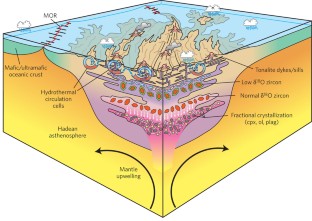
Figure 3: Schematic diagram illustrating the major processes responsible for the formation of the Idiwhaa tonalitic gneiss.
The alternative text for this image may have been generated using AI.
References
- Allen, R. M. et al. Plume-driven plumbing and crustal formation in Iceland. J. Geophys. Res. 107, 1–19 (2002).
Article Google Scholar - Jakobsson, S. P., Jonasson, K. & Sigurdsson, I. A. The three igneous rocks series of Iceland. Jokull 58, 117–138 (2008).
Google Scholar - Kroner, A. Evolution of the Archean continental crust. Ann. Rev. Earth Planet. Sci. 13, 49–74 (1982).
Article Google Scholar - Carmichael, I. S. E. The petrology of Thingmuli, a tertiary volcano in eastern Iceland. J. Petrol 5, 435–460 (1964).
Article Google Scholar - Muehlenbachs, K., Anderson, A. T. & Sigvaldason, G. E. Low-O18 basalts from Iceland. Geochim. Cosmochim. Acta 38, 577–588 (1974).
Article Google Scholar - Nicholson, H. et al. Geochemical and isotopic evidence for crustal assimilation beneath Krafla, Iceland. J. Petrol. 32, 1005–1020 (1991).
Article Google Scholar - Bindeman, I. N. et al. Silicic magma petrogenesis in Iceland by remelting of hydrothermally altered crust based on oxygen isotope diversity and disequilibria between zircon and magma with implications for MORB. Terra Nova 24, 227–232 (2012).
Article Google Scholar - Martin, E., Martin, H. & Sigmarsson, O. Could Iceland be a modern analogue for the Earth’s early continental crust? Terra Nova 20, 463–468 (2008).
Article Google Scholar - Harrison, T. M. The Hadean crust: Evidence from >4 Ga zircons. Annu. Rev. Earth Planet. Sci. 37, 479–505 (2009).
Article Google Scholar - Condie, K. The Distribution of Paleoarchean Crust. in Earth’s Oldest Rocks Vol. 15 (eds Van Kranendonk, R., Smithies, H. & Bennett, V. C.) 9–18 (Developments in Precambrian Geology, 15, 2007).
Chapter Google Scholar - Barker, F. & Arth, J. G. Generation of trondhjemitic-tonalitic liquids and Archean bimodal trondhjemite-basalt suites. Geology 4, 596–600 (1976).
Article Google Scholar - Moyen, J. F. The composite Archaean grey gneisses: Petrological significance, and evidence for a non-unique tectonic setting for Archaean crustal growth. Lithos 123, 21–36 (2011).
Article Google Scholar - Moyen, J. F. & Martin, H. Forty years of TTG research. Lithos 148, 312–336 (2012).
Article Google Scholar - Martin, H. Effect of steeper Archean geothermal gradient on geochemistry of subduction-zone magmas. Geology 14, 753–756 (1986).
Article Google Scholar - Rapp, R. P., Watson, E. B. & Miller, C. F. Partial melting of amphibolite/eclogite and the origin of Archean trondjhemites and tonalities. Precambr. Res. 51, 1–25 (1991).
Article Google Scholar - Nair, R. & Chacko, T. Role of oceanic plateaus in initiation of subduction and origin of continental crust. Geology 36, 583–586 (2008).
Article Google Scholar - Smithies, R. H., Champion, D. C. & Van Kranendonk, M. J. Formation of Paleoarchean continental crust through infracrustal melting of enriched basalt. Earth Plant. Sci. Lett. 281, 298–306 (2009).
Article Google Scholar - Zegers, T. E. & van Keken, P. E. Middle Archean continent formation by crustal delamination. Geology 29, 1083–1086 (2001).
Article Google Scholar - Bowring, S. A., Williams, I. S. & Compston, W. 3.96 Ga gneisses from the Slave province, Northwest Territories, Canada. Geology 17, 971–975 (1989).
Article Google Scholar - Stern, R. A. & Bleeker, W. Age of the world’s oldest rocks refined using Canada’s SHRIMP: The Acasta Gneiss Complex, Northwest Territories, Canada. Geosci. Can. 25, 27–31 (1998).
Google Scholar - Bowring, S. A. & Williams, I. S. Priscoan (4.00–4.03 Ga) orthogneisses from northwestern Canada. Contrib. Min. Petrol. 134, 3–16 (1999).
Article Google Scholar - Iizuka, T. et al. Geology and zircon geochronology of the Acasta Gneiss Complex, northwestern Canada: New constraints on its tectonothermal history. Precambr. Res. 153, 179–208 (2007).
Article Google Scholar - Iizuka, T. et al. 42 Ga zircon xenocryst in an Acasta gneiss from northwestern Canada: Evidence for early continental crust. Geology 34, 245–248 (2006).
Article Google Scholar - Grove, T. L. & Kinzler, R. J. Petrogenesis of Andesites. Ann. Rev. Earth Planet. Sci. Lett. 14, 417–454 (1986).
Article Google Scholar - Page, F. Z. et al. High-precision oxygen isotope analysis of picogram samples reveals 2 μm gradients and slow diffusion in zircon. Am. Mineral. 92, 1772–1775 (2007).
Article Google Scholar - Valley, J. W. et al. Zircon megacrysts from kimberlite: Oxygen isotope variability among mantle melts. Contrib. Min. Petrol. 133, 1–11 (1998).
Article Google Scholar - Taylor, H. P. & Sheppard, S. M. F. Igneous Rocks: I Processes of isotopic fractionation and isotope systematics. Rev. Min. Geochem. 16, 227–271 (1986).
Google Scholar - Bindeman, I. N. & Valley, J. W. Low-δ18O Rhyolites from Yellowstone: Magmatic evolution based on analyses of zircons and individual phenocrysts. J. Petrol. 42, 1491–1517 (2001).
Article Google Scholar - Trail, D., Watson, E. B. & Tailby, N. D. The oxidation state of Hadean magmas and the implications for the early Earth’s atmosphere. Nature 480, 79–83 (2011).
Article Google Scholar - Balsley, S. D. & Gregory, R. T. Low-18O silicic magmas: Why are they so rare? Earth Planet. Sci. Lett. 162, 123–136 (1998).
Article Google Scholar
Acknowledgements
We thank R. Ickert and A. Burnham for advice on zircon strain partition modelling; J. Davies for critical discussions throughout; J. Ketchum and the Northwest Territories Geoscience Office staff for scientific and field support; and E. Thiessen for mapping assistance. We thank T. Iizuka and T. Kemp for constructive and informative reviews. This research was funded by National Science and Engineering Research Council of Canada grants to T.C. and L.M.H. as well as a Circumpolar/Boreal Alberta Research grant for fieldwork to J.R.R.
Author information
Authors and Affiliations
- Department of Earth and Atmospheric Sciences, University of Alberta, Edmonton Alberta, T6G 2E3, Canada,
Jesse R. Reimink, Thomas Chacko, Richard A. Stern & Larry M. Heaman - Canadian Centre for Isotopic Microanalysis, University of Alberta, Edmonton Alberta, T6G 2E3, Canada,
Richard A. Stern
Authors
- Jesse R. Reimink
- Thomas Chacko
- Richard A. Stern
- Larry M. Heaman
Contributions
Mapping and sample collection was conducted by J.R.R. and T.C. Sample crushing, processing, and zircon separations were carried out by J.R.R. R.A.S. and J.R.R. carried out collection of zircon oxygen and U–Th–Pb isotopic data by SIMS. Chemical abrasion of zircon was carried out by J.R.R. and L.M.H. All authors contributed to discussion of results and their implications, as well as preparation of the manuscript.
Corresponding author
Correspondence toJesse R. Reimink.
Ethics declarations
Competing interests
The authors declare no competing financial interests.
Supplementary information
Rights and permissions
About this article
Cite this article
Reimink, J., Chacko, T., Stern, R. et al. Earth’s earliest evolved crust generated in an Iceland-like setting.Nature Geosci 7, 529–533 (2014). https://doi.org/10.1038/ngeo2170
- Received: 24 September 2013
- Accepted: 16 April 2014
- Published: 25 May 2014
- Issue date: July 2014
- DOI: https://doi.org/10.1038/ngeo2170