Model projections of rapid sea-level rise on the northeast coast of the United States (original) (raw)
- Letter
- Published: 15 March 2009
Nature Geoscience volume 2, pages 262–266 (2009) Cite this article
- 5028 Accesses
- 361 Citations
- 77 Altmetric
- Metrics details
Abstract
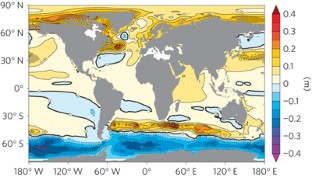
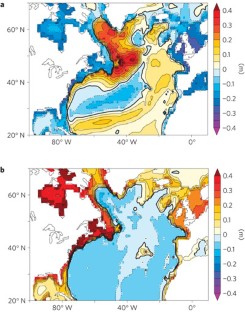
Human-induced climate change could cause global sea-level rise. Through the dynamic adjustment of the sea surface in response to a possible slowdown of the Atlantic meridional overturning circulation1,2, a warming climate could also affect regional sea levels, especially in the North Atlantic region3, leading to high vulnerability for low-lying Florida and western Europe4,5,6. Here we analyse climate projections from a set of state-of-the-art climate models for such regional changes, and find a rapid dynamical rise in sea level on the northeast coast of the United States during the twenty-first century. For New York City, the rise due to ocean circulation changes amounts to 15, 20 and 21 cm for scenarios with low, medium and high rates of emissions respectively, at a similar magnitude to expected global thermal expansion. Analysing one of the climate models in detail, we find that a dynamic, regional rise in sea level is induced by a weakening meridional overturning circulation in the Atlantic Ocean, and superimposed on the global mean sea-level rise. We conclude that together, future changes in sea level and ocean circulation will have a greater effect on the heavily populated northeastern United States than estimated previously7,8,9.
This is a preview of subscription content, access via your institution
Access options
Subscribe to this journal
Receive 12 print issues and online access
$259.00 per year
only $21.58 per issue
Buy this article
- Purchase on SpringerLink
- Instant access to the full article PDF.
USD 39.95
Prices may be subject to local taxes which are calculated during checkout
Additional access options:
Figure 1: Multi-model ensemble mean projection of the dynamic sea level.
The alternative text for this image may have been generated using AI.
Figure 2: Climate projections by the GFDL CM2.1.

The alternative text for this image may have been generated using AI.
Figure 3: Dynamic sea levels in the GFDL CM2.1.

The alternative text for this image may have been generated using AI.
Figure 4: Contributions of the steric effect and ocean mass redistribution to the dynamic SLR.
The alternative text for this image may have been generated using AI.
References
- Meehl, G. A. et al. in Climate Change 2007: The Physical Science Basis. Contribution of Working Group I to the Fourth Assessment Report of the Intergovernmental Panel on Climate Change (eds Solomon, S. et al.) 747–845 (Cambridge Univ. Press, 2007).
Google Scholar - Gregory, J. M. et al. A model intercomparison of changes in the Atlantic thermohaline circulation in response to increasing atmospheric CO2 concentration. Geophys. Res. Lett. 32, L12703 (2005).
Article Google Scholar - Levermann, A., Griesel, A., Hofmann, M., Montoya, M. & Rahmstorf, S. Dynamic sea level changes following changes in the thermohaline circulation. Clim. Dyn. 24, 347–354 (2005).
Article Google Scholar - Douglas, B. C., Kearney, M. S. & Leatherman, S. R. (eds) Sea Level Rise: History and Consequences (Academic, 2001).
- Stouffer, R. J. et al. Investigating the causes of the response of the thermohaline circulation to past and future climate changes. J. Clim. 19, 1365–1387 (2006).
Article Google Scholar - Vellinga, M. & Wood, R. A. Impacts of thermohaline circulation shutdown in the twenty-first century. Clim. Change 54, 251–267 (2002).
Article Google Scholar - Colle, B. A. et al. New York City’s vulnerability to coastal flooding. Bull. Am. Meteor. Soc. 89, 829–841 (2008).
Article Google Scholar - Gornitz, V., Couch, S. & Hartig, E. K. Impacts of sea level rise in the New York City metropolitan area. Glob. Planet. Change 32, 61–88 (2001).
Article Google Scholar - Jacob, K., Gornitz, V. & Rosenzweig, C. in Managing Coastal Vulnerability (eds McFadden, L., Nicholls, R. & Penning-Rowsell, E.) 139–156 (Elsevier, 2007).
Google Scholar - Knutti, R. & Stocker, T. F. Influence of the thermohaline circulation on projected sea level rise. J. Clim. 13, 1997–2001 (2000).
Article Google Scholar - Maximenko, N. A. & Niiler, P. P. in Recent Advances in Marine Science and Technology 2004 (ed. Saxena, N.) 55–59 (PACON International, 2005).
Google Scholar - Levermann, A. & Born, A. Bistability of the Atlantic subpolar gyre in a coarse resolution climate model. Geophys. Res. Lett. 34, L24605 (2007).
Article Google Scholar - Bryan, K. The steric component of sea level rise associated with enhanced greenhouse warming: A model study. Clim. Dyn. 12, 545–555 (1996).
Article Google Scholar - Landerer, F. W., Jungclaus, J. H. & Marotzke, J. Regional dynamic and steric sea level change in response to the IPCC-A1B scenario. J. Phys. Oceanogr. 37, 296–312 (2007).
Article Google Scholar - Stammer, D. & Huttemann, S. Response of regional sea level to atmospheric pressure loading in a climate change scenario. J. Clim. 21, 2093–2101 (2008).
Article Google Scholar - Yin, J. & Stouffer, R. J. Comparison of the stability of the Atlantic thermohaline circulation in two coupled atmosphere-ocean general circulation models. J. Clim. 20, 4293–4315 (2007).
Article Google Scholar - Peltier, W. R. in Sea Level Rise: History and Consequences (eds Douglas, B. C., Kearney, M. S. & Leatherman, S. P.) 65–95 (Academic, 2001).
Book Google Scholar - Gregory, J. M. et al. Comparison of results from several AOGCMs for global and regional sea-level change 1900–2100. Clim. Dyn. 18, 225–240 (2001).
Article Google Scholar - Meehl, G. A. et al. How much more global warming and sea level rise? Science 307, 1769–1772 (2005).
Article Google Scholar - Raper, S. C. B. & Braithwaite, R. J. Low sea level rise projections from mountain glaciers and icecaps under global warming. Nature 439, 311–313 (2006).
Article Google Scholar - Pfeffer, W. T., Harper, J. T. & O’Neel, S. Kinematic constraints on glacier contributions to 21st-century sea-level rise. Science 321, 1340–1343 (2008).
Article Google Scholar - Rahmstorf, S. A semi-empirical approach to projecting future sea-level rise. Science 315, 368–370 (2007).
Article Google Scholar - Kintisch, E. IPCC tunes up for its next report aiming for better, timely results. Science 320, 300 (2008).
Article Google Scholar - Delworth, T. L. et al. GFDL’s CM2 global coupled climate models. Part I: Formulation and simulation characteristics. J. Clim. 19, 643–674 (2006).
Article Google Scholar - Reichler, T. & Kim, J. How well do coupled models simulate today’s climate? Bull. Am. Meteor. Soc. 89, 303–311 (2008).
Article Google Scholar - Gleckler, P. J., Taylor, K. E. & Doutriaux, C. Performance metrics for climate models. J. Geophys. Res. 113, D06104 (2008).
Article Google Scholar - Greatbatch, R. J. A note on the representation of steric sea level in models that conserve volume rather than mass. J. Geophys. Res. 99, 12767–12771 (1994).
Article Google Scholar - Stouffer, R. J. et al. GFDL’s CM2 global coupled climate models. Part IV: Idealized climate response. J. Clim. 19, 723–740 (2006).
Article Google Scholar - Randall, D. A. et al. in Climate Change 2007: The Physical Science Basis. Contribution of Working Group I to the Fourth Assessment Report of the Intergovernmental Panel on Climate Change (eds Solomon, S. et al.) 589–662 (Cambridge Univ. Press, 2007).
Google Scholar
Acknowledgements
We thank T. L. Delworth, J. M. Gregory, A. Hu, T. F. Stocker, G. A. Vecchi and M. Winton for comments and suggestions. We also thank many others at GFDL for carrying out the IPCC AR4 integrations and providing computer and model support. We acknowledge other climate modelling groups, the Program for Climate Model Diagnosis and Intercomparison (PCMDI), the WCRP’s Working Group on Coupled Modelling (WGCM) and the Office of Science, US Department of Energy. J.Y. is supported by the US Department of Energy (Grant No. DE-FG02-07ER64470).
Author information
Authors and Affiliations
- Center for Ocean-Atmospheric Prediction Studies, Florida State University, Tallahassee, Florida 32306, USA
Jianjun Yin - Department of Atmospheric Sciences, Climate Research Group, University of Illinois at Urbana-Champaign, Urbana, Illinois 61801, USA
Michael E. Schlesinger - Geophysical Fluid Dynamics Laboratory, National Oceanic and Atmospheric Administration, Princeton, New Jersey 08542, USA
Ronald J. Stouffer
Authors
- Jianjun Yin
- Michael E. Schlesinger
- Ronald J. Stouffer
Corresponding author
Correspondence toJianjun Yin.
Supplementary information
Rights and permissions
About this article
Cite this article
Yin, J., Schlesinger, M. & Stouffer, R. Model projections of rapid sea-level rise on the northeast coast of the United States.Nature Geosci 2, 262–266 (2009). https://doi.org/10.1038/ngeo462
- Received: 13 October 2008
- Accepted: 10 February 2009
- Published: 15 March 2009
- Issue date: April 2009
- DOI: https://doi.org/10.1038/ngeo462