The contribution of manure and fertilizer nitrogen to atmospheric nitrous oxide since 1860 (original) (raw)
- Article
- Published: 30 August 2009
Nature Geoscience volume 2, pages 659–662 (2009)Cite this article
- 6987 Accesses
- 985 Citations
- 41 Altmetric
- Metrics details
Abstract
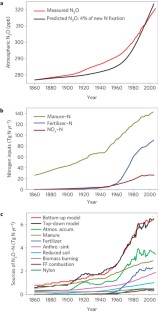
Atmospheric nitrous oxide concentrations have been increasing since the industrial revolution and currently account for 6% of total anthropogenic radiative forcing. Microbial production in soils is the dominant nitrous oxide source; this has increased with increasing use of nitrogen fertilizers. However, fertilizer use alone cannot account for the historical trends of atmospheric concentrations of nitrous oxide. Here, I analyse atmospheric concentrations, industrial sources of nitrous oxide, and fertilizer and manure production since 1860. Before 1960, agricultural expansion, including livestock production, may have caused globally significant mining of soil nitrogen, fuelling a steady increase in atmospheric nitrous oxide. After 1960, the rate of the increase rose, due to accelerating use of synthetic nitrogen fertilizers. Using a regression model, I show that 2.0% of manure nitrogen and 2.5% of fertilizer nitrogen was converted to nitrous oxide between 1860 and 2005; these percentage contributions explain the entire pattern of increasing nitrous oxide concentrations over this period. Consideration of processes that re-concentrate soil nitrogen, such as manure production by livestock, improved ‘hind-casting’ of nitrous oxide emissions. As animal protein consumption in human diets increases globally, management of manure will be an important component of future efforts to reduce anthropogenic nitrous oxide sources.
This is a preview of subscription content, access via your institution
Access options
Subscribe to this journal
Receive 12 print issues and online access
$259.00 per year
only $21.58 per issue
Buy this article
- Purchase on SpringerLink
- Instant access to the full article PDF.
USD 39.95
Prices may be subject to local taxes which are calculated during checkout
Additional access options:
Figure 1: Historical reconstructions of atmospheric N2O and its inferred anthropogenic sources.
The alternative text for this image may have been generated using AI.
References
- Forster, P. et al. in IPCC Climate Change 2007: The Physical Science Basis (eds Solomon, S. et al.) 129–234 (Cambridge Univ. Press, 2007).
Google Scholar - Prather, M. et al. in IPCC Climate Change 2001: The Scientific Basis (eds Houghton, J. et al.) 240–287 (Cambridge Univ. Press, 2001).
Google Scholar - Mosier, A. et al. Closing the global N2O budget: Nitrous oxide emissions through the agricultural nitrogen cycle. Nutr. Cycl. Agroecosys. 52, 225–248 (1998).
Article Google Scholar - Crutzen, P. J. & Ehhalt, D. H. Effects of nitrogen fertilizers and combustion on the stratospheric ozone layer. Ambio 6, 112–117 (1977).
Google Scholar - IFA Sustainable Management of the Nitrogen Cycle in Agriculture and Mitigation of Reactive Nitrogen Side Effects (International Fertilizer Industry Association, 2007); available at <http://www.fertilizer.org/ifa/form/pub_lat.asp>.
- Klein, C. et al. in IPCC Guidelines for National Greenhouse Gas Inventories (eds Eggleston, H. S., Buendia, L., Miwa, K., Ngara, T. & Tanabe, K.) 11.1–11.54 (Institute for Global Environmental Strategies, 2006).
Google Scholar - Crutzen, P. J., Mosier, A. R., Smith, K. A. & Winiwarter, W. N2O release from agro-biofuel production negated global warming reduction by replacing fossil fuels. Atmos. Chem. Phys. 8, 389–395 (2008).
Article Google Scholar - Nevison, C. & Holland, E. A re-examination of the impact of anthropogenically fixed nitrogen on atmospheric N2O and the stratospheric O3 layer. J. Geophys. Res. 102, 25519–25536 (1997).
Article Google Scholar - Kroeze, C., Mosier, A. & Bouwman, L. Closing the global N2O budget: A retrospective analysis 1500–1994. Glob. Biogeochem. Cycles 13, 1–8 (1999).
Article Google Scholar - Firestone, M. K. & Davidson, E. A. in Exchange of Trace Gases Between Terrestrial Ecosystems and the Atmosphere (eds Andreae, M. O. & Schimel, D. S.) 7–21 (Wiley, 1989).
Google Scholar - Granli, T. & Bockman, O. C. Nitrous oxide from agriculture. Norw. J. Agric. Sci. Suppl. 12, 1–128 (1994).
Google Scholar - Oenema, O. et al. Trends in global nitrous oxide emissions from animal production systems. Nutr. Cycl. Agroecosys. 72, 51–65 (2005).
Article Google Scholar - Galloway, J. N. et al. The nitrogen cascade. BioScience 53, 341–356 (2003).
Article Google Scholar - EPA Global Anthropogenic Non-CO 2 Greenhouse Gas Emissions: 1990–2020 (Environmental Protection Agency, 2006); available at <http://www.epa.gov/nonco2/econ-inv/international.html>.
- Smil, V. Nitrogen in crop production: An account of global flows. Glob. Biogeochem. Cycles 13, 647–662 (1999).
Article Google Scholar - Steinfeld, H. et al. Livestock’s Long Shadow. Environmental Issues and Options (Food and Agricultural Organization of the United Nations report, 2006).
- David, M. B., McIsaac, G. F., Royer, T. V., Darmody, R. G. & Gentry, L. E. Estimated historical and current nitrogen balances for Illinois. TheScientificWorld 1, 597–604 (2001).
Article Google Scholar - Montgomery, D. R. Dirt: The Erosion of Civilizations (Univ. California Press, 2007).
Google Scholar - McElroy, M. B. & Wang, Y. X. Human and animal wastes: Implications for atmospheric N2O and NO_x_ . Glob. Biogeochem Cycles 19, GB2008 (2005).
Article Google Scholar - Adviento-Borbe, M. A. A., Haddix, M. L., Binder, D. L., Walters, D. T. & Dobermann, A. Soil greenhouse gas fluxes and global warming potential in four high-yielding maize systems. Glob. Change Biol. 13, 1972–1988 (2007).
Article Google Scholar - Galloway, J. N. & Cowling, E. B. Reactive nitrogen and the world: 200 years of change. Ambio 31, 64–71 (2002).
Article Google Scholar - Holland, E. A., Lee-Taylor, J., Nevison, C. & Sulzman, J. Global N Cycle: Fluxes and N_2_O Mixing Ratios Originating from Human Activity (Oak Ridge National Laboratory, 2005); data set available at <http://daac.ornl.gov/CLIMATE/guides/N_Emiss.html>.
- Smil, V. Enriching the Earth (MIT Press, 2001).
Google Scholar
Acknowledgements
I thank the Henry Luce Foundation and the National Science Foundation (Award no. 0443439) for financial support.
Author information
Authors and Affiliations
- The Woods Hole Research Center, 149 Woods Hole Road, Falmouth, Massachusetts 02540-1644, USA
Eric A. Davidson
Corresponding author
Correspondence toEric A. Davidson.
Supplementary information
Rights and permissions
About this article
Cite this article
Davidson, E. The contribution of manure and fertilizer nitrogen to atmospheric nitrous oxide since 1860.Nature Geosci 2, 659–662 (2009). https://doi.org/10.1038/ngeo608
- Received: 02 January 2009
- Accepted: 21 July 2009
- Published: 30 August 2009
- Issue date: September 2009
- DOI: https://doi.org/10.1038/ngeo608