CCL3L1 and HIV/AIDS susceptibility (original) (raw)
- Correspondence
- Published: October 2009
- Jennifer Stanton3,
- Eun-Young Kim3,
- Kevin J Kunstman3,
- John P Phair3,
- Lisa P Jacobson4 &
- …
- Steven M Wolinsky3
Nature Medicine volume 15, pages 1112–1115 (2009)Cite this article
- 532 Accesses
- 58 Citations
- Metrics details
This article has been updated
To the Editor:
A selective advantage against infectious diseases such as HIV/AIDS is associated with differences in the genes relevant to immunity and virus replication. The CC chemokine receptor-5 (CCR5), the principal co-receptor for HIV, and its chemokine ligands, including CC chemokine ligand-3–like-1 (CCL3L1), influence the susceptibility of the CD4+ target cell to infection1. The CCL3L1 gene is one of several cytokine genes clustered in a region of segmental duplication on chromosome 17q12 (ref. 2). The CCL3L1 gene copy number per diploid genome varies between people and among persons of various geographical ancestries2,3,4,5; some people have a partial CCL3L1 pseudogene as well2. Evidence has been presented that increased CCL3L1 gene copy numbers can have marked phenotypic consequences for HIV/AIDS pathogenesis as a result of altering gene dosage3,4,5. We have been unable to reproduce these findings using the same methods in a different cohort.
This is a preview of subscription content, access via your institution
Relevant articles
Open Access articles citing this article.
Copy number variation of genes involved in the hepatitis C virus-human interactome
- Lucyna Budzko
- , Malgorzata Marcinkowska-Swojak
- … Marek Figlerowicz
Scientific Reports Open Access 11 August 2016
Technical considerations for genotyping multi-allelic copy number variation (CNV), in regions of segmental duplication
- Stuart Cantsilieris
- , Patrick S Western
- … Stefan J White
BMC Genomics Open Access 01 May 2014
CCL3L1 copy number, HIV load, and immune reconstitution in sub-Saharan Africans
- Eleni Aklillu
- , Linda Odenthal-Hesse
- … Edward J Hollox
BMC Infectious Diseases Open Access 12 November 2013
Access options
Subscribe to this journal
Receive 12 print issues and online access
$259.00 per year
only $21.58 per issue
Buy this article
- Purchase on SpringerLink
- Instant access to the full article PDF.
USD 39.95
Prices may be subject to local taxes which are calculated during checkout
Additional access options:
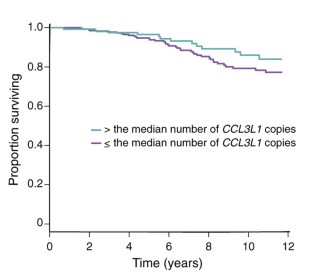
Figure 1: HIV disease–influencing effect associated with number of CCL3L1 gene copies during the pre-HAART era.
Change history
03 November 2009
In the version of this supplementary file originally posted online, the DNA sequence of the probe for real-time PCR quantification of CCL3L1 gene copy number was incorrect. The error has been corrected in this file as of 3 November 2009.
References
- Moore, J.P. & Klasse, P.J. Cell Host Microbe 2, 281–283 (2007).
Article CAS PubMed Google Scholar - Modi, W.S. Genomics 83, 735–738 (2004).
Article CAS PubMed Google Scholar - Gonzalez, E. et al. Science 307, 1434–1440 (2005).
Article CAS PubMed Google Scholar - Ahuja, S.K. et al. Nat. Med. 14, 413–420 (2008).
Article CAS PubMed PubMed Central Google Scholar - Dolan, M.J. et al. Nat. Immunol. 8, 1324–1336 (2007).
Article CAS PubMed Google Scholar - Townson, J.R., Barcellos, L.F. & Nibbs, R.J. Eur. J. Immunol. 32, 3016–3026 (2002).
Article CAS PubMed Google Scholar - Locke, D.P. et al. Am. J. Hum. Genet. 79, 275–290 (2006).
Article CAS PubMed PubMed Central Google Scholar - Khaja, R. et al. Nat. Genet. 38, 1413–1418 (2006).
Article CAS PubMed PubMed Central Google Scholar - Redon, R. et al. Nature 444, 444–454 (2006).
CAS PubMed PubMed Central Google Scholar - Detels, R. et al. J. Acquir. Immune Defic. Syndr. 7, 1263–1269 (1994).
Article CAS PubMed Google Scholar - Martin, M.P. et al. Science 282, 1907–1911 (1998).
Article CAS PubMed Google Scholar - Hendrickson, S.L. et al. J. Acquir. Immune Defic. Syndr. 48, 263–271 (2008).
Article CAS PubMed PubMed Central Google Scholar
Acknowledgements
We thank B. Korber for assistance with the figures. This work is funded by the US National Institutes of Health (AI-35039 to S.M.W. and J.P.P.).
Author information
Authors and Affiliations
- Santa Fe Institute, Santa Fe, New Mexico, USA
Tanmoy Bhattacharya - Los Alamos National Laboratory, Los Alamos, New Mexico, USA
Tanmoy Bhattacharya - Division of Infectious Diseases, The Feinberg School of Medicine, Northwestern University, Chicago, Illinois, USA
Jennifer Stanton, Eun-Young Kim, Kevin J Kunstman, John P Phair & Steven M Wolinsky - Department of Epidemiology, Johns Hopkins University Bloomberg School of Public Health, Baltimore, Maryland, USA
Lisa P Jacobson
Authors
- Tanmoy Bhattacharya
- Jennifer Stanton
- Eun-Young Kim
- Kevin J Kunstman
- John P Phair
- Lisa P Jacobson
- Steven M Wolinsky
Corresponding author
Correspondence toSteven M Wolinsky.
Supplementary information
Rights and permissions
About this article
Cite this article
Bhattacharya, T., Stanton, J., Kim, EY. et al. CCL3L1 and HIV/AIDS susceptibility.Nat Med 15, 1112–1115 (2009). https://doi.org/10.1038/nm1009-1112
- Issue date: October 2009
- DOI: https://doi.org/10.1038/nm1009-1112