Superhydrophobic states (original) (raw)
- Letter
- Published: 22 June 2003
Nature Materials volume 2, pages 457–460 (2003) Cite this article
- 23k Accesses
- 3216 Citations
- 27 Altmetric
- Metrics details
Abstract
It is well known that the roughness of a hydrophobic solid enhances its hydrophobicity1,2,3,4,5,6,7,8,9,10. The contact angle of water on such flat solids is typically of the order of 100 to 120°, but reaches values as high as 160 to 175° if they are rough3,4,5 or microtextured6,7,9,10. This result is remarkable because such behaviour cannot be generated by surface chemistry alone. Two distinct hypotheses are classically proposed to explain this effect. On one hand, roughness increases the surface area of the solid, which geometrically enhances hydrophobicity (Wenzel model)1. On the other hand, air can remain trapped below the drop, which also leads to a superhydrophobic behaviour, because the drop sits partially on air (Cassie model)2. However, it is shown here that both situations are very different from their adhesive properties, because Wenzel drops are found to be highly pinned. In addition, irreversible transitions can be induced between Cassie and Wenzel states, with a loss of the anti-adhesive properties generally associated with superhydrophobicity.
This is a preview of subscription content, access via your institution
Access options
Subscribe to this journal
Receive 12 print issues and online access
$259.00 per year
only $21.58 per issue
Buy this article
- Purchase on SpringerLink
- Instant access to the full article PDF.
USD 39.95
Prices may be subject to local taxes which are calculated during checkout
Additional access options:
Figure 1: The two models of superhydrophobicity.

The alternative text for this image may have been generated using AI.
Figure 2: Compression of a millimetric water drop between two identical microtextured hydrophobic surfaces.
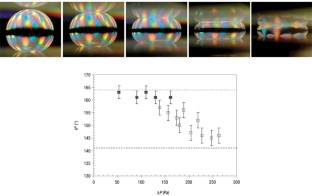
The alternative text for this image may have been generated using AI.
Figure 3: Separation of the two plates after having imposed a pressure Δ_P_ of about 250 Pa.

The alternative text for this image may have been generated using AI.
References
- Wenzel, R.N. Resistance of solid surfaces to wetting by water. Ind. Eng. Chem. 28, 988–994 ( 1936).
Article CAS Google Scholar - Cassie, A.B.D. & Baxter, S. Wettability of porous surfaces. Trans. Faraday Soc. 40, 546–551 ( 1944).
Article CAS Google Scholar - Johnson, R.E. & Dettre, R.H. in Contact angle, Wettability and Adhesion Vol. 43 (ed. Fowkes, F. M.) 112–135 (Advances in Chemistry Series, ACS, Washington DC, 1964).
Book Google Scholar - Onda, T., Shibuichi, S., Satoh, N. & Tsujii, K. Super water-repellent fractal surfaces. Langmuir 12, 2125–2127 ( 1996).
Article CAS Google Scholar - Shibuichi, S., Onda, T., Satoh, N. & Tsujii, K. Super water-repellent surfaces resulting from fractal surfaces. J. Phys. Chem. 100, 19512–19517 ( 1996).
Article CAS Google Scholar - Neinhuis, C. & Barthlott, W. Characterization and distribution of water-repellent, self-cleaning plant surfaces. Ann. Bot. 79, 667–677 ( 1997).
Article Google Scholar - Bico, J., Marzolin, C. & Quéré, D. Pearl drops. Europhys. Lett. 47, 220–226 ( 1999).
Article CAS Google Scholar - Herminghaus, S. Roughness-induced non-wetting. Europhys. Lett. 52, 165–170 ( 2000).
Article Google Scholar - Öner, D. & McCarthy T.J. Ultrahydrophobic surfaces. Effects of topography length scales on wettability. Langmuir 16, 7777–7782 ( 2000).
Article Google Scholar - Yoshimitsu, Z., Nakajima, A., Watanabe, T. & Hashimoto, K. Effects of surface structure on the hydrophobicity and sliding behavior of water droplets. Langmuir 18, 5818–5822 ( 2002).
Article CAS Google Scholar - Bico, J., Thiele, U. & Quéré, D. Wetting of textured surfaces. Colloids Surf. A 206, 41–46 ( 2002).
Article CAS Google Scholar - Patankar, N. On the modeling of hydrophobic contact angles on rough surfaces. Langmuir 19, 1249–1253 ( 2003).
Article CAS Google Scholar - Taylor, G.I. & Michael, D.H. On making holes in a sheet of fluid. J. Fluid Mech. 58, 625–639 ( 1973).
Article Google Scholar - Cottin-Bizonne, C., Barrat J.L., Bocquet, L. & Charlaix, E. Low friction flows of liquid at nanopatterned interfaces. Nature Mater. 2, 237–240 ( 2003).
Article CAS Google Scholar
Acknowledgements
We thank Steve Abbott and Nigel Holmes for kindly providing the samples, José Bico, Cédric Dieleman, Harald Keller, Neelesh Patankar and Uwe Thiele for fruitful discussions, and BASF for their support.
Author information
Authors and Affiliations
- Laboratoire de Physique de la Matière Condensée, UMR 7125 du CNRS, Collège de France, Paris, 75231 Cedex 05, France
Aurélie Lafuma & David Quéré
Authors
- Aurélie Lafuma
- David Quéré
Corresponding author
Correspondence toDavid Quéré.
Ethics declarations
Competing interests
The authors declare no competing financial interests.
Rights and permissions
About this article
Cite this article
Lafuma, A., Quéré, D. Superhydrophobic states.Nature Mater 2, 457–460 (2003). https://doi.org/10.1038/nmat924
- Received: 12 December 2002
- Accepted: 23 April 2003
- Published: 22 June 2003
- Issue date: 01 July 2003
- DOI: https://doi.org/10.1038/nmat924