Fluorescent protein FRET pairs for ratiometric imaging of dual biosensors (original) (raw)
- Brief Communication
- Published: 20 April 2008
Nature Methods volume 5, pages 401–403 (2008)Cite this article
- 9564 Accesses
- 332 Citations
- 11 Altmetric
- Metrics details
Abstract
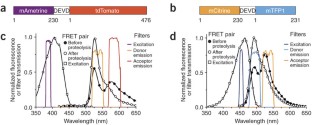
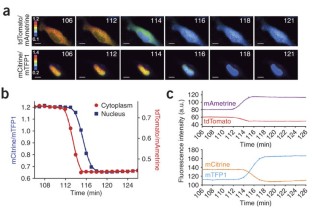
Fluorescence resonance energy transfer (FRET) with fluorescent proteins is a powerful method for detection of protein-protein interactions, enzyme activities and small molecules in the intracellular milieu. Aided by a new violet-excitable yellow-fluorescing variant of Aequorea victoria GFP, we developed dual FRET–based caspase-3 biosensors. Owing to their distinct excitation profiles, each FRET biosensor can be ratiometrically imaged in the presence of the other.
This is a preview of subscription content, access via your institution
Access options
Subscribe to this journal
Receive 12 print issues and online access
$259.00 per year
only $21.58 per issue
Buy this article
- Purchase on SpringerLink
- Instant access to the full article PDF.
USD 39.95
Prices may be subject to local taxes which are calculated during checkout
Additional access options:
Figure 1: Caspase-3 biosensors based on dual FRET pairs.
The alternative text for this image may have been generated using AI.
Figure 2: Live-cell imaging with dual FRET pairs.
The alternative text for this image may have been generated using AI.
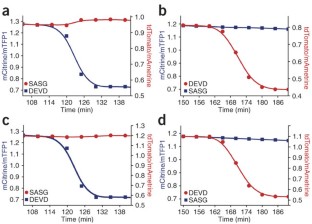
Figure 3: Control experiments with noncleavable FRET constructs.
The alternative text for this image may have been generated using AI.
Accession codes
Accessions
GenBank/EMBL/DDBJ
References
- Shaner, N.C., Steinbach, P.A. & Tsien, R.Y. Nat. Methods 2, 905–909 (2005).
Article CAS Google Scholar - Tsien, R.Y. Annu. Rev. Biochem. 67, 509–544 (1998).
Article CAS Google Scholar - Wu, X. et al. Cytometry A 69, 477–486 (2006).
Article Google Scholar - Peyker, A., Rocks, O. & Bastiaens, P.I. ChemBioChem 6, 78–85 (2005).
Article CAS Google Scholar - Kawai, H. et al. J. Pharmacol. Sci. 97, 361–368 (2005).
Article CAS Google Scholar - Ai, H.W., Henderson, J.N., Remington, S.J. & Campbell, R.E. Biochem. J. 400, 531–540 (2006).
Article CAS Google Scholar - Zapata-Hommer, O. & Griesbeck, O. BMC Biotechnol. 3, 5 (2003).
Article Google Scholar - Ai, H.W., Shaner, N.C., Cheng, Z., Tsien, R.Y. & Campbell, R.E. Biochemistry 46, 5904–5910 (2007).
Article CAS Google Scholar - Shaner, N.C. et al. Nat. Biotechnol. 22, 1567–1572 (2004).
Article CAS Google Scholar - Xu, X. et al. Nucleic Acids Res. 26, 2034–2035 (1998).
Article CAS Google Scholar - Ferrando-May, E. Cell Death Differ. 12, 1263–1276 (2005).
Article CAS Google Scholar
Acknowledgements
This work was funded by the University of Alberta, the Canada Foundation for Innovation, the Natural Sciences and Engineering Research Council of Canada and Alberta Ingenuity. We thank A.M. Sierra and I.S. Goping for technical assistance and helpful discussion. R.E.C. holds a Canada Research Chair in Bioanalytical Chemistry.
Author information
Authors and Affiliations
- Department of Chemistry, University of Alberta, 11227 Saskatchewan Drive, Edmonton, T6G 2G2, Alberta, Canada
Hui-wang Ai & Robert E Campbell - National High Magnetic Field Laboratory and Department of Biological Science, Florida State University, 1800 East Paul Dirac Drive, Tallahassee, 32310, Florida, USA
Kristin L Hazelwood & Michael W Davidson
Authors
- Hui-wang Ai
- Kristin L Hazelwood
- Michael W Davidson
- Robert E Campbell
Contributions
H.A. contributed to the conceptual development, performed experiments, analyzed data and assisted in manuscript preparation; K.L.H. performed photobleaching experiments and imaging of fusion proteins; M.W.D. contributed to experimental design, analyzed photobleaching data and assisted with manuscript preparation; and R.E.C. contributed to conceptual development, data analysis and writing of the manuscript.
Corresponding author
Correspondence toRobert E Campbell.
Ethics declarations
Competing interests
R.E.C. and H.A. are listed as authors on a US patent application describing mTFP1.
Supplementary information
Rights and permissions
About this article
Cite this article
Ai, Hw., Hazelwood, K., Davidson, M. et al. Fluorescent protein FRET pairs for ratiometric imaging of dual biosensors.Nat Methods 5, 401–403 (2008). https://doi.org/10.1038/nmeth.1207
- Received: 21 December 2007
- Accepted: 01 April 2008
- Published: 20 April 2008
- Issue date: May 2008
- DOI: https://doi.org/10.1038/nmeth.1207