Automated screening for mutants affecting dopaminergic-neuron specification in C. elegans (original) (raw)
- Brief Communication
- Published: 31 August 2008
Nature Methods volume 5, pages 869–872 (2008) Cite this article
- 1734 Accesses
- 80 Citations
- 6 Altmetric
- Metrics details
Abstract
We describe an automated method to isolate mutant Caenorhabditis elegans that do not appropriately execute cellular differentiation programs. We used a fluorescence-activated sorting mechanism implemented in the COPAS Biosort machine to isolate mutants with subtle alterations in the cellular specificity of GFP expression. This methodology is considerably more efficient than comparable manual screens and enabled us to isolate mutants in which dopamine neurons do not differentiate appropriately.
This is a preview of subscription content, access via your institution
Access options
Subscribe to this journal
Receive 12 print issues and online access
$259.00 per year
only $21.58 per issue
Buy this article
- Purchase on SpringerLink
- Instant access to the full article PDF.
USD 39.95
Prices may be subject to local taxes which are calculated during checkout
Additional access options:
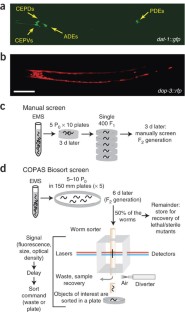
Figure 1: Screening for dopaminergic cell-fate mutants.
The alternative text for this image may have been generated using AI.
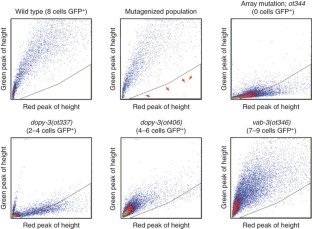
Figure 2: Relative fluorescence intensity plots between red and green channels of sorted worms.
The alternative text for this image may have been generated using AI.
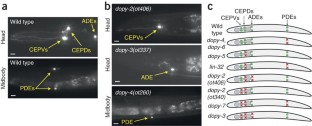
Figure 3: Phenotypes of isolated dopy mutants.
The alternative text for this image may have been generated using AI.
References
- Brenner, S. Genetics 77, 71–94 (1974).
CAS PubMed PubMed Central Google Scholar - Jorgensen, E.M. & Mango, S.E. Nat. Rev. Genet. 3, 356–369 (2002).
Article CAS PubMed Google Scholar - Chalfie, M., Tu, Y., Euskirchen, G., Ward, W.W. & Prasher, D.C. Science 263, 802–805 (1994).
Article CAS PubMed Google Scholar - Pulak, R. Methods Mol. Biol. 351, 275–286 (2006).
PubMed Google Scholar - Abeliovich, A. & Hammond, R. Dev. Biol. 304, 447–454 (2007).
Article CAS PubMed Google Scholar - Nass, R. et al. J. Neurochem. 94, 774–785 (2005).
Article CAS PubMed Google Scholar - Nass, R., Hall, D.H., Miller, D.M., III & Blakely, R.D. Proc. Natl. Acad. Sci. USA 99, 3264–3269 (2002).
Article CAS PubMed PubMed Central Google Scholar - Chase, D.L., Pepper, J.S. & Koelle, M.R. Nat. Neurosci. 7, 1096–1103 (2004).
Article CAS PubMed Google Scholar - Davis, M.W. et al. BMC Genomics 6, 118 (2005).
Article PubMed PubMed Central Google Scholar - Zhao, C. & Emmons, S.W. Nature 373, 74–78 (1995).
Article CAS PubMed Google Scholar - Hack, M.A. et al. Nat. Neurosci. 8, 865–872 (2005).
Article CAS PubMed Google Scholar - Guenther, C. & Garriga, G. Development 122, 3509–3518 (1996).
CAS PubMed Google Scholar - Chung, K., Crane, M.M. & Lu, H. Nat. Methods 5, 637–643 (2008).
Article CAS PubMed Google Scholar - Boulin, T. & Bessereau, J.L. Nat. Protoc. 2, 1276–1287 (2007).
Article CAS PubMed Google Scholar - Sarin, S., Prabhu, S., O'Meara, M.M., Pe'er, I. & Hobert, O. Nat. Methods advance online publication 1 August 2008 (doi:10.1038/nmeth.1249).
Article CAS PubMed PubMed Central Google Scholar
Acknowledgements
We thank A. Kruyer, A. Pretorian, J. Recio and Q. Chen for technical assistance, S. Sarin for calculating the degree of saturation, V. Bertrand and F. Zhang for communicating unpublished results, and S. Mitani (Tokyo Women's Medical University School of Medicine) for providing lin-32 deletion alleles. This work was funded by the US National Institutes of Health (R01NS039996-05; R01NS050266-03), the Howard Hughes Medical Institute, an European Molecular Biology Organization long-term fellowship to M.D. and N.F., and a Marie Curie Outgoing International fellowship to N.F.
Author information
Authors and Affiliations
- Department of Biochemistry and Molecular Biophysics, Howard Hughes Medical Institute, Columbia University Medical Center, 701 W. 168th Street, New York, 10032, New York, USA
Maria Doitsidou, Nuria Flames, Albert C Lee, Alexander Boyanov & Oliver Hobert
Authors
- Maria Doitsidou
- Nuria Flames
- Albert C Lee
- Alexander Boyanov
- Oliver Hobert
Contributions
M.D. conducted the genetic screens (manual and sorter), implemented the sorter strategy, mapped and characterized mutants, and co-wrote the paper; N.F. implemented the sorter strategy and conducted sorter screens; A.C.L. conducted manual screens; A.B. assisted in mapping mutants; and O.H. initiated and supervised the project, and co-wrote the paper.
Corresponding authors
Correspondence toMaria Doitsidou or Oliver Hobert.
Supplementary information
Rights and permissions
About this article
Cite this article
Doitsidou, M., Flames, N., Lee, A. et al. Automated screening for mutants affecting dopaminergic-neuron specification in C. elegans.Nat Methods 5, 869–872 (2008). https://doi.org/10.1038/nmeth.1250
- Received: 28 April 2008
- Accepted: 29 July 2008
- Published: 31 August 2008
- Issue date: October 2008
- DOI: https://doi.org/10.1038/nmeth.1250