Connectivity-based segregation of the human striatum predicts personality characteristics (original) (raw)
- Brief Communication
- Published: 23 November 2008
Nature Neuroscience volume 12, pages 32–34 (2009) Cite this article
- 3560 Accesses
- 258 Citations
- 11 Altmetric
- Metrics details
Abstract
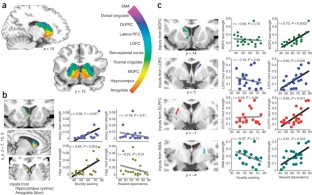
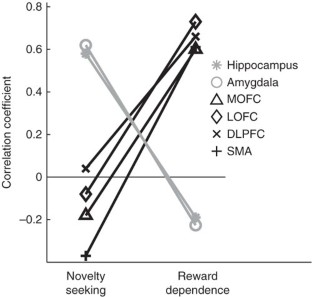
We found that personality characteristics are linked to dissociable connectivity streams in the human brain. Whereas fiber tracts between a subcortical network, including the hippocampus and amygdala, and the ventral striatum predicted individual differences in novelty seeking, tracts between prefrontal cortex and the striatum predicted individual differences in reward dependence. These findings suggest that the strength of limbic-striatal connectivity may, in part, underlie human personality traits.
This is a preview of subscription content, access via your institution
Access options
Subscribe to this journal
Receive 12 print issues and online access
$259.00 per year
only $21.58 per issue
Buy this article
- Purchase on SpringerLink
- Instant access to the full article PDF.
USD 39.95
Prices may be subject to local taxes which are calculated during checkout
Additional access options:
Figure 1: Overview of tractography results and correlations with personality.
The alternative text for this image may have been generated using AI.
Figure 2: Dissociation of white-matter fiber inputs into the striatum predicting individual differences in novelty seeking and reward dependence.
The alternative text for this image may have been generated using AI.
References
- Everitt, B.J. & Robbins, T.W. Nat. Neurosci. 8, 1481–1489 (2005).
Article CAS Google Scholar - Haber, S.N., Kim, K.S., Mailly, P. & Calzavara, R. J. Neurosci. 26, 8368–8376 (2006).
Article CAS Google Scholar - Robbins, T.W., Cador, M., Taylor, J.R. & Everitt, B.J. Neurosci. Biobehav. Rev. 13, 155–162 (1989).
Article CAS Google Scholar - Lisman, J.E. & Grace, A.A. Neuron 46, 703–713 (2005).
Article CAS Google Scholar - Hollerman, J.R., Tremblay, L. & Schultz, W. Prog. Brain Res. 126, 193–215 (2000).
Article CAS Google Scholar - Cloninger, C.R., Svrakic, D.M. & Przybeck, T.R. Arch. Gen. Psychiatry 50, 975–990 (1993).
Article CAS Google Scholar - Behrens, T.E. et al. Nat. Neurosci. 6, 750–757 (2003).
Article CAS Google Scholar - Cohen, M.X., Lombardo, M. & Blumenfeld, R.S. Eur. J. Neurosci. 27, 1534–1546 (2008).
Article Google Scholar - Draganski, B. et al. J. Neurosci. 28, 7143–7152 (2008).
Article CAS Google Scholar - Peters, J.R., Vallie, B., Difronzo, M. & Donaldson, S.T. Brain Res. Bull. 74, 232–236 (2007).
Article CAS Google Scholar - Bhatti, A.S., Hall, P., Ma, Z., Tao, R. & Isgor, C. Hippocampus 17, 922–933 (2007).
Article Google Scholar - Sheth, A., Berretta, S., Lange, N. & Eichenbaum, H. Hippocampus 18, 169–181 (2008).
Article Google Scholar - Rolls, E.T. Rev. Neurol. (Paris) 150, 648–660 (1994).
CAS Google Scholar - King–Casas, B. et al. Science 308, 78–83 (2005).
Article Google Scholar - Cohen, M.X., Elger, C.E. & Weber, B. Neuroimage 39, 1396–1407 (2008).
Article Google Scholar
Acknowledgements
We thank J.F. Cavanagh, M. Tittgemeyer and B. Knutson for helpful comments on the manuscript. J.S. and B.W. conducted the experiment, and M.X.C. analyzed the data and wrote the paper. All authors approved the analyses and manuscript.
Author information
Authors and Affiliations
- Department of Epileptology and Life & Brain Center, Department of NeuroCognition, University of Bonn, Sigmund Freud Street 25, Bonn, 53105, Germany
Michael X Cohen, Jan-Christoph Schoene-Bake, Christian E Elger & Bernd Weber - Department of Psychology, University of Arizona, 1503 E University Boulevard, PO Box 210068, Psychology Bldg., Tucson, 85721, Arizona, USA
Michael X Cohen
Authors
- Michael X Cohen
- Jan-Christoph Schoene-Bake
- Christian E Elger
- Bernd Weber
Corresponding author
Correspondence toMichael X Cohen.
Supplementary information
Rights and permissions
About this article
Cite this article
Cohen, M., Schoene-Bake, JC., Elger, C. et al. Connectivity-based segregation of the human striatum predicts personality characteristics.Nat Neurosci 12, 32–34 (2009). https://doi.org/10.1038/nn.2228
- Received: 08 September 2008
- Accepted: 17 October 2008
- Published: 23 November 2008
- Issue date: January 2009
- DOI: https://doi.org/10.1038/nn.2228