Cocaine-induced structural plasticity in frontal cortex correlates with conditioned place preference (original) (raw)
- Brief Communication
- Published: 25 August 2013
Nature Neuroscience volume 16, pages 1367–1369 (2013) Cite this article
- 10k Accesses
- 84 Citations
- 167 Altmetric
- Metrics details
Subjects
Abstract
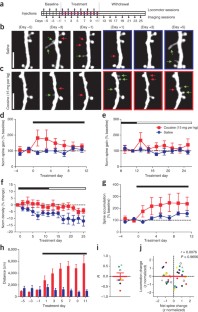
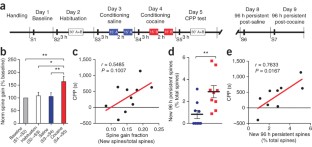
Contextual cues associated with previous drug exposure can trigger drug craving and seeking, and form a substantial obstacle in substance use recovery. Using in vivo imaging in mice, we found that cocaine administration induced a rapid increase in the formation and accumulation of new dendritic spines, and that measures of new persistent spine gain correlated with cocaine conditioned place preference. Our data suggest that new persistent spine formation in the frontal cortex may be involved in stimulant-related learning driving appetitive behavior.
This is a preview of subscription content, access via your institution
Access options
Subscribe to this journal
Receive 12 print issues and online access
$259.00 per year
only $21.58 per issue
Buy this article
- Purchase on SpringerLink
- Instant access to the full article PDF.
USD 39.95
Prices may be subject to local taxes which are calculated during checkout
Additional access options:
Figure 1: Cocaine exposure increases spine gains in the frontal cortex.
The alternative text for this image may have been generated using AI.
Figure 2: Cocaine increases spine gains in the frontal cortex within 2 h of injection.

The alternative text for this image may have been generated using AI.
Figure 3: New persistent spine gains after cocaine CPP training correlate with the magnitude of gain in preference for the cocaine-paired context.
The alternative text for this image may have been generated using AI.
References
- McLaughlin, J. & See, R.E. Psychopharmacology (Berl.) 168, 57–65 (2003).
Article CAS Google Scholar - Pierce, R.C., Reeder, D.C., Hicks, J., Morgan, Z.R. & Kalivas, P.W. Neuroscience 82, 1103–1114 (1998).
Article CAS PubMed Google Scholar - Tai, L.H., Lee, A.M., Benavidez, N., Bonci, A. & Wilbrecht, L. Nat. Neurosci. 15, 1281–1289 (2012).
Article CAS PubMed PubMed Central Google Scholar - Chudasama, Y. & Robbins, T.W. Biol. Psychol. 73, 19–38 (2006).
Article CAS PubMed Google Scholar - Robinson, T.E., Gorny, G., Mitton, E. & Kolb, B. Synapse 39, 257–266 (2001).
Article CAS PubMed Google Scholar - Robinson, T.E. & Kolb, B. Eur. J. Neurosci. 11, 1598–1604 (1999).
Article CAS PubMed Google Scholar - Robinson, T.E. & Kolb, B. Neuropharmacology 47, 33–46 (2004).
Article CAS PubMed Google Scholar - Feng, G. et al. Neuron 28, 41–51 (2000).
Article CAS PubMed Google Scholar - Hofer, S.B., Mrsic-Flogel, T.D., Bonhoeffer, T. & Hübener, M. Nature 457, 313–317 (2009).
Article CAS PubMed Google Scholar - Wilbrecht, L., Holtmaat, A., Wright, N., Fox, K. & Svoboda, K. J. Neurosci. 30, 4927–4932 (2010).
Article CAS PubMed PubMed Central Google Scholar - Xu, T. et al. Nature 462, 915–919 (2009).
CAS PubMed PubMed Central Google Scholar - Kasai, H., Matsuzaki, M., Noguchi, J., Yasumatsu, N. & Nakahara, H. Trends Neurosci. 26, 360–368 (2003).
Article CAS PubMed Google Scholar - Bourne, J. & Harris, K.M. Curr. Opin. Neurobiol. 17, 381–386 (2007).
Article CAS PubMed Google Scholar - Holtmaat, A.J.G.D. et al. Neuron 45, 279–291 (2005).
Article CAS PubMed Google Scholar - Zuo, Y., Lin, A., Chang, P. & Gan, W.-B. Neuron 46, 181–189 (2005).
Article CAS PubMed Google Scholar - Knott, G.W., Holtmaat, A., Wilbrecht, L., Welker, E. & Svoboda, K. Nat. Neurosci. 9, 1117–1124 (2006).
Article CAS PubMed Google Scholar - Holtmaat, A. et al. Nat. Protoc. 4, 1128–1144 (2009).
Article CAS PubMed PubMed Central Google Scholar
Acknowledgements
We thank J. Whistler, P. Janak, S. Jurado, C. Johnson and C. Bates for comments on the manuscript. This work was supported by the National Institute on Drug Abuse (R01DA029150), the State of California, University of California San Francisco, and the P. Royer and K. Clayton Family.
Author information
Authors and Affiliations
- Department of Neurology, Ernest Gallo Clinic and Research Center, University of California, San Francisco, California, USA
Francisco Javier Muñoz-Cuevas, Jegath Athilingam, Denise Piscopo & Linda Wilbrecht - Department of Biology, University of Oregon, Eugene, Oregon, USA
Denise Piscopo - Department of Psychology, University of California, Berkeley, USA
Linda Wilbrecht
Authors
- Francisco Javier Muñoz-Cuevas
- Jegath Athilingam
- Denise Piscopo
- Linda Wilbrecht
Contributions
F.J.M.-C., J.A. and D.P. performed the experiments. L.W. and F.J.M.-C. designed the experiments, analyzed the data and wrote the paper.
Corresponding author
Correspondence toLinda Wilbrecht.
Ethics declarations
Competing interests
The authors declare no competing financial interests.
Supplementary information
Rights and permissions
About this article
Cite this article
Muñoz-Cuevas, F., Athilingam, J., Piscopo, D. et al. Cocaine-induced structural plasticity in frontal cortex correlates with conditioned place preference.Nat Neurosci 16, 1367–1369 (2013). https://doi.org/10.1038/nn.3498
- Received: 16 May 2013
- Accepted: 15 July 2013
- Published: 25 August 2013
- Issue date: October 2013
- DOI: https://doi.org/10.1038/nn.3498