Free-standing graphene at atomic resolution (original) (raw)
- Article
- Published: 28 September 2008
- Ursel Bangert2 na1,
- Andrew L. Bleloch1,
- Peng Wang1,
- Rahul R. Nair2,3 &
- …
- A. K. Geim3
Nature Nanotechnology volume 3, pages 676–681 (2008) Cite this article
- 7577 Accesses
- 629 Citations
- 3 Altmetric
- Metrics details
Abstract
Research interest in graphene, a two-dimensional crystal consisting of a single atomic plane of carbon atoms, has been driven by its extraordinary properties, including charge carriers that mimic ultra-relativistic elementary particles. Moreover, graphene exhibits ballistic electron transport on the submicrometre scale, even at room temperature, which has allowed the demonstration of graphene-based field-effect transistors and the observation of a room-temperature quantum Hall effect. Here we confirm the presence of free-standing, single-layer graphene with directly interpretable atomic-resolution imaging combined with the spatially resolved study of both the π → π* transition and the π + σ plasmon. We also present atomic-scale observations of the morphology of free-standing graphene and explore the role of microstructural peculiarities that affect the stability of the sheets. We also follow the evolution and interaction of point defects and suggest a mechanism by which they form ring defects.
This is a preview of subscription content, access via your institution
Access options
Subscribe to this journal
Receive 12 print issues and online access
$259.00 per year
only $21.58 per issue
Buy this article
- Purchase on SpringerLink
- Instant access to the full article PDF.
USD 39.95
Prices may be subject to local taxes which are calculated during checkout
Additional access options:
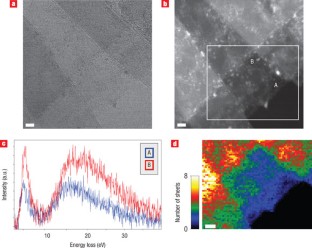
Figure 1: Thickness analysis of graphene layers.
The alternative text for this image may have been generated using AI.
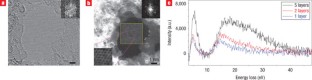
Figure 2: High-resolution images of mono-layer graphene.
The alternative text for this image may have been generated using AI.
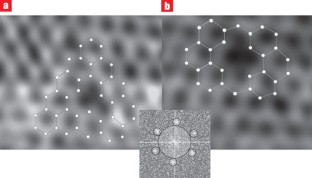
Figure 3: HAADF lattice images of defects.
The alternative text for this image may have been generated using AI.
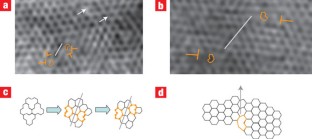
Figure 4: Termination of hexagon rows in HAADF images.
The alternative text for this image may have been generated using AI.
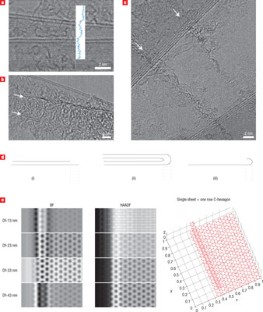
Figure 5: Edge structures of graphene.
The alternative text for this image may have been generated using AI.
References
- Novoselov, K. S. et al. Two-dimensional gas of massless Dirac fermions in graphene. Nature 438, 197–200 (2005).
Article CAS Google Scholar - Zhang, Y., Tan, Y. W., Stormer, H. L. & Kim, P. Experimental observation of the quantum Hall effect and Berry's phase in graphene. Nature 438, 201–204 (2005).
Article CAS Google Scholar - Geim, A. K. & Novoselov, K. S. The rise of graphene. Nature Mater. 6, 183–191 (2007).
Article CAS Google Scholar - Schedin, F. et al. Detection of individual gas molecules by graphene sensors. Nature Mater. 6, 652–655 (2007).
Article CAS Google Scholar - Novoselev, K. S. et al. Room temperature quantum Hall effect in graphene. Science 315, 1379 (2007).
Article Google Scholar - Meyer, J. C. et al. The structure of suspended graphene sheets. Nature 446, 60–63 (2007).
Article CAS Google Scholar - Fasolino, A., Los, J. H. & Katsnelson, M. I. Intrinsic ripples in graphene. Nature Mater. 6, 858–861 (2007).
Article CAS Google Scholar - Meyer, J. C. et al. Direct imaging of lattice atoms and topological defects in graphene membranes. Nano Lett. doi: 10.1021/nl801386 m (2008).
- Eberlein, T. et al. Plasmon spectroscopy of free-standing graphene films. Phys. Rev. B 77, 233406 (2008).
Article Google Scholar - Stephan, O., Taverna, D., Kociak, M., Charbois, V. & Henrard, L. Electron energy-loss spectrum of an electron passing near a locally anisotropic nanotube. Phys. Rev. B 66, 235419 (2002).
Article Google Scholar - Kociak, M., Henrard, L., Stephan, O., Suenaga, K. & Colliex, C. Plasmons in layered nanospheres and nanotubes investigated by spatially resolved electron energy-loss spectroscopy. Phys. Rev. B 61, 13936–13944 (2000).
Article CAS Google Scholar - Li, Z. Y. et al. Three-dimensional atomic-scale structure of size-selected gold nanoclusters. Nature 451, 46–48 (2008).
Article CAS Google Scholar - Filippi, M. & Calliari, L. Measuring the energy of the graphitic π + σ plasmon peak. Surf. Interface Anal. 38, 595–598 (2006).
Article CAS Google Scholar - Nair, R. R. et al. Fine structure constant defines visual transparency of graphene. Science 320, 1308 (2008).
Article CAS Google Scholar - Hahn, J. R. & Kang, H. Vacancy and interstitial defects at graphite surfaces: Scanning tunnelling microscopic study of the structure, electronic property and yield for ion-induced defect creation. Phys. Rev. B 60, 6007–6017 (1999).
Article CAS Google Scholar - Bourelle, E., Konno, H. & Inagaki, M. Structural defects created on natural graphite surface by slight treatment of oxygen plasma—STM observations. Carbon 37, 2041–2048 (1999).
Article CAS Google Scholar - Telling, R. H. & Heggie, M. I. Radiation defects in graphite. Phil. Mag. 87, 4797–4846 (2007).
Article CAS Google Scholar - Krasheninnikov, A. V., Nordlund, K., Sirviö, M., Salonen, E. & Keinonen, J. Formation of ion-irradiation-induced atomic-scale defects on walls of carbon nanotubes. Phys. Rev. B 63, 245405 (2001).
Article Google Scholar - Terrones, M. & Terrones, H. The role of defects in graphitic structures. Fuller. Nanotub. Carbon Nanostruct. 4, 517–533 (1996).
CAS Google Scholar - Rotkin, S. V. & Gogotsi, Y. Analysis of non-planar graphitic structures: From arched edge planes of graphite crystals to nanotubes. Mater. Res. Innovat. 5, 191–200 (2002).
Article CAS Google Scholar - Moriguchi, K. et al. Nano-tube-like surface structure in graphite particles and its formation mechanism: A role in anodes of lithium-ion secondary batteries. J. Appl. Phys. 88, 6369–6376 (2000).
Article CAS Google Scholar - Novoselov, K. S. et al. Electric field effect in atomically thin carbon films. Science 306, 666–669 (2004).
Article CAS Google Scholar - Egerton, R. F. Electron Energy Loss Spectroscopy in the Electron Microscope 2nd edn, 304 (Plenum, 1996).
Book Google Scholar
Acknowledgements
The authors wish to thank the Engineering and Physical Sciences Research Council (EPSRC) for SuperSTEM funding under grant EP/D040396/1.
Author information
Author notes
- Mhairi H. Gass and Ursel Bangert: These authors contributed equally to this work.
Authors and Affiliations
- SuperSTEM, STFC Daresbury Laboratory, Warrington, WA4 4AD, UK
Mhairi H. Gass, Andrew L. Bleloch & Peng Wang - School of Materials, University of Manchester, Manchester, M13 9PL, UK
Ursel Bangert & Rahul R. Nair - Manchester Centre for Mesoscience and Nanotechnology, University of Manchester, Manchester, M13 9PL, UK
Rahul R. Nair & A. K. Geim
Authors
- Mhairi H. Gass
- Ursel Bangert
- Andrew L. Bleloch
- Peng Wang
- Rahul R. Nair
- A. K. Geim
Contributions
M.H.G., U.B., A.L.B. and A.K.G. conceived and designed the experiments. R.R.N. performed sample preparation. M.H.G., U.B. and A.L.B. carried out the experiments and performed data analysis. P.W. performed the image simulations. M.H.G., U.B. and A.L.B. co-wrote the paper. All authors discussed the results and commented on the manuscript.
Corresponding author
Correspondence toMhairi H. Gass.
Rights and permissions
About this article
Cite this article
Gass, M., Bangert, U., Bleloch, A. et al. Free-standing graphene at atomic resolution.Nature Nanotech 3, 676–681 (2008). https://doi.org/10.1038/nnano.2008.280
- Received: 16 July 2008
- Accepted: 29 August 2008
- Published: 28 September 2008
- Issue date: November 2008
- DOI: https://doi.org/10.1038/nnano.2008.280
This article is cited by
Ab initio study of water anchored in graphene pristine and vacancy-type defects
- Mariana Zancan Tonel
- João Pedro Kleinubing Abal
- Marcia Cristina Barbosa
Journal of Molecular Modeling (2023)
Resolving few-layer antimonene/graphene heterostructures
- Tushar Gupta
- Kenan Elibol
- Bernhard C. Bayer
npj 2D Materials and Applications (2021)
Chemical and structural properties of reduced graphene oxide—dependence on the reducing agent
- B. Lesiak
- G. Trykowski
- A. Malolepszy
Journal of Materials Science (2021)
Laser-Induced Graphene: En Route to Smart Sensing
- Libei Huang
- Jianjun Su
- Ruquan Ye
Nano-Micro Letters (2020)
Functionalized graphene materials for hydrogen storage
- Vatsal Jain
- Balasubramanian Kandasubramanian
Journal of Materials Science (2020)