Universal control and error correction in multi-qubit spin registers in diamond (original) (raw)
- Letter
- Published: 02 February 2014
Nature Nanotechnology volume 9, pages 171–176 (2014)Cite this article
- 15k Accesses
- 424 Citations
- 51 Altmetric
- Metrics details
Subjects
This article has been updated
Abstract
Quantum registers of nuclear spins coupled to electron spins of individual solid-state defects are a promising platform for quantum information processing1,2,3,4,5,6,7,8,9,10,11,12,13. Pioneering experiments selected defects with favourably located nuclear spins with particularly strong hyperfine couplings4,5,6,7,8,9,10. To progress towards large-scale applications, larger and deterministically available nuclear registers are highly desirable. Here, we realize universal control over multi-qubit spin registers by harnessing abundant weakly coupled nuclear spins. We use the electron spin of a nitrogen–vacancy centre in diamond to selectively initialize, control and read out carbon-13 spins in the surrounding spin bath and construct high-fidelity single- and two-qubit gates. We exploit these new capabilities to implement a three-qubit quantum-error-correction protocol14,15,16,17 and demonstrate the robustness of the encoded state against applied errors. These results transform weakly coupled nuclear spins from a source of decoherence into a reliable resource, paving the way towards extended quantum networks and surface-code quantum computing based on multi-qubit nodes11,18,19.
This is a preview of subscription content, access via your institution
Access options
Subscribe to this journal
Receive 12 print issues and online access
$259.00 per year
only $21.58 per issue
Buy this article
- Purchase on SpringerLink
- Instant access to the full article PDF.
USD 39.95
Prices may be subject to local taxes which are calculated during checkout
Additional access options:
Figure 1: Definition and initialization of the quantum registers.

The alternative text for this image may have been generated using AI.
Figure 2: Individual nuclear spin control and readout.
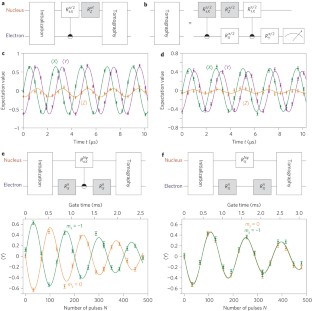
The alternative text for this image may have been generated using AI.
Figure 3: Two-qubit control and nuclear–nuclear entangling gate.

The alternative text for this image may have been generated using AI.
Figure 4: Implementation of three-qubit quantum error correction.
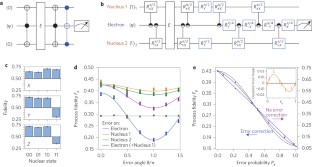
The alternative text for this image may have been generated using AI.
Change history
07 February 2014
In the version of this Letter originally published online, in Fig. 3b in one instance of R _X_π/2, a subscript 'α' was used instead of a subscript 'X'. This error has now been corrected in all versions of the Letter.
References
- Awschalom, D. D., Bassett, L. C., Dzurak, A. S., Hu, E. L. & Petta, J. R. Quantum spintronics: engineering and manipulating atom-like spins in semiconductors. Science 339, 1174–1179 (2013).
Article CAS Google Scholar - Koehl, W. F., Buckley, B. B., Heremans, F. J., Calusine, G. & Awschalom, D. D. Room temperature coherent control of defect spin qubits in silicon carbide. Nature 479, 84–87 (2011).
Article CAS Google Scholar - Yin, C. et al. Optical addressing of an individual erbium ion in silicon. Nature 497, 91–94 (2013).
Article CAS Google Scholar - Gurudev Dutt, M. V. et al. Quantum register based on individual electronic and nuclear spin qubits in diamond. Science 316, 1312–1316 (2007).
Article CAS Google Scholar - Neumann, P. et al. Multipartite entanglement among single spins in diamond. Science 320, 1326–1329 (2008).
Article CAS Google Scholar - Fuchs, G. D., Burkard, G., Klimov, P. V. & Awschalom, D. D. A quantum memory intrinsic to single nitrogen–vacancy centres in diamond. Nature Phys. 7, 789–793 (2011).
Article Google Scholar - Van der Sar, T. et al. Decoherence-protected quantum gates for a hybrid solid-state spin register. Nature 484, 82–86 (2012).
Article CAS Google Scholar - Maurer, P. C. et al. Room-temperature quantum bit memory exceeding one second. Science 336, 1283–1286 (2012).
Article CAS Google Scholar - Pfaff, W. et al. Demonstration of entanglement-by-measurement of solid-state qubits. Nature Phys. 9, 29–33 (2013).
Article CAS Google Scholar - Pla, J. J. et al. High-fidelity readout and control of a nuclear spin qubit in silicon. Nature 496, 334–338 (2013).
Article CAS Google Scholar - Dolde, F. et al. Room-temperature entanglement between single defect spins in diamond. Nature Phys. 9, 139–143 (2013).
Article CAS Google Scholar - Jiang, L. et al. Repetitive readout of a single electronic spin via quantum logic with nuclear spin ancillae. Science 326, 267–272 (2009).
Article CAS Google Scholar - Lee, S-Y. et al. Readout and control of a single nuclear spin with a metastable electron spin ancilla. Nature Nanotech. 8, 487–492 (2013).
Article CAS Google Scholar - Cory, D. G. et al. Experimental quantum error correction. Phys. Rev. Lett. 81, 2152–2155 (1998).
Article CAS Google Scholar - Moussa, O., Baugh, J., Ryan, C. A. & Laflamme, R. Demonstration of sufficient control for two rounds of quantum error correction in a solid state ensemble quantum information processor. Phys. Rev. Lett. 107, 160501 (2011).
Article Google Scholar - Schindler, P. et al. Experimental repetitive quantum error correction. Science 332, 1059–1061 (2011).
Article CAS Google Scholar - Reed, M. D. et al. Realization of three-qubit quantum error correction with superconducting circuits. Nature 482, 382–385 (2012).
Article CAS Google Scholar - Bernien, H. et al. Heralded entanglement between solid-state qubits separated by three metres. Nature 497, 86–90 (2013).
Article CAS Google Scholar - Nickerson, N. H., Li, Y. & Benjamin, S. C. Topological quantum computing with a very noisy network and local error rates approaching one percent. Nature Commun. 4, 1756 (2013).
Article Google Scholar - Neumann, P. et al. Single-shot readout of a single nuclear spin. Science 329, 542–544 (2010).
Article CAS Google Scholar - Robledo, L. et al. High-fidelity projective read-out of a solid-state spin quantum register. Nature 477, 574–578 (2011).
Article CAS Google Scholar - Dreau, A., Spinicelli, P., Maze, J. R., Roch, J. F. & Jacques, V. Single-shot readout of multiple nuclear spin qubits in diamond under ambient conditions. Phys. Rev. Lett. 110, 060502 (2013).
Article CAS Google Scholar - Taminiau, T. H. et al. Detection and control of individual nuclear spins using a weakly coupled electron spin. Phys. Rev. Lett. 109, 137602 (2012).
Article CAS Google Scholar - Kolkowitz, S., Unterreithmeier, Q. P., Bennett, S. D. & Lukin, M. D. Sensing distant nuclear spins with a single electron spin. Phys. Rev. Lett. 109, 137601 (2012).
Article Google Scholar - Zhao, N. et al. Sensing single remote nuclear spins. Nature Nanotech. 7, 657–662 (2012).
Article CAS Google Scholar - Hodges, J. S., Yang, J. C., Ramanathan, C. & Cory, D. G. Universal control of nuclear spins via anisotropic hyperfine interactions. Phys. Rev. A 78, 010303 (2008).
Article Google Scholar - Zhang, Y., Ryan, C. A., Laflamme, R. & Baugh, J. Coherent control of two nuclear spins using the anisotropic hyperfine interaction. Phys. Rev. Lett. 107, 170503 (2011).
Article Google Scholar - Maze, J. R., Taylor, J. M. & Lukin, M. D. Electron spin decoherence of single nitrogen–vacancy defects in diamond. Phys. Rev. B 78, 094303 (2008).
Article Google Scholar - London, P. et al. Detecting and polarizing nuclear spins with double resonance on a single electron spin. Phys. Rev. Lett. 111, 067601 (2013).
Article CAS Google Scholar - Filidou, V. et al. Ultrafast entangling gates between nuclear spins using photoexcited triplet states. Nature Phys. 8, 596–600 (2012).
Article CAS Google Scholar - Bar-Gill, N., Pham, L. M., Jarmola, A., Budker, D. & Walsworth, R. L. Solid-state electronic spin coherence time approaching one second. Nature Commun. 4, 1743 (2013).
Article CAS Google Scholar - Waldherr, G. et al. Quantum error correction in a solid-state hybrid spin register. Preprint at http://arxiv.org/abs/1309.6424 (2013).
Acknowledgements
The authors thank L. Childress, J.J.L. Morton, O. Moussa and L.M.K. Vandersypen for discussions and comments. T.H.T. acknowledges support from a Marie Curie Intra European Fellowship within the 7th European Community Framework Programme. Work at the Ames Laboratory was supported by the US Department of Energy Basic Energy Sciences (contract no. DE- AC02-07CH11358). The authors acknowledge support from the Dutch Organization for Fundamental Research on Matter (FOM), the Netherlands Organization for Scientific Research (NWO), the DARPA QuASAR programme, the EU SOLID and DIAMANT programmes, and the European Research Council through a Starting Grant.
Author information
Author notes
- T. van der Sar
Present address: Present address: Department of Physics, Harvard University, Cambridge, Massachusetts 02138, USA,
Authors and Affiliations
- Kavli Institute of Nanoscience, Delft University of Technology, PO Box 5046, 2600 GA Delft, The Netherlands
T. H. Taminiau, J. Cramer, T. van der Sar & R. Hanson - Ames Laboratory and Iowa State University, Ames, Iowa 50011, USA
V. V. Dobrovitski
Authors
- T. H. Taminiau
- J. Cramer
- T. van der Sar
- V. V. Dobrovitski
- R. Hanson
Contributions
V.V.D., T.H.T., T.v.d.S. and R.H. conceived the control method. T.H.T., J.C., T.v.d.S. and R.H. devised the experiments. T.H.T., J.C. and T.v.d.S. performed the measurements and processed the data. T.H.T. and R.H. wrote the manuscript. All authors analysed the results and commented on the manuscript.
Corresponding author
Correspondence toR. Hanson.
Ethics declarations
Competing interests
The authors declare no competing financial interests.
Supplementary information
Rights and permissions
About this article
Cite this article
Taminiau, T., Cramer, J., van der Sar, T. et al. Universal control and error correction in multi-qubit spin registers in diamond.Nature Nanotech 9, 171–176 (2014). https://doi.org/10.1038/nnano.2014.2
- Received: 15 September 2013
- Accepted: 07 January 2014
- Published: 02 February 2014
- Issue date: March 2014
- DOI: https://doi.org/10.1038/nnano.2014.2
This article is cited by
Associated content
Three of diamonds
- John J. L. Morton
- Jeroen Elzerman
Nature Nanotechnology News & Views 05 Mar 2014