Multi-country evidence that crop diversification promotes ecological intensification of agriculture (original) (raw)
- Letter
- Published: 22 February 2016
- Zhongxian Lu3 na1,
- Xusong Zheng3,
- Hongxing Xu3,
- Pingyang Zhu ORCID: orcid.org/0000-0003-0417-65834,
- Guihua Chen4,
- Xiaoming Yao4,
- Jiaan Cheng5,
- Zengrong Zhu5,
- Josie Lynn Catindig6,
- Sylvia Villareal6,
- Ho Van Chien7,
- Le Quoc Cuong7,
- Chairat Channoo8,
- Nalinee Chengwattana8,
- La Pham Lan9,
- Le Huu Hai10,
- Jintana Chaiwong11,
- Helen I. Nicol2,
- David J. Perovic1,
- Steve D. Wratten12 &
- …
- Kong Luen Heong6,13
Nature Plants volume 2, Article number: 16014 (2016) Cite this article
- 5885 Accesses
- 429 Citations
- 81 Altmetric
- Metrics details
Subjects
Abstract
Global food security requires increased crop productivity to meet escalating demand1–3. Current food production systems are heavily dependent on synthetic inputs that threaten the environment and human well-being2,4,5. Biodiversity, for instance, is key to the provision of ecosystem services such as pest control6,7, but is eroded in conventional agricultural systems. Yet the conservation and reinstatement of biodiversity is challenging5,8,9, and it remains unclear whether the promotion of biodiversity can reduce reliance on inputs without penalizing yields on a regional scale. Here we present results from multi-site field studies replicated in Thailand, China and Vietnam over a period of four years, in which we grew nectar-producing plants around rice fields, and monitored levels of pest infestation, insecticide use and yields. Compiling the data from all sites, we report that this inexpensive intervention significantly reduced populations of two key pests, reduced insecticide applications by 70%, increased grain yields by 5% and delivered an economic advantage of 7.5%. Additional field studies showed that predators and parasitoids of the main rice pests, together with detritivores, were more abundant in the presence of nectar-producing plants. We conclude that a simple diversification approach, in this case the growth of nectar-producing plants, can contribute to the ecological intensification of agricultural systems.
This is a preview of subscription content, access via your institution
Access options
Subscribe to this journal
Receive 12 digital issues and online access to articles
$119.00 per year
only $9.92 per issue
Buy this article
- Purchase on SpringerLink
- Instant access to the full article PDF.
USD 39.95
Prices may be subject to local taxes which are calculated during checkout
Additional access options:
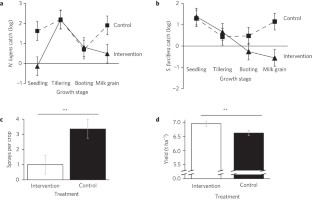
Figure 1: Multi-site, multi-year comparison of diversification of rice (intervention) with conventional practice (control).
The alternative text for this image may have been generated using AI.
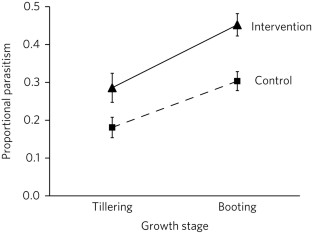
Figure 2: Parasitoid activity in rice with diversification (intervention) and with conventional practice (control).
The alternative text for this image may have been generated using AI.
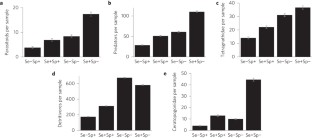
Figure 3: Response of ecosystem service provider guilds and taxa to insecticide and the presence of nectar-producing plants (sesame) on bunds around rice fields.
The alternative text for this image may have been generated using AI.
References
- Godfray, H. C. & Garnett, T. Food security and sustainable intensification. Phil. Trans. R. Soc. B. 369, 20120273 (2014).
Article Google Scholar - West, P. C. et al. Leverage points for improving global food security and the environment. Science 345, 325–328 (2014).
Article CAS Google Scholar - Tilman, D., Balzer, C., Hill, J. & Befort, B. L. Global food demand and the sustainable intensification of agriculture. Proc. Natl Acad. Sci. USA 108, 20260–20264 (2011).
Article CAS Google Scholar - Stehle, S. & Schulz, R. Agricultural insecticides threaten surface waters at the global scale. Proc. Natl Acad. Sci. USA 112, 5750–5755 (2015).
Article CAS Google Scholar - Foley, J. A. et al. Global consequences of land use. Science 309, 570–574 (2005).
Article CAS Google Scholar - Costanza, R. et al. The value of the world's ecosystem services and natural capital. Nature 387, 253–260 (1997).
Article CAS Google Scholar - Losey, J. E. & Vaughan, M. The economic value of ecological services provided by insects. Bioscience 56, 311–323 (2006).
Article Google Scholar - Matson, P. A., Parton, W. J., Power, A. G. & Swift, M. J. Agricultural intensification and ecosystem properties. Science 277, 504–509 (1997).
Article CAS Google Scholar - Bennett, E. et al. Toward a more resilient agriculture. Solutions 5, 65–75 (2014).
Google Scholar - Phalan, B., Onial, M., Balmford, A. & Green, R. E. Reconciling food production and biodiversity conservation: land sharing and land sparing compared. Science 333, 1289–1291 (2011).
Article CAS Google Scholar - Foley, J. A. et al. Solutions for a cultivated planet. Nature 478, 337–342 (2011).
Article CAS Google Scholar - Gill, R. J., Ramos-Rodriguez, O. & Raine, N. E. Combined pesticide exposure severely affects individual- and colony-level traits in bees. Nature 491, 105–108 (2012).
Article CAS Google Scholar - Diaz, R. J. & Rosenberg, R. Spreading dead zones and consequences for marine ecosystems. Science 321, 926–929 (2008).
Article CAS Google Scholar - Eskenazi, B. et al. Organophosphate pesticide exposure and neurodevelopment in young Mexican-American children. Environ. Health Persp. 115, 792–798 (2007).
Article CAS Google Scholar - Loos, J. et al. Putting meaning back into “sustainable intensification”. Front. Ecol. Environ. 12, 356–361 (2014).
Article Google Scholar - Cardinale, B. J. et al. Effects of biodiversity on the functioning of trophic groups and ecosystems. Nature 443, 989–992 (2006).
Article CAS Google Scholar - Bommarco, R., Kleijn, D. & Potts, S. G. Ecological intensification: harnessing ecosystem services for food security. Trends Ecol. Evol. 28, 230–238 (2013).
Article Google Scholar - Wood, S. A. et al. Functional traits in agriculture: agrobiodiversity and ecosystem services. Trends Ecol. Evol. 30, 531–539 (2015).
Article Google Scholar - Ekroos, J., Olsson, O., Rundlöf, M., Wätzold, F. & Smith, H. G. Optimizing agri-environment schemes for biodiversity, ecosystem services or both? Biol. Conserv. 172, 65–71 (2014).
Article Google Scholar - Letourneau, D. K. et al. Does plant diversity benefit agroecosystems? A synthetic review. Ecol. Appl. 21, 9–21 (2011).
Article Google Scholar - Pretty, J. N. et al. Resource-conserving agriculture increases yields in developing countries. Environ. Sci. Technol. 40, 1114–1119 (2006).
Article CAS Google Scholar - Khan, Z. R. et al. Exploiting chemical ecology and species diversity: stem borer and striga control for maize and sorghum in Africa. Pest Manag. Sci. 56, 957–962 (2000).
Article CAS Google Scholar - Crowder, D. W., Northfield, T. D., Strand, M. R. & Snyder, W. E. Organic agriculture promotes evenness and natural pest control. Nature 466, 109–112 (2010).
Article CAS Google Scholar - Seufert, V., Ramankutty, N. & Foley, J. A. Comparing the yields of organic and conventional agriculture. Nature 485, 229–232 (2012).
Article CAS Google Scholar - Kremen, C. & Miles, A. Ecosystem services in biologically diversified versus conventional farming systems: benefits, externalities, and trade-offs. Ecol. Soc. 17, 40 (2012).
Google Scholar - Luck, G. W. et al. Quantifying the contribution of organisms to the provision of ecosystem services. Bioscience 59, 223–235 (2009).
Article Google Scholar - Wäckers, F. L., Romeis, J. & van Rijn, P. Nectar and pollen feeding by insect herbivores and implications for multitrophic interactions. Annu. Rev. Entomol. 52, 301–323 (2007).
Article Google Scholar - Zhu, P. et al. Laboratory screening supports the selection of sesame (Sesamum indicum) to enhance Anagrus spp. parasitoids (Hymenoptera: Mymaridae) of rice planthoppers. Biol. Control 64, 83–89 (2013).
Article Google Scholar - Liu, Z. et al. A nicotinic acetylcholine receptor mutation conferring target-site resistance to imidacloprid in Nilaparvata lugens (brown planthopper). Proc. Natl Acad. Sci. USA 102, 8420–8425 (2005).
Article CAS Google Scholar - Czaja, K. et al. Biopesticides—towards increased consumer safety in the European Union. Pest Manag. Sci. 71, 3–6 (2015).
Article CAS Google Scholar
Acknowledgements
This work was supported by the Asian Development Bank (TA7648-R-RDTA) and National Basic Research Program of China (973, grant no. 2010CB126200). G.M.G. is supported by a Chinese Government Thousand Talents fellowship. We thank the farmers who hosted field experiments and J. Tylianakis (Christchurch University, New Zealand) for comments on this manuscript. Assistance with arthropod sorting and taxonomy was provided by Y. Yang, G. Wenqin, L. Ding and D. Biqing of Zhejiang Academy of Agricultural Sciences, and F. Zhang and X. Sheng of Jianhua Plant Protection Station, China.
Author information
Author notes
- Geoff M. Gurr and Zhongxian Lu: These authors contributed equally to this work.
Authors and Affiliations
- Institute of Applied Ecology, Fujian Agriculture and Forestry, University, Fuzhou, 35002, Fujian, China
Geoff M. Gurr & David J. Perovic - Graham Centre, Charles Sturt University, Orange, 2800, New South Wales, Australia
Geoff M. Gurr & Helen I. Nicol - State Key Laboratory Breeding Base for Zhejiang Sustainable Pest and Disease Control, Institute of Plant Protection and Microbiology, Zhejiang Academy of Agriculture Sciences, Hangzhou 310021, China
Zhongxian Lu, Xusong Zheng & Hongxing Xu - Jinhua Plant Protection Station, Jinhua 321017, China
Pingyang Zhu, Guihua Chen & Xiaoming Yao - Institute of Insect Sciences, Zhejiang University, Hangzhou 310058, China
Jiaan Cheng & Zengrong Zhu - Crop and Environmental Sciences Division, International Rice Research Institute, DAPO Box 7777, Metro Manila 1301, The Philippines
Josie Lynn Catindig, Sylvia Villareal & Kong Luen Heong - Southern Regional Plant Protection Center, Long Dinh 860000, Vietnam
Ho Van Chien & Le Quoc Cuong - Chainat Rice Research Center, Chainat 17000, Thailand
Chairat Channoo & Nalinee Chengwattana - Institute of Agricultural Science for Southern Vietnam, Ho Chi Minh City 700000, Vietnam
La Pham Lan - TienGiang University, Tien Giang 860000, Vietnam
Le Huu Hai - Rice Department, Bureau of Rice Research and Development, Bangkok 10220, Thailand
Jintana Chaiwong - Bio-Protection Research Centre, Lincoln University, Christchurch 7642, New Zealand
Steve D. Wratten - Centre for Agricultural Biosciences International (CABI), South East Asia, Regional Centre, Universiti Putra Malaysia, Serdang 43400, Malaysia
Kong Luen Heong
Authors
- Geoff M. Gurr
- Zhongxian Lu
- Xusong Zheng
- Hongxing Xu
- Pingyang Zhu
- Guihua Chen
- Xiaoming Yao
- Jiaan Cheng
- Zengrong Zhu
- Josie Lynn Catindig
- Sylvia Villareal
- Ho Van Chien
- Le Quoc Cuong
- Chairat Channoo
- Nalinee Chengwattana
- La Pham Lan
- Le Huu Hai
- Jintana Chaiwong
- Helen I. Nicol
- David J. Perovic
- Steve D. Wratten
- Kong Luen Heong
Contributions
G.M.G. and K.L.H. conceived and designed the project; Z.L., Z.Z., J.C. and G.C. led the Chinese studies supported by X.Z., X.Y., H.X. and P.Z.; H.V.C. and L.Q.C. led the Vietnamese studies; C.C. led the Thai studies; N.C. and P.Z. performed the bait plant study; and P.Z. and X.Z. performed the factorial study; P.V., J.L.C., L.P.L., J.C. and S.V. identified arthropods; H.I.N., D.J.P. and G.M.G. analysed the data; G.M.G. led the manuscript writing with input from all authors.
Corresponding author
Correspondence toKong Luen Heong.
Ethics declarations
Competing interests
The authors declare no competing financial interests.
Supplementary information
Rights and permissions
About this article
Cite this article
Gurr, G., Lu, Z., Zheng, X. et al. Multi-country evidence that crop diversification promotes ecological intensification of agriculture.Nature Plants 2, 16014 (2016). https://doi.org/10.1038/nplants.2016.14
- Received: 02 November 2015
- Accepted: 22 January 2016
- Published: 22 February 2016
- DOI: https://doi.org/10.1038/nplants.2016.14