Increased angiotensin-receptor blocking is not the first option (original) (raw)
- News & Views
- Published: July 2009
Proteinuria
Nature Reviews Nephrology volume 5, pages 367–368 (2009)Cite this article
- 166 Accesses
- 12 Citations
- Metrics details
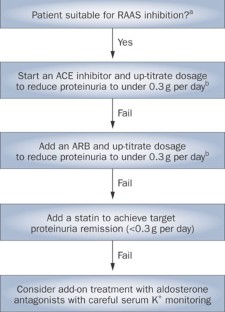
Candesartan doses in excess of the recommended antihypertensive maxima have been reported to lead to greater reductions of proteinuria than the advised doses. High-dose angiotensin-converting-enzyme inhibitors, however, are at least as effective as high-dose angiotensin blockers and less expensive. Angiotensin-converting-enzyme inhibition is thus the first-line strategy to halt kidney disease progression.
This is a preview of subscription content, access via your institution
Relevant articles
Open Access articles citing this article.
The role of renin angiotensin system inhibition in kidney repair
- Irene M van der Meer
- , Paolo Cravedi
- & Giuseppe Remuzzi
Fibrogenesis & Tissue Repair Open Access 04 May 2010
Access options
Subscribe to this journal
Receive 12 print issues and online access
$189.00 per year
only $15.75 per issue
Buy this article
- Purchase on SpringerLink
- Instant access to the full article PDF.
USD 39.95
Prices may be subject to local taxes which are calculated during checkout
Additional access options:
Figure 1: Algorithm for the treatment of patients with proteinuric kidney disease.
References
- Burgess, E. et al. Supramaximal dose of candesartan in proteinuric renal disease. J. Am. Soc. Nephrol. doi:10.1681/ASN.2008040416 (2009).
- Hollemberg, N. K. et al. Albuminuria response to very high-dose valsartan in type 2 diabetes mellitus. J. Hypertens. 25, 1921–1926 (2007).
Article Google Scholar - Remuzzi, G., Benigni, A. & Remuzzi, A. Mechanisms of progression and regression of renal lesions of chronic nephropathies and diabetes. J. Clin. Invest. 116, 288–296 (2006).
Article CAS Google Scholar - Ruggenenti, P., Perna, A., Remuzzi, G. & GISEN Group Investigators. Retarding progression of chronic renal disease: the neglected issue of residual proteinuria. Kidney Int. 63, 2254–2261 (2003).
Article CAS Google Scholar - Ruggenenti, P., Perna, A., Gherardi, G., Benini, R. & Remuzzi, G. Chronic proteinuric nephropathies: outcomes and response to treatment in a prospective cohort of 352 patients with different patterns of renal injury. Am. J. Kidney Dis. 35, 1155–1165 (2000).
Article CAS Google Scholar - Hou, F. F. et al. Renoprotection of Optimal Antiproteinuric Doses (ROAD) Study: a randomized controlled study of benazepril and losartan in chronic renal insufficiency. J. Am. Soc. Nephrol. 18, 1889–1898 (2007).
Article CAS Google Scholar - Ruggenenti, P. et al. Diverse effects of increasing lisinopril doses on lipid abnormalities in chronic nephropathies. Circulation 107, 586–592 (2003).
Article CAS Google Scholar - Catapano, F. et al. Antiproteinuric response to dual blockade of the renin-angiotensin system in primary glomerulonephritis: meta-analysis and metaregression. Am. J. Kidney Dis. 52, 475–485 (2008).
Article Google Scholar - Campbell, R. et al. Effects of combined ACE inhibitor and angiotensin II antagonist treatment in human chronic nephropathies. Kidney Int. 63, 1094–1103 (2003).
Article CAS Google Scholar - Ruggenenti, P. et al. Role of remission clinics in the longitudinal treatment of CKD. J. Am. Soc. Nephrol. 19, 1213–1224 (2008).
Article Google Scholar
Author information
Author notes
- G. Remuzzi, “Mario Negri” Institute for Pharmacological Research, Negri Bergamo Laboratories, Via Gavazzeni 11, 24125 Bergamo, Italy gremuzzi@marionegri.it
Authors and Affiliations
- Clinical Research Center for Rare Diseases 'Aldo & Cele Daccò' and Mario Negri Institute for Pharmacological Research, Bergamo, Italy
Piero Ruggenenti, Paolo Cravedi & Giuseppe Remuzzi
Authors
- Piero Ruggenenti
- Paolo Cravedi
- Giuseppe Remuzzi
Ethics declarations
Competing interests
The authors declare no competing financial interests.
Rights and permissions
About this article
Cite this article
Ruggenenti, P., Cravedi, P. & Remuzzi, G. Increased angiotensin-receptor blocking is not the first option.Nat Rev Nephrol 5, 367–368 (2009). https://doi.org/10.1038/nrneph.2009.77
- Issue date: July 2009
- DOI: https://doi.org/10.1038/nrneph.2009.77
This article is cited by
Achieving remission of proteinuria in childhood CKD
- Piero Ruggenenti
- Paolo Cravedi
- Giuseppe Remuzzi
Pediatric Nephrology (2017)
The role of renin angiotensin system inhibition in kidney repair
- Irene M van der Meer
- Paolo Cravedi
- Giuseppe Remuzzi
Fibrogenesis & Tissue Repair (2010)
The RAAS in the pathogenesis and treatment of diabetic nephropathy
- Piero Ruggenenti
- Paolo Cravedi
- Giuseppe Remuzzi
Nature Reviews Nephrology (2010)