The Forest Observation System, building a global reference dataset for remote sensing of forest biomass (original) (raw)
Background & Summary
Global estimates of forest height, aboveground biomass (AGB) and changes over space and time are needed as both essential climate variables1 and essential biodiversity variables2, and to support international policy initiatives such as REDD+ 3. Several space-borne missions to assess forest structure and functioning, including BIOMASS (ESA), ALOS PALSAR (JAXA), GEDI (NASA) and NISAR (NASA-ISRO), will be operational in the coming years. These missions require ground-based estimates for algorithm calibration and product validation. For instance, high-quality, standardized measurements of forest biomass and height are critical for improving the accuracy of products derived from space-borne instruments. Furthermore, ensuring that different missions have access to the same set of high-quality standardized measurements for calibration and validation should vastly help improve comparability and confidence in future remote sensing (RS) products.
Remote Sensing users typically have different product requirements compared to those of the ecological and forestry communities. Namely, RS users often (1) need access to AGB estimates at the pixel level, while ecologists and foresters produce area-based estimates derived from individual trees measurements. RS users typically (2) need products at a consistent spatial resolution, while a variety of plot sizes and shapes have been adopted by ecologists and foresters. Finally, RS users (3) require AGB to be computed via globally and regionally consistent routines, while various approaches have been developed to derive AGB estimates from tree measurements. These communities also operate differently from a funding perspective. Most notably, recurrent investments are needed to maintain permanent forest plots – including censuses that temporally match RS data collection – and to ensure field and botanical staff are paid and trained, without whom the data would not be collected. In contrast, RS users typically access data provided by space-borne missions that have already been funded. Despite these differences, there is a clear need to share existing data sets for the benefit of both communities.
The Forest Observation System – FOS (http://forest-observation-system.net/) – is an international, collaborative initiative that aims to establish a global in situ forest AGB database to support Earth Observation (EO) and to encourage investment in relevant field-based measurements and research[4](/articles/s41597-019-0196-1#ref-CR4 "Chave, J. et al. Ground data are essential for biomass remote sensing missions. Surv. Geophys. https://doi.org/10.1007/s10712-019-09528-w
(2019)."). The FOS enables access to high-quality field data by partnering with some of the most well-established teams and networks responsible for managing permanent forest plots globally. In doing so, FOS is benefiting both the RS and ecological/forestry communities while facilitating positive interactions between them.To this end, the FOS project has established a data sharing policy and framework that seeks to overcome existing barriers between data providers and users. For example, data made available on the FOS website are plot-aggregated (i.e., stand AGB, canopy height, etc.), while the underlying original tree-by-tree data are managed by participating ecological networks. To ensure that estimates added to the FOS are robust and consistent, a freely downloadable BIOMASS R-package[5](/articles/s41597-019-0196-1#ref-CR5 "Réjou-Méchain, M., Tanguy, A., Piponiot, C., Chave, J. & Hérault, B. biomass: an r package for estimating above-ground biomass and its uncertainty in tropical forests. Methods Ecol. Evol, https://doi.org/10.1111/2041-210X.12753
             (2017).") has been upgraded, which makes the procedure for computing plot AGB estimates from tropical forest inventories transparent, standardized and reproducible. There are developments underway to make the package usable for any forest type, including boreal and temperate ecosystems. This work has been complemented by the definition of a set of technical requirements and standards aimed at ensuring data comparability[4](/articles/s41597-019-0196-1#ref-CR4 "Chave, J. et al. Ground data are essential for biomass remote sensing missions. Surv. Geophys.
              https://doi.org/10.1007/s10712-019-09528-w

             (2019).").
The FOS currently hosts aggregate data from plots contributed by several existing networks, including: the network of the Center for Tropical Forest Science – Forest Global Earth Observatory (CTFS-ForestGEO)6, the RAINFOR7, AfriTRON8 and T-FORCES9 (curated on the ForestPlots.net platform)10, the IIASA network11,12, the Tropical Managed Forests Observatory (TmFO)13 and AusCover14. These international collaborations have already (i) invested in establishing permanent sampling plots; (ii) proposed robust protocols for accurate tree mapping and measurement, which are largely standardized across networks; (iii) monitored existing plots repeatedly; and (iv) established databases with particular emphasis on data quality control10,15. As the FOS is an open initiative, additional networks (e.g., GFBI16) and teams that comply with the aforementioned criteria are welcome to join in the future.
The data presented here have been partly published before17,18,19,20,21, but never in such a unified and comprehensive manner. Results based on some of the plots presented here have impacted a wide range of scientific fields, including tropical forest ecology22,23,24,25,26, drought sensitivity of forests19,27,28,29, tree allometry30,31,32,33, carbon cycles21,34,35,36, remote sensing18,37,38,39, climate change8,40,41,42,43, biodiversity44,45,46,47, diversity-carbon relationships48,49 and historical forest use50,51, among others.
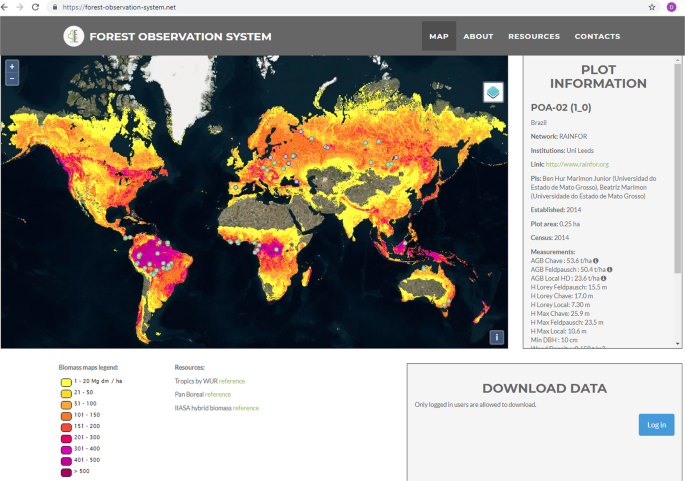
The online database (http://forest-observation-system.net/) provides open access to the canopy height and biomass estimates as well as information about the plot PIs who have granted access to the data (see Fig. 1 below).
Fig. 1
The alternative text for this image may have been generated using AI.
The Forest-Observation-System.net web portal.
Methods
Within the sample plots, every stem above a defined threshold in diameter at breast height (DBH, usually 1, 5, 7 or 10 cm) was taxonomically identified and the DBH measured, avoiding any buttresses or deformities. In most plots, tree height was measured for a subset of trees that are representative of different diameter classes and tree species in order to develop site-specific height-diameter regression equations. Based on an analysis using the tropical forest plot data, as few as 40 tree height observations are sufficient for characterizing this relationship if stratified by diameter22.
All the data presented here were collected from permanent forest sample plots with known locations; accurate coordinates (with an error of less than 30 meters) have been either delivered to the FOS or will be recorded during the next census. Plot sizes are typically 1 ha in area (i.e., the median), but they can vary from 0.25 ha to 50 ha. Large plots are subdivided into 0.25 ha, i.e., 50 × 50 m sub-plots. The FOS consortium made the decision to consider only relatively large and permanent plots in order to reduce errors in georeferencing and to decrease the variability in the measured parameters. Recent research has quantified the effect of spatial resolution on the uncertainties in the AGB estimates, with sampling error dropping from 46.3% for 0.1 ha plots, to 26% and 16.5% for 0.25 ha and 1 ha plots, respectively52. Scaling up from the plot to the landscape level using lidar-derived metrics, studies have shown decreases in the RMSE for the AGB-lidar models, from 70–90 to 36–51 Mg AGB per ha, when increasing the plot size from 0.25 ha to 1 ha17,53. Clearly there are always size-effort tradeoffs, e.g., smaller plots would permit greater replication, but by focusing on larger plots that are also permanent, FOS has chosen to focus its efforts on a smaller but high-quality set of plots. Our approach, therefore, excludes the possibility of using databases of smaller plots such as those found in national forest inventories.
AGB and associated uncertainties were obtained using a standardized procedure implemented in the BIOMASS R-package[5](/articles/s41597-019-0196-1#ref-CR5 "Réjou-Méchain, M., Tanguy, A., Piponiot, C., Chave, J. & Hérault, B. biomass: an r package for estimating above-ground biomass and its uncertainty in tropical forests. Methods Ecol. Evol, https://doi.org/10.1111/2041-210X.12753
             (2017)."). For the sake of standardization, we systematically considered only trees having a diameter ≥10 cm (or a 5 cm threshold in the case where these trees contribute substantially (>5%) to the total AGB, e.g., in savannas). Taxonomy was first checked using the Taxonomic Name Resolution Service, which in turn served to assign a wood density value to each tree using the Global Wood Density Database (GWDD) as a reference[54](/articles/s41597-019-0196-1#ref-CR54 "Chave, J. et al. Towards a worldwide wood economics spectrum. Ecol. Lett. 12, 351–366 (2009)."),[55](/articles/s41597-019-0196-1#ref-CR55 "Zanne, A. E. et al. Global Wood Density Database. Dryad Digital Repository,
              https://doi.org/10.5061/dryad.234/1

             (2009)."). Species- or genus-level averages were assigned when possible and, if not, the plot-level mean wood density was assigned to each tree species with no known wood density. Tree height was estimated in three different ways. First, when available, subsets of tree height measurements were used to build plot-specific height-diameter relationships, assuming a three-parameter Weibull model[5](/articles/s41597-019-0196-1#ref-CR5 "Réjou-Méchain, M., Tanguy, A., Piponiot, C., Chave, J. & Hérault, B. biomass: an r package for estimating above-ground biomass and its uncertainty in tropical forests. Methods Ecol. Evol,
              https://doi.org/10.1111/2041-210X.12753

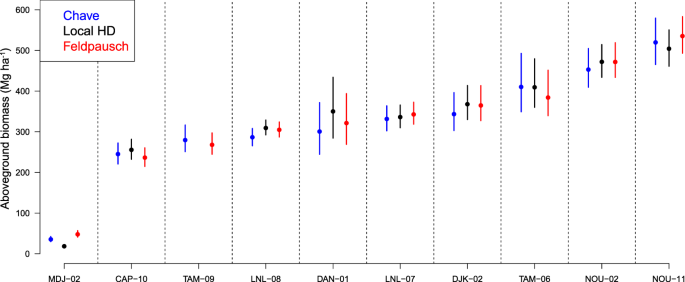
             (2017).") or a two-parameter Michaelis-Menten model, whichever provided the lowest prediction error. Secondly, the regional height-diameter models proposed by Feldpausch _et al_.[31](/articles/s41597-019-0196-1#ref-CR31 "Feldpausch, T. R. et al. Tree height integrated into pantropical forest biomass estimates. Biogeosciences 9, 3381–3403 (2012).") were used to infer tree height. Finally, height was implicitly taken into consideration in the AGB calculation through the use of the bioclimatic predictor E proposed by Chave _et al_.[30](/articles/s41597-019-0196-1#ref-CR30 "Chave, J. et al. Improved allometric models to estimate the aboveground biomass of tropical trees. Glob. Change Biol. 20, 3177–3190 (2014)."). Equation 7 of Chave _et al_.[30](/articles/s41597-019-0196-1#ref-CR30 "Chave, J. et al. Improved allometric models to estimate the aboveground biomass of tropical trees. Glob. Change Biol. 20, 3177–3190 (2014).") was used in this case while the generalized allometric model equation 4 was used otherwise (where heights were derived from local or Feldpausch height-diameter relationships). Among the three approaches, the use of a local HD model is the most accurate. However, local height measurements are not systematically available for all plots. The Chave _et al_. (2014) and Feldpausch _et al_. (2012) approaches are both an alternative to the use of a local HD model but independent validation (e.g., Fig. [2](/articles/s41597-019-0196-1#Fig2)) has shown that their relative performance varies among locations. Thus, the most conservative approach is to provide the three estimates so that the uncertainty associated with the HD relationship can be assessed.
Fig. 2
The alternative text for this image may have been generated using AI.
An example of the AGB estimation with the BIOMASS R-package. MDJ-02, CAP-10 and other indexes on the horizontal axis are Plot IDs. The vertical axis is AGB in Mg ha−1 and the error bar represents the credibility interval at 95% of the stand AGB value following error propagation.
Errors associated with each of these steps (i.e., DBH measurement, wood density, tree height) were propagated through a Monte Carlo scheme to provide mean AGB estimates with associated credibility intervals (Fig. 2).
Boreal and temperate plots (representing 11% of the total number of sub-plots) were processed manually using similar steps. Species-specific allometric equations56 allowed the stem volume to be estimated based on the height and DBH measurements. Biomass conversion and expansion factors57 were used to estimate AGB from the stem volume taking the tree age, site index and stocking into account. The next version of the BIOMASS R-package will be capable of processing boreal and temperate data in addition to tropical.
Data Records
The data in FOS[58](/articles/s41597-019-0196-1#ref-CR58 "Schepaschenko, D. et al. A global reference dataset for remote sensing of forest biomass. The Forest Observation System approach. IIASA, https://doi.org/10.22022/ESM/03-2019.38
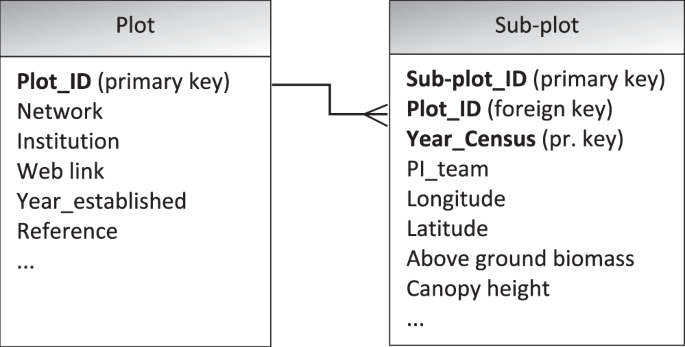
(2019).") are organized in a hierarchical structure (Fig. [3](/articles/s41597-019-0196-1#Fig3)). The **Plot** description includes a link to the institution and network. The central part of the database is the **Sub-plot** table, where geolocation, the date of the census, the people who manage the specific plots, the AGB and the canopy height are stored.Fig. 3
The alternative text for this image may have been generated using AI.
The database structure of the plot information.
The FOS does not store individual tree-level information, only plot-level aggregates. Users interested in tree-level information can contact the contributing networks or the plot PIs using the links provided in the Plot table.
The details of the fields found in the two linked tables of Fig. 3 are provided below.
Plot description
- Plot_ID – unique plot ID
- Country_Name – Name of the country
- Network – the name of the network (e.g., RAINFOR)
- Institution – the institution that carried out the measurements
- Link – web link to the data provider
- Year_established – the year when the plot was established
- Reference – a reference to the publications
- Other_measurements – list of parameters measured on the plot
- Biomass_processing_protocol – file name of the biomass processing protocol (available at Data Package 1), which contains the R code, the variables assigned and the intermediate results.
Sub-plot description
- Sub-plot_ID – unique sub-plot ID
- Plot_ID – link to the Plot description table
- Year_census – year of the census
- PI_team – List of Principal Investigator(s)
- Lat_cnt – Latitude of the center of the plot
- Long_cnt – Longitude of the center of the plot
- Altitude (m a.s.l.)
- Slope (degree)
- Plot_area (ha)
- Plot_shape (e.g., rectangle, circle, plus dimensions)
- Forest_status – forest description, including age, successional stage, disturbances, etc.
- Min_DBH – Minimum diameter of trees at breast height included in the census (cm)
- H_Lorey – Lorey’s height, DBH-weighted mean tree height (m)
- H_max – height of the tallest tree (m)
- Hmax local – tallest tree measured or estimated from local H = f(DBH) curve (m)
- Hmax Chave – maximum height estimated from the curve by Chave (m)
- Hmax Feldpausch – maximum height estimated from the curve by Feldpausch (m)
- AGB – Above ground biomass (Mg ha−1)
- AGB_local – aboveground biomass (Mg ha−1) estimated using local equations or equation 4 in Chave30 with wood density, DBH and H derived from local height-diameter relationships.
* Cred_2.5 – lower bound of 95% credibility interval (Mg ha−1)
* Cred_97.5– upper bound of 95% credibility interval (Mg ha−1) - AGB_Feldpausch – AGB (Mg ha−1) using equation 4 in Chave30 with wood density, DBH and H derived from Feldpausch31 height-diameter relationship.
* Cred_2.5 – lower bound of 95% credibility interval (Mg ha−1)
* Cred_97.5 – upper bound of 95% credibility interval (Mg ha−1) - AGB_Chave – aboveground biomass (in Mg ha−1) estimated using equation 7 in Chave30 with wood density, DBH and H implicitly taken into consideration through the use of the bioclimatic predictor E
* Cred_2.5 – lower bound of 95% credibility interval (Mg ha−1)
* Cred_97.5 – upper bound of 95% credibility interval (Mg ha−1)
- AGB_local – aboveground biomass (Mg ha−1) estimated using local equations or equation 4 in Chave30 with wood density, DBH and H derived from local height-diameter relationships.
- Wood_density - mean wood density of the trees (g cm−3)
- GSV – growing stock volume (m3 ha−1)
- BA – basal area (m2 ha−1)
- Ndens – number of trees per hectare
Note that we have merged the Plot and Sub-plot tables in the data package associated with this paper[58](/articles/s41597-019-0196-1#ref-CR58 "Schepaschenko, D. et al. A global reference dataset for remote sensing of forest biomass. The Forest Observation System approach. IIASA, https://doi.org/10.22022/ESM/03-2019.38
(2019).") for the user’s convenience.Technical Validation
The key predictive variables of AGB are tree dimensions (primarily diameter and height) and taxonomic identity, which is responsible for explaining most tree-to-tree variations through interspecific wood density variations59. The procedures for ensuring the quality of the data collected are as follows:
- (1)
On-site measurement accuracy. To ensure diameter accuracy and consistency among and within censuses, field teams follow standard forest inventory protocols for the correct choice of the Point of measurement (POM). For example, the RAINFOR protocol for tropical forests60 records each POM by painting the location on each tree to ensure that subsequent measurements can be performed at the same point. For tree height, the consistency of the height measurement is ensured by having a designated, trained operator who works at multiple sites using the same instrument. At some sites, double measurements of height (from different positions) have been carried out, and mean values have been used as the height of the individual trees. For species identification, the reliability in highly diverse tropical plots is important; hence, the tree and plot AGB is estimated by taking the species-level variability in wood density into account61. This is supported by collecting botanical vouchers from every taxon (or potential taxon) in the field. In many cases, these vouchers have been deposited in recognized regional herbaria, identified by botanical experts, and where possible, made available electronically (e.g., via ForestPlots.net). However, voucher collection is not currently a standard protocol for every plot in the FOS. - (2)
Multiple censusing. By working primarily with re-censused permanent plots rather than single census plots, we have ensured that the uncertainties are reduced because almost every tree has been measured at least twice by the time of the focal census, thus providing the opportunity to correct any errors that may have been made previously, through the identification of spurious values. Repeat censuses also provide more opportunities to improve species identification by increasing the chance of encountering fertile material (see the next step). - (3)
Post fieldwork data processing, e.g., by identifying trees to species level. Species identification can be extremely challenging in tropical forests due to their diversity and the fact that most trees lack flowers or fruits when inventoried. Botanical identity is a key control on the AGB through its effect on wood density. To explore the reliability of identification in some of the most diverse RAINFOR sites in western Amazonia, PIs have separated the tree species assemblages into several larger taxonomic groups. As reported by Baker et al.62, taxonomic specialists for each group have then assessed the accuracy of the species identifications of the herbarium collections using 18 different botanists across 60 plots during the past 30 years. Overall, even in taxonomically difficult groups where species are often very rare, 75% of tree species were correctly identified. - (4)
Common protocols for potential error detection. These protocols have been developed by contributing networks, e.g., by flagging trees for attention that have declined by more than 5 mm in diameter. This allows trees to be detected that have shrunk between two censuses, and whether that individual is dead/rotten. Potential issues are flagged in order to be checked against existing field notes, and during the following census. Thus, as mentioned previously, repeat censuses provide more opportunities to improve data quality as compared to single-census plots. - (5)
Within-network collaboration. Data quality is further enhanced through the exchange of ideas between experts at different sites and between nations, through the use of common data analysis protocols (i.e., allometric equations, R packages, etc.), and by promoting shared publications. - (6)
Cross-network collaboration. In the FOS, by applying a uniform R script for data aggregation and AGB estimation, potential biases from using different height-diameter, wood density and allometric relations are strongly reduced.
The distribution of FOS plots by continent is presented in Table 1. Africa, Europe and South America are represented by similar numbers of locations (i.e., 62–80 plots) and contribute more than 80% of the plots at the time of publication, but in terms of coverage, South America alone comprises 49% of the forest area covered.
Table 1 Distribution of records by continents (as of December 2018).
The IIASA network provides the highest number of plot locations to FOS (Table 2), while the TmFO network contributes the most in terms of areal coverage.
Table 2 The distribution of records by participating networks (as of December 2018).
The range of values of major forest parameters represented in the FOS database is shown in Table 3. The maximum AGB value (918 Mg ha−1) and canopy height (41.7 m) at a 0.25 ha sub-plot were recorded in Lopé, Gabon. Some savannah sub-plots (e.g., in Gabon) have a few or no trees >5 cm dbh, which leads to low or no biomass estimation. The tallest trees (60.1 m) was found in Costa Rica and the maximum basal area (85.6 m2 ha−1) was found in the Caucasus, Russia.
Table 3 The range of major forest parameters in the FOS database (as of December 2018).
Table 4 contains information about the AGB for different biomes and globally. As expected, the average AGB increases from boreal to temperate and then from temperate to tropical forests.
Table 4 The distribution of aboveground biomass data (t ha−1) by biome in the FOS database (as of December 2018).
Usage Notes
This data set will be essential for validating and calibrating satellite observations and forest biometric models. The focus is to provide ground support for current and planned space-borne missions, such as NASA GEDI (https://gedi.umd.edu/), NASA-ISRO NISAR (https://nisar.jpl.nasa.gov/), JAXA ALOS PALSAR (http://global.jaxa.jp/projects/sat/alos/) and ESA BIOMASS (https://earth.esa.int/web/guest/missions/esa-future-missions/biomass), which are aimed at retrieving forest structure parameters such as forest height and biomass.
At this stage, we are making no claims regarding the statistical robustness of the FOS data set for global or regional biomass estimations. Instead our aim is to present uniformly processed data on forest biomass from available locations (see Table 1). One of the main goals of the FOS is to highlight gaps in the observations.
Using sub-plot data for validation of RS data might lead to spatial autocorrelation problems so possible solutions would be to use a plot average, use only values from the plot or test for the presence of spatial autocorrelation.
This data package contains geographical coordinates rounded to 2 digits after decimal point (up to 1 km at equator). The most up-to-date extended data set with accurate geolocation is available in the FOS portal: https://forest-observation-system.net/
The FOS initiative depends on the contributions of high-quality forest plot data from participating networks. The fair use of the data presented here requires respecting the efforts and rights of the partners and supporting the long-term future of these observational efforts. The data set will be licensed under a Creative Commons Attribution 4.0 International License (CC-BY 4.0), which means that it will be fully open even for commercial use but requires acknowledgment of the PIs and plot owners. We would also appreciate that all users of the FOS data either share their own data via the FOS, and/or commit to collaboratively funding new censuses and the expansion of existing plot networks.
Code Availability
The BIOMASS R-package is an open source library available from the CRAN R repository. The development version is publicly available and can be found on the GitHub platform at: https://github.com/AMAP-dev/BIOMASS. Furthermore, the BIOMASS R-package is accompanied by an open access paper describing the functionality in more detail[5](/articles/s41597-019-0196-1#ref-CR5 "Réjou-Méchain, M., Tanguy, A., Piponiot, C., Chave, J. & Hérault, B. biomass: an r package for estimating above-ground biomass and its uncertainty in tropical forests. Methods Ecol. Evol, https://doi.org/10.1111/2041-210X.12753
(2017).").References
- Bojinski, S. et al. The Concept of Essential Climate Variables in Support of Climate Research, Applications, and Policy. Bull. Am. Meteorol. Soc. 95, 1431–1443 (2014).
Article ADS Google Scholar - Pereira, H. M. et al. Essential Biodiversity Variables. Science 339, 277–278 (2013).
Article PubMed ADS CAS Google Scholar - Schepaschenko, D. et al. Global biomass information: from data generation to application. In Handbook of Clean Energy Systems 1, 11–33 (Wiley, 2015).
- Chave, J. et al. Ground data are essential for biomass remote sensing missions. Surv. Geophys. https://doi.org/10.1007/s10712-019-09528-w (2019).
Article ADS Google Scholar - Réjou-Méchain, M., Tanguy, A., Piponiot, C., Chave, J. & Hérault, B. biomass: an r package for estimating above-ground biomass and its uncertainty in tropical forests. Methods Ecol. Evol, https://doi.org/10.1111/2041-210X.12753 (2017).
Article Google Scholar - Anderson‐Teixeira, K. J. et al. CTFS-ForestGEO: a worldwide network monitoring forests in an era of global change. Glob. Change Biol. 21, 528–549 (2015).
Article ADS Google Scholar - Malhi, Y. et al. An international network to monitor the structure, composition and dynamics of Amazonian forests (RAINFOR). J. Veg. Sci. 13, 439–450 (2002).
Article Google Scholar - Lewis, S. L. et al. Increasing carbon storage in intact African tropical forests. Nature 457, 1003–1006 (2009).
Article PubMed ADS CAS Google Scholar - Qie, L. et al. Long-term carbon sink in Borneo’s forests halted by drought and vulnerable to edge effects. Nat. Commun. 8, 1966 (2017).
Article PubMed PubMed Central ADS Google Scholar - Lopez‐Gonzalez, G., Lewis, S. L., Burkitt, M. & Phillips, O. L. ForestPlots.net: a web application and research tool to manage and analyse tropical forest plot data. J. Veg. Sci 22, 610–613 (2011).
Article Google Scholar - Schepaschenko, D. et al. A dataset of forest biomass structure for Eurasia. Sci. Data 4, 201770 (2017).
Article Google Scholar - Pietsch, S. A. Modelling ecosystem pools and fluxes. Implementation and application of biogeochemical ecosystem models. (BOKU, 2014).
- Sist, P. et al. The Tropical managed Forests Observatory: a research network addressing the future of tropical logged forests. Appl. Veg. Sci. 18, 171–174 (2015).
Article Google Scholar - TERN Auscover. Biomass Plot Library - National collation of tree and shrub inventory data, allometric model predictions of above and below-ground biomass, Australia. Made available by the AusCover facility of the Terrestrial Ecosystem Research Network (TERN) (2016).
- Condit, R. S. et al. Tropical forest dynamics across a rainfall gradient and the impact of an El Niño dry season. J. Trop. Ecol. 20, 51–72 (2004).
Article Google Scholar - Liang, J. et al. Positive biodiversity-productivity relationship predominant in global forests. Science 354, 196 (2016).
Article CAS Google Scholar - Labrière, N. et al. In situ reference datasets from the TropiSAR and AfriSAR campaigns in support of upcoming spaceborne biomass missions. IEEE J. Sel. Top. Appl. Earth Obs. Remote Sens. 11, 3617–3627 (2018).
Article ADS Google Scholar - Taylor, P. et al. Landscape-scale controls on aboveground forest carbon stocks on the Osa peninsula, Costa Rica. PLOS ONE 10, e0126748 (2015).
Article PubMed PubMed Central Google Scholar - Hofhansl, F. et al. Sensitivity of tropical forest aboveground productivity to climate anomalies in SW Costa Rica. Glob. Biogeochem. Cycles 28, 1437–1454 (2014).
Article ADS CAS Google Scholar - Piponiot, C. et al. Carbon recovery dynamics following disturbance by selective logging in Amazonian forests. eLife 5, e21394 (2016).
Article PubMed PubMed Central Google Scholar - Lewis Simon, L. et al. Above-ground biomass and structure of 260 African tropical forests. Philos. Trans. R. Soc. B Biol. Sci. 368, 20120295 (2013).
Article CAS Google Scholar - Sullivan, M. J. P. et al. Field methods for sampling tree height for tropical forest biomass estimation. Methods Ecol. Evol. 9, 1179–1189 (2018).
Article PubMed PubMed Central Google Scholar - ter Steege, H. et al. Hyperdominance in the Amazonian tree flora. Science 342, 1243092 (2013).
Article PubMed Google Scholar - Baker, T. R. et al. Fast demographic traits promote high diversification rates of Amazonian trees. Ecol. Lett. 17, 527–536 (2014).
Article PubMed PubMed Central Google Scholar - Johnson, M. O. et al. Variation in stem mortality rates determines patterns of above-ground biomass in Amazonian forests: implications for dynamic global vegetation models. Glob. Change Biol. 22, 3996–4013 (2016).
Article ADS Google Scholar - Aguirre‐Gutiérrez, J. et al. Drier tropical forests are susceptible to functional changes in response to a long-term drought. Ecol. Lett. 22, 855–865 (2019).
Article PubMed Google Scholar - Phillips, O. L. et al. Drought Sensitivity of the Amazon Rainforest. Science 323, 1344–1347 (2009).
Article PubMed ADS CAS Google Scholar - Esquivel‐Muelbert, A. et al. Seasonal drought limits tree species across the Neotropics. Ecography 40, 618–629 (2017).
Article Google Scholar - Feldpausch, T. R. et al. Amazon forest response to repeated droughts. Glob. Biogeochem. Cycles 30, 964–982 (2016).
Article ADS CAS Google Scholar - Chave, J. et al. Improved allometric models to estimate the aboveground biomass of tropical trees. Glob. Change Biol. 20, 3177–3190 (2014).
Article ADS Google Scholar - Feldpausch, T. R. et al. Tree height integrated into pantropical forest biomass estimates. Biogeosciences 9, 3381–3403 (2012).
Article ADS Google Scholar - Bastin, J.-F. et al. Pan-tropical prediction of forest structure from the largest trees. Glob. Ecol. Biogeogr. 27, 1366–1383 (2018).
Article Google Scholar - Feldpausch, T. R. et al. Height-diameter allometry of tropical forest trees. Biogeosciences 8, 1081–1106 (2011).
Article ADS Google Scholar - Phillips, O. L. Changes in the Carbon Balance of Tropical Forests: Evidence from Long-Term Plots. Science 282, 439–442 (1998).
Article PubMed ADS CAS Google Scholar - Slik, J. W. F. et al. Large trees drive forest aboveground biomass variation in moist lowland forests across the tropics. Glob. Ecol. Biogeogr. 22, 1261–1271 (2013).
Article Google Scholar - Hubau, W. et al. The persistence of carbon in the African forest understory. Nat. Plants 5, 133 (2019).
Article PubMed CAS Google Scholar - Mitchard, E. T. A. et al. Markedly divergent estimates of Amazon forest carbon density from ground plots and satellites. Glob. Ecol. Biogeogr. 23, 935–946 (2014).
Article PubMed PubMed Central Google Scholar - Santoro, M. et al. Forest growing stock volume of the northern hemisphere: Spatially explicit estimates for 2010 derived from Envisat ASAR. Remote Sens. Environ. 168, 316–334 (2015).
Article ADS Google Scholar - Valbuena, R. et al. Enhancing of accuracy assessment for forest above-ground biomass estimates obtained from remote sensing via hypothesis testing and overfitting evaluation. Ecol. Model. 366, 15–26 (2017).
Article Google Scholar - Thomas, C. D. et al. Extinction risk fromclimate change. Nature 427, 145–148 (2004).
Article PubMed ADS CAS Google Scholar - Esquivel‐Muelbert, A. et al. Compositional response of Amazon forests to climate change. Glob. Change Biol. 25, 39–56 (2019).
Article ADS Google Scholar - Brienen, R. J. W. et al. Long-term decline of the Amazon carbon sink. Nature 519, 344–348 (2015).
Article PubMed ADS CAS Google Scholar - Pan, Y. et al. A large and persistent carbon sink in the world’s forests. Science 333, 988–993 (2011).
Article PubMed ADS CAS Google Scholar - Phillips, O. L., Hall, P., Gentry, A. H., Sawyer, S. A. & Vásquez, R. Dynamics and species richness of tropical rain forests. Proc. Natl. Acad. Sci. 91, 2805–2809 (1994).
Article PubMed ADS CAS PubMed Central Google Scholar - de Souza, F. C. et al. Evolutionary heritage influences Amazon tree ecology. Proc R Soc B 283, 20161587 (2016).
Article Google Scholar - Coronado, E. N. H. et al. Phylogenetic diversity of Amazonian tree communities. Divers. Distrib. 21, 1295–1307 (2015).
Article Google Scholar - ter Steege, H. et al. Estimating the global conservation status of more than 15,000 Amazonian tree species. Sci. Adv. 1, e1500936 (2015).
Article PubMed PubMed Central ADS Google Scholar - Sullivan, M. J. P. et al. Diversity and carbon storage across the tropical forest biome. Sci. Rep. 7, 39102 (2017).
Article PubMed PubMed Central ADS CAS Google Scholar - Fauset, S. et al. Hyperdominance in Amazonian forest carbon cycling. Nat. Commun. 6, 6857 (2015).
Article PubMed ADS CAS Google Scholar - Levis, C. et al. Persistent effects of pre-Columbian plant domestication on Amazonian forest composition. Science 355, 925–931 (2017).
Article PubMed ADS CAS Google Scholar - Willcock, S. et al. Land cover change and carbon emissions over 100 years in an African biodiversity hotspot. Glob. Change Biol. 22, 2787–2800 (2016).
Article ADS Google Scholar - Réjou-Méchain, M. et al. Local spatial structure of forest biomass and its consequences for remote sensing of carbon stocks. Biogeosciences 11, 6827–6840 (2014).
Article ADS Google Scholar - Knapp, N., Fischer, R. & Huth, A. Linking lidar and forest modeling to assess biomass estimation across scales and disturbance states. Remote Sens. Environ. 205, 199–209 (2018).
Article ADS Google Scholar - Chave, J. et al. Towards a worldwide wood economics spectrum. Ecol. Lett. 12, 351–366 (2009).
Article PubMed Google Scholar - Zanne, A. E. et al. Global Wood Density Database. Dryad Digital Repository, https://doi.org/10.5061/dryad.234/1 (2009).
- Zagreev, V. V. et al. All-Union regulations for forest mensuration. (Kolos, 1992).
- Schepaschenko, D. et al. Improved estimates of biomass expansion factors for Russian forests. Forests 9, 312 (2018).
Article Google Scholar - Schepaschenko, D. et al. A global reference dataset for remote sensing of forest biomass. The Forest Observation System approach. IIASA, https://doi.org/10.22022/ESM/03-2019.38 (2019).
- Baker, T. R. et al. Variation in wood density determines spatial patterns in Amazonian forest biomass. Glob. Change Biol. 10, 545–562 (2004).
Article ADS Google Scholar - Marthews, T. R. et al. Measuring tropical forest carbon allocation and cycling: A RAINFOR-GEM field manual for intensive census plots (v 3.0). Manual. (Global Ecosystems Monitoring network, 2014).
- Phillips, O. L. et al. Species matter: wood density influences tropical forest biomass at multiple scales. Surv. Geophys. https://doi.org/10.1007/s10712-019-09540-0 (2019).
Article PubMed PubMed Central Google Scholar - Baker, T. R. et al. Maximising synergy among tropical plant systematists, ecologists, and evolutionary biologists. Trends Ecol. Evol. 32, 258–267 (2017).
Article PubMed Google Scholar
Acknowledgements
This study has been partly supported by the IFBN (4000114425/15/NL/FF/gp) and CCI Biomass (4000123662/18/I-NB) projects funded by ESA; the Austrian Federal Ministry of Science and Research (BMWF-4.409/30-II/4/2009); the Austrian Academy of Sciences (ÖAW2007-11); the Research Project AGL2009-08562, Ministry of Science’s Research and Development, Spain; the Project LIFE+ “ForBioSensing PL Comprehensive monitoring of stand dynamics in Białowieża Forest supported with remote sensing techniques” cofounded by Life+ UE program (contract number LIFE13 ENV/PL/000048) and The National Fund for Environmental Protection and Water Management in Poland (contract number 485/2014/WN10/OP-NM-LF/D); the Brazilian National Council of Science and Technology (PVE project #401279/2014-6 and PELD (LTER) project #441244/2016-5); USAID (1993–2006); Brazilian National Council of Science and Technology-CNPq (Processes 481097/2008-2, 201138/2012-3); Foundation for Research Support of the State of Sao Paulo-FAPESP (Processes 2013/16262-4, 2013/50718-5). European Research Council Advanced Grant T-FORCES (291585); the Russian State Assignment of the CEPF RAS no. АААА-А18-118052400130-7. The Russian Science Foundation supported data processing of the plot data from Russia (project no. 19-77-30015). We would like to thank Shell Gabon and the Smithsonian Conservation Biology Institute for funding the collection of the RABI data (contribution No 172 of the Gabon Biodiversity Program). We would also like to thank Alexander Parada Gutierrez, Javier Eduardo Silva-Espejo, Jon Lloyd, and Olaf Banki for sharing their plot data. JC is funded by Agence Nationale de la Recherche (CEBA, ref. ANR-10-LABX-25-01; TULIP: ANR-10-LABX-0041).
Author information
Authors and Affiliations
- Ecosystems Services and Management Program, International Institute for Applied Systems Analysis, Laxenburg, A-2361, Austria
Dmitry Schepaschenko, Christoph Perger, Florian Hofhansl, Christopher Dresel, Steffen Fritz, Florian Kraxner, Stephan Pietsch, Linda See & Anatoly Shvidenko - Forestry faculty, Bauman Moscow State Technical University, Mytischi, 141005, Russia
Dmitry Schepaschenko, Petr V. Ontikov, Sergey Vasiliev & Foma K. Vozmitel - Laboratoire Evolution et Diversité Biologique CNRS/Université Paul Sabatier, Toulouse, France
Jérôme Chave & Nicolas Labrière - School of Geography, University of Leeds, Leeds, LS2 9JT, UK
Oliver L. Phillips, Simon L. Lewis, Timothy Baker, Roel Brienen, Wannes Hubau & Martin J P Sullivan - University College London, 30 Guilford Street, London, WC1N 1EH, UK
Simon L. Lewis - Forest Global Earth Observatory, Smithsonian Tropical Research Institute, P.O. Box 37012, Washington 20013, USA
Stuart J. Davies - AMAP, IRD, CNRS, CIRAD, INRA, University Montpellier, Montpellier, France
Maxime Réjou-Méchain - CIRAD, Forêts et Sociétés, Campus International de Baillarguet, Montpellier, F-34398, France
Plinio Sist, Bruno Herault, Lilian Blanc & Sylvie Gourlet-Fleury - Forêts et Sociétés, Univ Montpellier, CIRAD, Montpellier, F-34398, France
Plinio Sist, Bruno Herault, Lilian Blanc & Sylvie Gourlet-Fleury - European Space Agency, ESTEC, Noordwijk, The Netherlands
Klaus Scipal - Spatial Focus GmbH, Vienna, Austria
Christoph Perger & Christopher Dresel - Mensuration Unit, Forestry Commission of Ghana, 4 Third Avenue Ridge, Kumasi, POB M434, Ghana
Kofi Affum-Baffoe - Center of Forest Ecology and Productivity of the Russian Academy of Sciences, Profsoyuznaya 84/32/14, Moscow, 117997, Russia
Alexei Aleinikov, Tatyana Braslavskaya, Aleksey Gornov, Maria Gornova, Viktor N. Karminov, Natalia Lukina, Nikolay Shevchenko & Elena Tikhonova - Smithsonian Conservation Biology Institute, 1100 Jefferson Dr SW, Suite 3123, Washington, DC, 20560-0705, USA
Alfonso Alonso - Centre for International Forestry Research, CIFOR, Jalan CIFOR, Situ Gede, Bogor, 16115, Indonesia
Christian Amani - Universidad Autonoma Gabriel Rene Moreno, Santa Cruz, Bolivia
Alejandro Araujo-Murakami - Department of Geographical Sciences, University of Maryland, 2181 Lefrak Hall, College Park, MD, 20742, USA
John Armston - Joint Remote Sensing Research Program, School of Earth and Environmental Sciences, University of Queensland, Chamberlain Building (35), Campbell Road, St Lucia Campus, Brisbane, 4072, Australia
John Armston - Museo de Historia Natural Noel Kempff Mercado, Universidad Autónoma Gabriel Rene Moreno Av. Irala 565 - casilla, 2489, Santa Cruz, Bolivia
Luzmila Arroyo & Marisol Toledo - IBIF, Instituto Boliviano de Investigacion Forestal, Av. 6 de agosto # 28, Km 14 doble via La Guardia, Santa Cruz, Casilla, 6204, Bolivia
Nataly Ascarrunz & Juan Carlos Licona - Embrapa, Rodovia AM 10, km 29, Manaus, AM, 69010-970, Brazil
Celso Azevedo & Cintia Souza - Forest Research Institute, Department of Geomatics, Braci Leśnej 3, Sękocin Stary, Raszyn, 05-090, Poland
Radomir Bałazy & Krzysztof Stereńczak - Naturalis Biodiversity Center, Leiden, The Netherlands
Hans ter Steege - ONF, ONF-Réserve de Montabo Cayenne Cedex, Cayenne, BP 7002; 97307, French Guiana
Caroline Bedeau & Laurent Descroix - The Landscapes and Livelihoods Group, 20 Chambers St, Edinburgh, EH1 1JZ, UK
Nicholas Berry - National University of Life and Environmental Sciences of Ukraine, General Rodimtsev 19, Kyiv, 3041, Ukraine
Andrii M. Bilous, Svitlana Yu. Bilous, Ivan Lakyda, Petro I. Lakyda, Maksym Matsala & Olga V. Moroziuk - Herbier National du Gabon (IPHAMETRA), B.P 1165, Libreville, Gabon
Pulchérie Bissiengou - Institute of Biology, Komi Scientific Center, Ural Branch of Russian Academy of Sciences, Kommunisticheskaya 28, Syktyvkar, 167982, Russia
Kapitolina S. Bobkova, Mikhail A. Kuznetsov & Andrey F. Osipov - School of Biological Sciences, University of Aberdeen, Cruickshank Building, St Machar Drive, Aberdeen, AB24 3UU, UK
David F. R. P. Burslem - Smithsonian Tropical Research Institute, Balboa, Ancon, Panama 3092, Panama
Ervan Rutishauser - Department of Environment and Geography, University of York, Heslington, York, YO10 5NG, UK
Aida Cuni-Sanchez - V.N. Sukachev Institute of Forest, Siberian Branch of the Russian Academy of Science, Academgorodok 50(28), Krasnoyarsk, 660036, Russia
Dilshad Danilina, Mikhail D. Evdokimenko, Viktor V. Ivanov, Maria Konovalova, Leonid V. Krivobokov, Liudmila Mukhortova, Dina I. Nazimova, Anatoly Shvidenko, Olga V. Trefilova & Estella F. Vedrova - Instituto de Investigaciones de la Amazonía Peruana, Av. Abelardo Quiñones km 2.5, Iquitos, Apartado Postal 784, Peru
Dennis del Castillo Torres & Eurídice N. Honorio Coronado - U Gent-Woodlab, Laboratory of Wood Technology, Department of Environment, Ghent University, Ghent, 9000, Belgium
Wannes Hubau - CIRAD, UMR EcoFoG, Campus Agronomique - BP 701, Kourou, 97387, France, French Guiana
Géraldine Derroire - Embrapa, Rodovia Juscelino Kubitscheck, Km 5, no 2.600, Macapa, Caixa Postal 10, CEP: 68903-419, Brazil
Eleneide Doff Sotta & Marcelino Guedes - Embrapa, BR 364, Caixa postal 321, Rio Branco, CEP 69.900-970, Brazil
Marcus V. N. d’Oliveira & Luis Claudio Oliveira - Morton Arboretum, 4100 Illinois Rte. 53, Lisle, 60532, IL, USA
Richard Condit - SI Entomology, Smithsonian Institution, PO Box 37012, MRC 187, Washington, DC, DC 20013-7012, USA
Terry Erwin - Department Forest Ecology and Management, The Swedish University of Agricultural Sciences, SLU, Umeå, SE-901 83, Sweden
Jan Falck, Ulrik Ilstedt, Anders Karlsson & Daniel Lussetti - Geography, College of Life and Environmental Sciences, University of Exeter,Laver Building, North Park Road, Exeter, EX4 4QE, UK
Ted R. Feldpausch - Forestry Research Institute of Ghana, UP Box 63, KNUST, Kumasi, Ghana
Ernest G. Foli - The Field Musium, 1400S Lake Shore Dr, Chicago, IL, 60605, USA
Robin Foster - Universidad Politecnica de Madrid, Calle Ramiro de Maeztu, 7, Madrid, 28040, Spain
Antonio Damian Garcia-Abril & José Antonio Manzanera - Institut Centrafricain de Recherche Agronomique, ICRA, BP 122, Bangui, Central African Republic
Ernest Gothard-Bassébé - School of Biology, University of Leeds, Leeds, LS2 9JT, UK
Keith C. Hamer - FOERDIA, Forestry and Environment Research Development and Innovation Agency, Jalan Gunung Batu No 5, Bogor, 16610, Indonesia
Farida Herry Susanty & Haruni Krisnawati - Instituto Nacional de Pesquisas da Amazônia - Coordenação de Pesquisas em Silvicultura Tropical, Manaus, 69060-001, Brazil
Niro Higuchi - Department of Ecology and Evolutionary Biology, University of California, 621 Charles E. Young Dr. South, Los Angeles, CA, 90095-1606, USA
Stephen Hubbell - Embrapa Amazonia Oriental, Travessa Doutor Enéas Pinheiro, Belém, PA, 66095-903, Brazil
Milton Kanashiro, Lucas Mazzei & Ademir Ruschel - World Wildlife Fund, Calle Diego de Mendoza 299, Santa Cruz de la Sierra, Bolivia
Timothy Killeen - Sodefor, boulevard François Mitterrand, Cocody, Abidjan, 01BP 3770, Côte d’Ivoire
Jean-Claude Konan Koffi - Global Change Research Institute CAS, Bělidla 986/4a, Brno, 603 00, Czech Republic
Jan Krejza & Justyna Szatniewska - Department of Geography and Earth Sciences, Aberystwyth University, Aberystwyth, SY23 3DB, UK
Richard M. Lucas - School of Geography and the Environment, University of Oxford, Oxford, OX1 3QY, UK
Yadvinder Malhi - Laboratório de Ecologia Vegetal, Universidade do Estado de Mato Grosso, UNEMAT, Campus de Nova Xavantina, Nova Xavantina, Mato Grosso, 78.690-000, Brazil
Beatriz Marimon & Ben Hur Marimon Junior - Jardín Botánico de Missouri; Universidad Nacional de San Antonio Abad del Cusco, Oxapampa, Peru
Rodolfo Vasquez Martinez, Abel Monteagudo Mendoza & Luis Valenzuela Gamarra - Russian Institute of Continuous Education in Forestry, Institutskaya 17, Pushkino, 141200, Russia
Olga V. Martynenko, Maria Shchepashchenko & Leonid Stonozhenko - Institute for Evolutionary Ecology of the National Academy of Sciences of Ukraine, Lebedev 37, Kyiv, 03143, Ukraine
Raisa K. Matyashuk & Vladimir G. Radchenko - University of Oregon, 1585 E 13th Ave, Eugene, OR, 97403, USA
Hervé Memiaghe - Forest Management in Bolivia, Sacta, Bolivia
Casimiro Mendoza - FRIM Forest Reserach Institute of Malaysia, 52109 Kepong, Selangor, Kuala Lumpur, Malaysia
Samsudin Musa - Hiroshima University, 1-7-1 Kagamiyama, Higashi-Hiroshima, Hiroshima, 739-8521, Japan
Toshinori Okuda & Toshihiro Yamada - Center for Agricultural research in Suriname, CELOS, 1914, Paramaribo, Suriname
Maureen Playfair & Verginia Wortel - Nicholas School of the Environment, Duke University, P.O. Box 90328, Durham, NC, 27708, USA
John Poulsen - IIC, The Iwokrama International Centre for Rain Forest Conservation and Development, 77 High Street, Georgetown, Guyana
Kenneth Rodney - Cibodas Botanic Gardens - Indonesian Institute of Sciences (LIPI), Jl. Kebun Raya Cibodas, Cipanas, Cianjur, 43253, Indonesia
Andes H. Rozak - Museu Universitário, Universidade Federal do Acre, BR 364, Km 04 - Distrito Industrial, Rio Branco, 69915-559, Brazil
Marcos Silveira - Guyana Forestry Commission, 1 Water Street, Kingston Georgetown, Guyana
James Singh - Plant Systematic and Ecology Laboratory, University of Yaoundé I, P.O. Box 047, Yaounde, Cameroon
Bonaventure Sonké & Hermann Taedoumg - Bioversity international, P.O. Box 2008, Messa, Yaoundé, Cameroun
Hermann Taedoumg - School of Natural Sciences, Bangor University, Thoday Building. Deiniol Rd, Bangor, LL57 2UW, United Kingdom
Ruben Valbuena - Siberian Federal University, Svobodnyy Ave, 79, Krasnoyarsk, 660041, Russia
Sergey V. Verhovets - Department of Forest Sciences, Luiz de Queiroz College of Agriculture, University of Sao Paolo, PO Box 9, Av. Pádua Dias, 11, Piracicaba, São Paulo, 13418-900, Brazil
Edson Vidal - State Nature Reserve Denezhkin Kamen, Lenina, 6, Sverdlovsk reg, Severouralsk, 624480, Russia
Nadezhda A. Vladimirova - International Center for Tropical Botany, Department of Biological Sciences, Florida International University, 11200 S.W. 8th Street, Miami, 33199, FL, USA
Jason Vleminckx - Universidad Autónoma del Beni, Riberalta, Bolivia
Vincent A. Vos - Department of Microbiology and Ecosystem Science, Division of Terrestrial Ecosystem research, University of Vienna, Althanstrasse 14, Vienna, A-1090, Austria
Wolfgang Wanek - New Zealand Forest Research Institute (Scion) Te Papa Tipu Innovation Park, 49 Sala Street, Rotorua, 3046, New Zealand
Thales A. P. West - Unaffiliated (retired), Sommersbergseestrasse 291, Bad Aussee, 8990, Austria
Hannsjorg Woell - W.R.T College of Agriculture and Forestry, University of Liberia, Capitol Hill, Monrovia, 9020, Liberia
John T. Woods - FRIM Forest Research Institute of Malaysia, 52109 Kepong, Selangor, Kuala Lumpur, Malaysia
Zamah Shari Nur Hajar - Department Foresterie et Environnement (DFR FOREN), Institut National Polytechnique Félix Houphouët-Boigny, INP-HB, Yamoussoukro, BP 2661, Côte d’Ivoire
Bruno Herault & Irié Casimir Zo-Bi - Reshetnev Siberian state university of science and technology, pr. Mira 82, Krasnoyarsk, 660049, Russia
Sergey V. Verhovets
Authors
- Dmitry Schepaschenko
- Jérôme Chave
- Oliver L. Phillips
- Simon L. Lewis
- Stuart J. Davies
- Maxime Réjou-Méchain
- Plinio Sist
- Klaus Scipal
- Christoph Perger
- Bruno Herault
- Nicolas Labrière
- Florian Hofhansl
- Kofi Affum-Baffoe
- Alexei Aleinikov
- Alfonso Alonso
- Christian Amani
- Alejandro Araujo-Murakami
- John Armston
- Luzmila Arroyo
- Nataly Ascarrunz
- Celso Azevedo
- Timothy Baker
- Radomir Bałazy
- Caroline Bedeau
- Nicholas Berry
- Andrii M. Bilous
- Svitlana Yu. Bilous
- Pulchérie Bissiengou
- Lilian Blanc
- Kapitolina S. Bobkova
- Tatyana Braslavskaya
- Roel Brienen
- David F. R. P. Burslem
- Richard Condit
- Aida Cuni-Sanchez
- Dilshad Danilina
- Dennis del Castillo Torres
- Géraldine Derroire
- Laurent Descroix
- Eleneide Doff Sotta
- Marcus V. N. d’Oliveira
- Christopher Dresel
- Terry Erwin
- Mikhail D. Evdokimenko
- Jan Falck
- Ted R. Feldpausch
- Ernest G. Foli
- Robin Foster
- Steffen Fritz
- Antonio Damian Garcia-Abril
- Aleksey Gornov
- Maria Gornova
- Ernest Gothard-Bassébé
- Sylvie Gourlet-Fleury
- Marcelino Guedes
- Keith C. Hamer
- Farida Herry Susanty
- Niro Higuchi
- Eurídice N. Honorio Coronado
- Wannes Hubau
- Stephen Hubbell
- Ulrik Ilstedt
- Viktor V. Ivanov
- Milton Kanashiro
- Anders Karlsson
- Viktor N. Karminov
- Timothy Killeen
- Jean-Claude Konan Koffi
- Maria Konovalova
- Florian Kraxner
- Jan Krejza
- Haruni Krisnawati
- Leonid V. Krivobokov
- Mikhail A. Kuznetsov
- Ivan Lakyda
- Petro I. Lakyda
- Juan Carlos Licona
- Richard M. Lucas
- Natalia Lukina
- Daniel Lussetti
- Yadvinder Malhi
- José Antonio Manzanera
- Beatriz Marimon
- Ben Hur Marimon Junior
- Rodolfo Vasquez Martinez
- Olga V. Martynenko
- Maksym Matsala
- Raisa K. Matyashuk
- Lucas Mazzei
- Hervé Memiaghe
- Casimiro Mendoza
- Abel Monteagudo Mendoza
- Olga V. Moroziuk
- Liudmila Mukhortova
- Samsudin Musa
- Dina I. Nazimova
- Toshinori Okuda
- Luis Claudio Oliveira
- Petr V. Ontikov
- Andrey F. Osipov
- Stephan Pietsch
- Maureen Playfair
- John Poulsen
- Vladimir G. Radchenko
- Kenneth Rodney
- Andes H. Rozak
- Ademir Ruschel
- Ervan Rutishauser
- Linda See
- Maria Shchepashchenko
- Nikolay Shevchenko
- Anatoly Shvidenko
- Marcos Silveira
- James Singh
- Bonaventure Sonké
- Cintia Souza
- Krzysztof Stereńczak
- Leonid Stonozhenko
- Martin J P Sullivan
- Justyna Szatniewska
- Hermann Taedoumg
- Hans ter Steege
- Elena Tikhonova
- Marisol Toledo
- Olga V. Trefilova
- Ruben Valbuena
- Luis Valenzuela Gamarra
- Sergey Vasiliev
- Estella F. Vedrova
- Sergey V. Verhovets
- Edson Vidal
- Nadezhda A. Vladimirova
- Jason Vleminckx
- Vincent A. Vos
- Foma K. Vozmitel
- Wolfgang Wanek
- Thales A. P. West
- Hannsjorg Woell
- John T. Woods
- Verginia Wortel
- Toshihiro Yamada
- Zamah Shari Nur Hajar
- Irié Casimir Zo-Bi
Contributions
The co-authors have contributed with their own data and are indicated as principal investigators in the plot table58. Stuart Davies, Simon Lewis, Oliver Phillips, Plinio Sist and Dmitry Schepaschenko are coordinating contributing networks and have managed the process of providing specific plot data to the FOS. Maxime Réjou-Méchain, Jérôme Chave and Bruno Hérault have developed the R BIOMASS package. Maxime Réjou-Méchain and Nicolas Labrière have processed the initial tree-level data to the plot-level, as presented in the paper. Christoph Perger and Christopher Dresel developed the database structure and the web interface for the FOS. Dmitry Schepaschenko, Jérôme Chave, Oliver Phillips, Simon Lewis, Maxime Réjou-Méchain have written the paper. Edits and suggestions for improvements were provided by Nicolas Labrière, Bruno Herault, Florian Hofhansl, Klaus Scipal, Steffen Fritz, Linda See, Sylvie Gourlet-Fleury, Géraldine Derroire, Ted R. Feldpausch, Ruben Valbuena, Krzysztof Stereńczak, Plinio Sist and Wolfgang Wanek. All remaining authors have contributed data to the FOS.
Corresponding author
Correspondence toDmitry Schepaschenko.
Ethics declarations
Competing Interests
The authors declare no competing interests.
Additional information
Publisher’s note Springer Nature remains neutral with regard to jurisdictional claims in published maps and institutional affiliations.
Rights and permissions
Open Access This article is licensed under a Creative Commons Attribution 4.0 International License, which permits use, sharing, adaptation, distribution and reproduction in any medium or format, as long as you give appropriate credit to the original author(s) and the source, provide a link to the Creative Commons license, and indicate if changes were made. The images or other third party material in this article are included in the article’s Creative Commons license, unless indicated otherwise in a credit line to the material. If material is not included in the article’s Creative Commons license and your intended use is not permitted by statutory regulation or exceeds the permitted use, you will need to obtain permission directly from the copyright holder. To view a copy of this license, visit http://creativecommons.org/licenses/by/4.0/.
The Creative Commons Public Domain Dedication waiver http://creativecommons.org/publicdomain/zero/1.0/ applies to the metadata files associated with this article.
About this article
Cite this article
Schepaschenko, D., Chave, J., Phillips, O.L. et al. The Forest Observation System, building a global reference dataset for remote sensing of forest biomass.Sci Data 6, 198 (2019). https://doi.org/10.1038/s41597-019-0196-1
- Received: 24 January 2019
- Accepted: 19 August 2019
- Published: 10 October 2019
- Version of record: 10 October 2019
- DOI: https://doi.org/10.1038/s41597-019-0196-1