Simple rules yield complex food webs (original) (raw)
- Letter
- Published: 09 March 2000
Nature volume 404, pages 180–183 (2000) Cite this article
- 9848 Accesses
- 1233 Citations
- 26 Altmetric
- Metrics details
Abstract
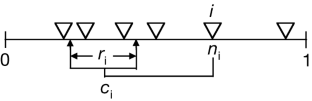
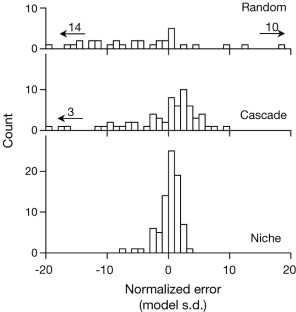
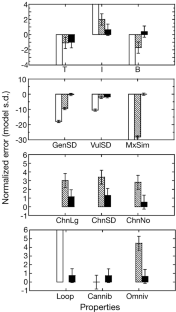
Several of the most ambitious theories in ecology1,2,3,4,5,6,7,8,9,10,11,12,13,14 describe food webs that document the structure of strong and weak trophic links9 that is responsible for ecological dynamics among diverse assemblages of species4,11,12,13. Early mechanism-based theory asserted that food webs have little omnivory and several properties that are independent of species richness1,2,3,4,6. This theory was overturned by empirical studies that found food webs to be much more complex5,7,8,9,14,15,16,17,18, but these studies did not provide mechanistic explanations for the complexity9. Here we show that a remarkably simple model fills this scientific void by successfully predicting key structural properties of the most complex and comprehensive food webs in the primary literature. These properties include the fractions of species at top, intermediate and basal trophic levels, the means and variabilities of generality, vulnerability and food-chain length, and the degrees of cannibalism, omnivory, looping and trophic similarity. Using only two empirical parameters, species number and connectance, our ‘niche model’ extends the existing ‘cascade model’3,19 and improves its fit ten-fold by constraining species to consume a contiguous sequence of prey in a one-dimensional trophic niche20.
This is a preview of subscription content, access via your institution
Access options
Subscribe to this journal
Receive 51 print issues and online access
$199.00 per year
only $3.90 per issue
Buy this article
- Purchase on SpringerLink
- Instant access to the full article PDF.
USD 39.95
Prices may be subject to local taxes which are calculated during checkout
Additional access options:
Figure 1: Diagram of the niche model.
The alternative text for this image may have been generated using AI.
Figure 2: Distribution of normalized errors between empirical data and model means for all properties of the random, cascade and niche models.
The alternative text for this image may have been generated using AI.
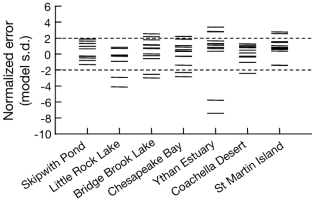
Figure 3: The niche model's normalized errors for each property of each food web.
The alternative text for this image may have been generated using AI.
Figure 4: Mean normalized error of each property for each model averaged across the seven food webs (Table 1).
The alternative text for this image may have been generated using AI.
References
- May, R. M. How many species are there on earth? Science 241, 1441–1449 (1988).
Article ADS CAS Google Scholar - Lawton, J. H. in Ecological Concepts (ed. Cherrett, J. M.) 43– 78 (Blackwell Scientific, Oxford, 1989).
Google Scholar - Cohen, J. E., Briand, F. & Newman, C. M. Community Food Webs: Data and Theory (Biomathematics Vol. 20) (Springer, Berlin, 1990).
Chapter Google Scholar - Pimm, S. L., Lawton, J. H. & Cohen, J. E. Food web patterns and their consequences. Nature 350, 669–674 ( 1991).
Article ADS Google Scholar - Polis, G. A. Complex desert food webs: an empirical critique of food web theory. Am. Nat. 138, 123–155 ( 1991).
Article Google Scholar - Havens, K. Scale and structure in natural food webs. Science 257 , 1107–1109 (1992).
Article ADS CAS Google Scholar - Martinez, N. D. Effects of scale on food web structure. Science 260 , 242–243 (1993).
Article ADS CAS Google Scholar - Martinez, N. D. Scale-dependent constraints on food-web structure. Am. Nat. 144, 935–953 (1994).
Article Google Scholar - Lawton, J. H. Webbing and WIWACS. Oikos 72, 305– 306 (1995).
Article Google Scholar - Polis, G. A. & Winemiller, K. (Eds) Food Webs: Integration of Patterns and Dynamics (Chapman and Hall, New York, 1996).
Book Google Scholar - deRuiter, P. C., Neutel, A-M & Moore, J. C. Energetics, patterns of interaction strengths, and stability in real ecosystems. Science 269, 1257–1260 (1995).
Article ADS CAS Google Scholar - McCann, K., Hastings, A. & Huxel, G. R. Weak trophic interactions and the balance of nature. Nature 395, 794–798 (1998).
Article ADS CAS Google Scholar - Berlow, E. L. Strong effects of weak interactions in ecological communities. Nature 398, 330–334 ( 1999)
Article ADS CAS Google Scholar - Schoener, T. W. Food webs from the small to the large. Ecology 70, 1559–1589 (1989).
Article Google Scholar - Warren, P. H. Spatial and temporal variation in the structure of a freshwater food web. Oikos 55, 299–311 (1989).
Article Google Scholar - Hall, S. J. & Raffaelli, D. Food-web patterns: lessons from a species-rich web. J. Anim. Ecol. 60, 823 –842 (1991).
Article Google Scholar - Martinez, N. D. Artifacts or attributes? Effects of resolution on the Little Rock Lake food web. Ecol. Monog. 61, 367– 392 (1991).
Article Google Scholar - Goldwasser, L. & Roughgarden, J. Construction of a large Caribbean food web. Ecology 74, 1216–1233 (1993).
Article Google Scholar - Solow, A. R. & Beet, A. R. On lumping species in food webs. Ecology 79, 2013–2018 (1998).
Article Google Scholar - Cohen, J. E. Food Webs and Niche Space (Princeton Univ. Press, Princeton, 1978).
Google Scholar - Murtaugh, P. A. & Kollath, J. P. Variation of trophic fractions and connectance in food webs. Ecology 78, 1382–1287 (1997).
Article Google Scholar - Huxman, M., Raffaelli, D. & Pike, A. Parasites and food web patterns. J. Anim. Ecol. 64, 168–176 ( 1995).
Article Google Scholar - Marcogliese, D. J. & Cone, D. K. Food webs: A plea for parasites. Trends Ecol. Evol. 12, 320 –325 (1997).
Article CAS Google Scholar - Hutchinson, G. E. Concluding remarks. Population studies: Animal ecology and demography. Cold Spring Harbor Symp. Quant. Biol. 22, 415– 427 (1957).
Article Google Scholar - Warren, P. H. in Aspects of the Genesis and Maintenance of Biological Diversity (eds Hochberg, M. E., Clobert, J. & Barbault, R.) 142– 161 (Oxford Univ. Press, New York, 1996).
Google Scholar - Begon, M., Harper, J. L. & Townsend, C. R. Ecology: Individuals, Populations, and Communities 3rd edn (Blackwell Science, Oxford, 1996).
Book Google Scholar - Warren, P. H. & Lawton, J. H. Invertebrate predator–prey body size relationships: an explanation for upper triangular food webs and patterns in food web structure? Oecologia 74, 231–235 (1987).
Article ADS CAS Google Scholar - Cohen, J. E., Pimm, S. L., Yodzis, P. & Saldana, J. Body sizes of animal predators and animal prey in food webs. J. Anim. Ecol. 62, 67–78 (1993).
Article Google Scholar - Symstad, A. J., Tilman, D., Willson, J. & Knops, J. M. H. Species loss and ecosystem functioning: effects of species identity and community composition. Oikos 81, 389–397 (1998).
Article Google Scholar - Baird D. & Ulanowicz, R. E. The seasonal dynamics of the Chesapeake Bay ecosystem. Ecol. Monogr. 59, 329–364 (1989).
Acknowledgements
We thank J. Dunne, M. Geluardi, E. Connor, L. Goldwasser, J. Harte, T. Parker, E. Berlow and I. Billick for comments and suggestions. The USA National Science Foundation provided support.
Author information
Authors and Affiliations
- Department of Biology, Romberg Tiburon Center, San Francisco State University, PO Box 855, Tiburon, 94920, California , USA
Richard J. Williams & Neo D. Martinez
Authors
- Richard J. Williams
- Neo D. Martinez
Corresponding author
Correspondence toNeo D. Martinez.
Supplementary information
Rights and permissions
About this article
Cite this article
Williams, R., Martinez, N. Simple rules yield complex food webs.Nature 404, 180–183 (2000). https://doi.org/10.1038/35004572
- Received: 04 October 1999
- Accepted: 04 January 2000
- Issue date: 09 March 2000
- DOI: https://doi.org/10.1038/35004572