Total silencing by intron-spliced hairpin RNAs (original) (raw)
- Brief Communication
- Published: 21 September 2000
Gene expression
Nature volume 407, pages 319–320 (2000) Cite this article
- 6298 Accesses
- 735 Citations
- 31 Altmetric
- Metrics details
Abstract
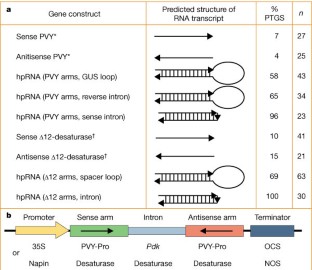
Post-transcriptional gene silencing (PTGS), a sequence-specific RNA degradation mechanism inherent in many life-forms, can be induced in plants by transforming them with either antisense1 or co-suppression2 constructs, but typically this results in only a small proportion of silenced individuals. Here we show that gene constructs encoding intron-spliced RNA with a hairpin structure can induce PTGS with almost 100% efficiency when directed against viruses or endogenous genes. These constructs could prove valuable in reverse genetics, genomics, engineering of metabolic pathways and protection against pathogens.
This is a preview of subscription content, access via your institution
Access options
Subscribe to this journal
Receive 52 print issues and online access
$199.00 per year
only $3.83 per issue
Buy this article
- Purchase on SpringerLink
- Instant access to the full article PDF.
USD 39.95
Prices may be subject to local taxes which are calculated during checkout
Additional access options:
Figure 1: Efficiency of induction of post-transcriptional gene silencing (PTGS) by different gene constructs and the predicted structure of RNA transcribed from the transgenes.
References
- Hamilton, A. J., Lycett, G. W. & Grierson, D. Nature 346, 284– 287 (1990).
Article ADS CAS Google Scholar - Jorgensen, R. A. Science 268, 689–691 ( 1995).
Article ADS Google Scholar - Waterhouse, P. M., Graham, M. W. & Wang, M.-B Proc. Natl Acad. Sci. USA 95, 13959–13964 (1998).
Article ADS CAS Google Scholar - Waterhouse, P. M., Smith, N. A. & Wang, M.-B Trends Plant Sci. 4, 452– 457 (1999).
Article CAS Google Scholar - Wang, M.-B, Upadhyaya, M. N., Brettel, R. I. S. & Waterhouse, P. M. J. Genet. Breed. 51, 325–334 (1997).
CAS Google Scholar - Okuley, J. et al. Plant Cell 6, 147–158 (1994).
Article CAS Google Scholar - Cartea, M. E., Migdal, M., Galle, A. M., Pelletier, G. & Guerche, P. Plant Sci. 136, 181– 194 (1998).
Article CAS Google Scholar - Rosche, E. & Westhoff, P. Plant Mol. Biol. 29 , 663–678 (1995).
Article CAS Google Scholar - Gleave, A. P. Plant Mol. Biol. 20, 1203–1207 (1992).
Article CAS Google Scholar - Stalberg, K., Ellerstrom, M., Josefsson, L. G. & Rask, L. Plant Mol. Biol. 23, 671–683 (1993).
Article CAS Google Scholar - Fire, A. et al. Nature 391, 806–811 (1998).
Article ADS CAS Google Scholar - Sharp, P. A. Genes Dev. 13, 139–141 ( 1999).
Article CAS Google Scholar
Author information
Authors and Affiliations
- CSIRO Plant Industry, Canberra, ACT 2601, Australia
Neil A. Smith, Surinder P. Singh, Ming-Bo Wang, Peter A. Stoutjesdijk, Allan G. Green & Peter M. Waterhouse
Authors
- Neil A. Smith
- Surinder P. Singh
- Ming-Bo Wang
- Peter A. Stoutjesdijk
- Allan G. Green
- Peter M. Waterhouse
Corresponding author
Correspondence toPeter M. Waterhouse.
Additional information
brief communications is intended to provide a forum for short, topical reports of general scientific interest and for technical discussion of recently published material of particular interest to non-specialist readers. Priority will be given to contributions that have fewer than 500 words, 10 references and only one figure. Detailed guidelines are available on Nature's website (http://www.nature.com) or on request from nature@nature.com
Rights and permissions
About this article
Cite this article
Smith, N., Singh, S., Wang, MB. et al. Total silencing by intron-spliced hairpin RNAs.Nature 407, 319–320 (2000). https://doi.org/10.1038/35030305
- Issue date: 21 September 2000
- DOI: https://doi.org/10.1038/35030305