Unusual spectral energy distribution of a galaxy previously reported to be at redshift 6.68 (original) (raw)
- Letter
- Published: 30 November 2000
Nature volume 408, pages 562–564 (2000)Cite this article
- 200 Accesses
- 477 Citations
- 6 Altmetric
- Metrics details
Abstract
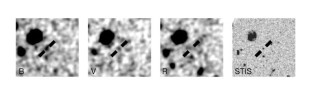
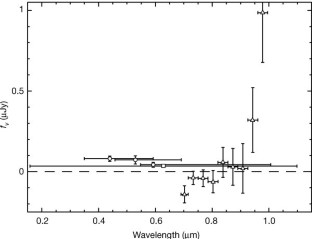
Observations of distant galaxies are important both for understanding how galaxies form and for probing the physical conditions of the Universe at early times. It is, however, very difficult to identify galaxies at redshifts z > 5, because they are so faint and have few spectral characteristics. We previously reported1 the probable identification of a galaxy at z = 6.68, based on one line and an apparent break in the spectrum just shortwards of that, which we interpreted as Lyman α emission and the Lyman α break, where photons with shorter wavelengths are absorbed by the intervening neutral hydrogen gas. Here we present optical photometry that shows moderate detections of light in the B- and V-band images, which are inconsistent with the expected absence of flux shortwards of the Lyman α break for a galaxy at z > 5, and inconsistent with the previous flux measurement. Moreover, the spectral energy distribution for this object cannot readily be fitted by any known galaxy spectral template at any redshift, so the redshift is undetermined.
This is a preview of subscription content, access via your institution
Access options
Subscribe to this journal
Receive 51 print issues and online access
$199.00 per year
only $3.90 per issue
Buy this article
- Purchase on SpringerLink
- Instant access to the full article PDF.
USD 39.95
Prices may be subject to local taxes which are calculated during checkout
Additional access options:
Figure 1: Portions of the ground-based B, V and R images, smoothed by the size of the point spread functions, and the corresponding STIS image centred at galaxy A.
The alternative text for this image may have been generated using AI.
Figure 2: The observed spectral energy distribution of galaxy A.
The alternative text for this image may have been generated using AI.
References
- Chen, H.-W., Lanzetta, K. M. & Pascarelle, S. A spectroscopically identified galaxy of probable redshift z = 6.68. Nature 398, 586–588 (1999).
Article ADS CAS Google Scholar - Yahata, N. et al. Photometry and photometric redshifts of faint galaxies in the Hubble deep field south NICMOS field. Astrophys. J. 538, 493–504 (2000).
Article ADS Google Scholar - Puetter, R. C. & Yahil, A. in The Astronomical Data Analysis Software and Systems (ADASS) VIII Conference (eds Mehringer, D. M., Plante, R. L. & Roberts, D. A.) Vol. 172, 307–316 (Astronomical Society Publications, ASP, San Francisco, 1999).
Google Scholar - Fernández-Soto, A., Lanzetta, K. M. & Yahil, A. A new catalog of photometric redshifts in the Hubble deep field. Astrophys. J. 513, 34–50 (1999).
Article ADS Google Scholar - Holtzman, J. A. et al. The photometric performance and calibration of WFPC2. Publ. Astron. Soc. Pacif. 107, 1065–1093 (1995).
Article ADS Google Scholar - Schmidt, B. P. et al. The high-z supernova search: measuring cosmic deceleration and global curvature of the universe using type Ia supernovae. Astrophys. J. 507, 46–63 (1998).
Article ADS Google Scholar
Author information
Authors and Affiliations
- Observatories of the Carnegie Institution of Washington, 813 Santa Barbara, Pasadena, 91101, California, USA
Hsiao-Wen Chen - Department of Physics and Astronomy, State University of New York at Stony Brook, Stony Brook, 11794-3800, New York, USA
Kenneth M. Lanzetta, Sebastian Pascarelle & Noriaki Yahata
Authors
- Hsiao-Wen Chen
- Kenneth M. Lanzetta
- Sebastian Pascarelle
- Noriaki Yahata
Corresponding author
Correspondence toHsiao-Wen Chen.
Rights and permissions
About this article
Cite this article
Chen, HW., Lanzetta, K., Pascarelle, S. et al. Unusual spectral energy distribution of a galaxy previously reported to be at redshift 6.68.Nature 408, 562–564 (2000). https://doi.org/10.1038/35046031
- Received: 26 June 2000
- Accepted: 05 October 2000
- Issue date: 30 November 2000
- DOI: https://doi.org/10.1038/35046031