Branched integumental structures in Sinornithosaurus and the origin of feathers (original) (raw)
- Letter
- Published: 08 March 2001
Nature volume 410, pages 200–204 (2001) Cite this article
- 2382 Accesses
- 167 Citations
- 24 Altmetric
- Metrics details
Abstract
The evolutionary origin of feathers has long been obscured because no morphological antecedents were known to the earliest, structurally modern feathers of Archaeopteryx1. It has been proposed that the filamentous integumental appendages on several theropod dinosaurs are primitive feathers2,3,4,5,6; but the homology between these filamentous structures and feathers has been disputed7,8,9, and two taxa with true feathers (Caudipteryx and Protarchaeopteryx) have been proposed to be flightless birds8,10. Confirmation of the theropod origin of feathers requires documentation of unambiguously feather-like structures in a clearly non-avian theropod. Here we describe our observations of the filamentous integumental appendages of the basal dromaeosaurid dinosaur Sinornithosaurus millenii, which indicate that they are compound structures composed of multiple filaments. Furthermore, these appendages exhibit two types of branching structure that are unique to avian feathers: filaments joined in a basal tuft, and filaments joined at their bases in series along a central filament. Combined with the independent phylogenetic evidence supporting the theropod ancestry of birds11,12,13, these observations strongly corroborate the hypothesis that the integumental appendages of Sinornithosaurus are homologous with avian feathers. The plesiomorphic feathers of Sinornithosaurus also conform to the predictions of an independent, developmental model of the evolutionary origin of feathers14.
This is a preview of subscription content, access via your institution
Access options
Subscribe to this journal
Receive 51 print issues and online access
$199.00 per year
only $3.90 per issue
Buy this article
- Purchase on SpringerLink
- Instant access to the full article PDF.
USD 39.95
Prices may be subject to local taxes which are calculated during checkout
Additional access options:
Figure 1: Sinornithosaurus millenii, holotype (IVPP 12811).
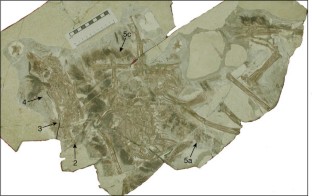
The alternative text for this image may have been generated using AI.
Figure 2: Filamentous integumental appendages of S. millenii dissociated from the integument and preserved overlying each other in the matrix near the skull.
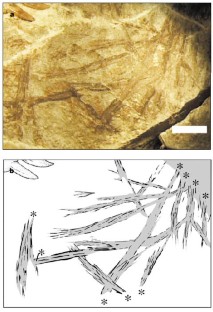
The alternative text for this image may have been generated using AI.
Figure 3: Filamentous integumental appendage of S. millenii from the dorsal surface of the snout.
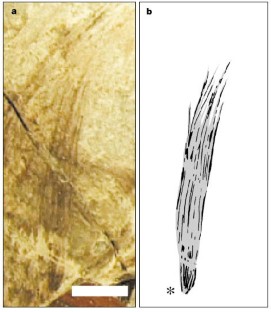
The alternative text for this image may have been generated using AI.
Figure 4: Dissociated filamentous integumental appendage of S. millenii from near the skull. a, Arrows indicate the distal tips of some component filaments.
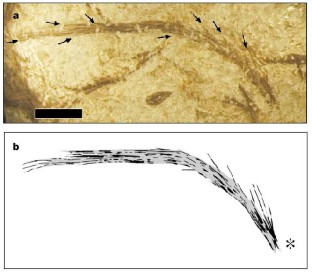
The alternative text for this image may have been generated using AI.
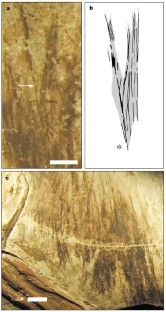
Figure 5: Filamentous integumental appendages of S. millenii indicating the presence of larger central filaments, or shafts, and secondary branched filaments.
The alternative text for this image may have been generated using AI.
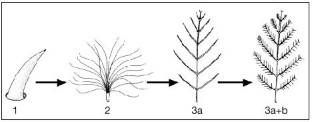
Figure 6: The predicted transition series of feather morphologies from an independent, developmental model of the evolutionary origin of feathers14.
The alternative text for this image may have been generated using AI.
References
- de Beer, G. Archaeopteryx lithographica; A Study Based on the British Museum Specimen (Trustees of the British Museum, London, 1954).
Google Scholar - Chen, P.-J., Dong, Z. M. & Zhen, S. N. An exceptionally well-preserved theropod dinosaur from the Yixian formation of China. Nature 391, 147–152 (1998).
Article ADS CAS Google Scholar - Ji, Q., Currie, P. J., Norell, M. A. & Ji, S.-A. Two feathered dinosaurs from northeastern China. Nature 393, 753–761 (1998).
Article ADS Google Scholar - Xu, X., Tang, Z.-l. & Wang, X.-I. A therizinosauroid dinosaur with integumentary structures from China. Nature 399, 350–354 (1999).
Article ADS CAS Google Scholar - Xu, X., Wang, X.-l. & Wu, X.-C. A dromaeosaurid dinosaur with a filamentous integument from the Yixian Formation of China. Nature 401, 262–266 (1999).
Article ADS CAS Google Scholar - Xu, X., Zhou, Z. & Wang, X. The smallest known non-avian theropod dinosaur. Nature 408, 705–708 (2000).
Article ADS CAS Google Scholar - Gibbons, A. Plucking the feathered dinosaur. Science 278, 1229–1230 (1997).
ADS Google Scholar - Feduccia, A. The Origin and Evolution of Birds 2nd edn (Yale Univ. Press, New Haven, 1999).
Google Scholar - Dalton, R. Feathers fly in Beijing. Nature 405, 992 (2000).
Article CAS Google Scholar - Jones, T. D., Farlow, J. O., Ruben, J. A., Henderson, D. M. & Hillenius, W. J. Cursoriality in bipedal archosaurs. Nature 406, 716–718 (2000).
Article ADS CAS Google Scholar - Gauthier, J. A. Saurischian monophyly and the origin of birds. Mem. California Acad. Sci. 8, 1–55 (1986).
Google Scholar - Holtz, T. R. The phylogenetic position of the Tyrannosauridae: implications for theropod systematics. J. Paleontol. 68, 1100–1117 (1994).
Article Google Scholar - Sereno, P. The evolution of dinosaurs. Science 284, 2137–2147 (1999).
Article CAS Google Scholar - Prum, R. O. Development and evolutionary origin of feathers. J. Exp. Zool. Mol. Dev. Evol. 285, 291–306 (1999).
Article CAS Google Scholar - Lucas, A. M. & Stettenheim, P. R. Avian Anatomy–Integument (US Dept. Agriculture Handbook, Washington DC, 1972).
Google Scholar - Nowak, R. M. & Paradiso, J. L. Walker's Mammals of the World (Johns Hopkins Univ. Press, Baltimore, 1983).
Google Scholar - Grau, V. J. Biología y Patología de la Chinchilla (Ediciones OIKOS, Santiago, Chile, 1994).
Google Scholar - Jones, T. A. et al. Non-avian feathers in a late Triassic archosaur. Science 288, 2202–2205 (2000).
Article ADS CAS Google Scholar
Acknowledgements
We thank M. Chang and Y. Wang for assistance during the work; S.-h. Xie for preparation of the holotype specimen of Sinornithosaurus; and members of the Liaoxi expedition team of the IVPP, who participated in the excavation of the specimen. The paper benefited from discussions with C.-M. Chuong, P. Currie, A. Deane, L. Martin, B. Timm, G. Wagner, L. Witmer and F. Zhang; and was improved by comments from W. Boles, P. Stettenheim and L. Witmer. We acknowledge financial support from the Chinese Academy of Sciences, Chinese Natural Science Foundation, Chinese Special Funds for Major State Basic Research Projects (X.X., Z.Z.), and the United States National Science Foundation (R.O.P.). Order of authorship was assigned randomly.
Author information
Authors and Affiliations
- Institute of Vertebrate Paleontology and Paleoanthropology, Academica Sinica, PO Box 643, Beijing, 100044, People's Republic of China
Xing Xu & Zhong-he Zhou - Department of Ecology and Evolutionary Biology, and Natural History Museum, University of Kansas, Lawrence, 66045, Kansas, USA
Richard O. Prum
Authors
- Xing Xu
- Zhong-he Zhou
- Richard O. Prum
Corresponding author
Correspondence toRichard O. Prum.
Rights and permissions
About this article
Cite this article
Xu, X., Zhou, Zh. & Prum, R. Branched integumental structures in Sinornithosaurus and the origin of feathers.Nature 410, 200–204 (2001). https://doi.org/10.1038/35065589
- Received: 02 August 2000
- Accepted: 19 December 2000
- Issue date: 08 March 2001
- DOI: https://doi.org/10.1038/35065589