Subsidence risk from thawing permafrost (original) (raw)
- Brief Communication
- Published: 19 April 2001
Nature volume 410, pages 889–890 (2001) Cite this article
- 5863 Accesses
- 398 Citations
- 19 Altmetric
- Metrics details
The threat to man-made structures across regions in the far north can be monitored.
Abstract
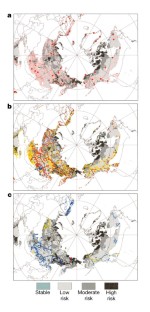
The thawing and disappearance of permafrost has accelerated in recent decades1, damaging buildings and infrastructure and causing public concern2. Here we offer a geographic overview of the hazard potential associated with thawing permafrost in the Northern Hemisphere which indicates that vulnerability to subsidence is widespread. Much of the existing infrastructure erected in northern regions is located in areas of high hazard potential and could be affected by thaw subsidence under conditions of global warming.
This is a preview of subscription content, access via your institution
Access options
Subscribe to this journal
Receive 52 print issues and online access
$199.00 per year
only $3.83 per issue
Buy this article
- Purchase on SpringerLink
- Instant access to the full article PDF.
USD 39.95
Prices may be subject to local taxes which are calculated during checkout
Additional access options:
Figure 1: Permafrost hazard potential in the Northern Hemisphere.
The alternative text for this image may have been generated using AI.
References
- Serreze, M. C. et al. Climatic Change 46, 159–207 (2000).
Article Google Scholar - Linden, E. Time 156, 52–56 (2000).
Google Scholar - Kattenberg, A. et al. in Climate Change 1995: The Science of Climate Change. Contribution of Working Group I to the Second Assessment Report of the Intergovernmental Panel on Climate Change (eds Houghton, J. J. et al.) 285–357 (Cambridge Univ. Press, New York, 1996).
Google Scholar - Greco, S. et al. & IPCC Working Group II. Climate Scenarios and Socioeconomic Projections for IPCC WG II Assessment (Consortium for International Earth Science Information Network, Washington DC, 1994).
Google Scholar - Anisimov, O. A., Shiklomanov, N. I. & Nelson, F. E. Glob. Planet. Change 15, 61–77 (1997).
Article ADS Google Scholar - Staub, B. & Rosenzweig, C. Global Gridded Data Sets of Soil Type, Soil Texture, Surface Slope and Other Properties (National Center for Atmospheric Research, Boulder, CO, 1987). URL: http://www.ngdc.noaa.gov/seg/eco/cdroms/ged_iia/datasets/a11/sr.htm#top
Google Scholar - Brown, J., Ferrians, O. J. J., Heginbottom, J. A. & Melnikov, E. S. International Permafrost Association Circum-Arctic Map of Permafrost and Ground Ice Conditions (scale 1:10,000,000, US Geological Survey Circum-Pacific Map Series, Map CP-45, Reston, VA, 1997). URL: http://www.geodata.soton.ac.uk/ipa/
Google Scholar - Monmonier, M. Cartographies of Danger: Mapping Hazards in America (Univ. Chicago Press, 1997).
Book Google Scholar - Anisimov, O. A. & Nelson, F. E. Climatic Change 35, 241–258 (1997).
Article Google Scholar - Riseborough, D. W. in Proc.Fifth Canadian Permafrost Conf. (eds Burgess, M. M., Harry, D. G. & Sego, D. C.) 199–205 (Centre d'études nordiques, Université Laval/National Research Council of Canada, Québec, 1990).
Google Scholar - Parmuzin, S. Y. & Shamanova, I. I. Polar Geogr. Geol. 10, 184–193 (1986).
Article Google Scholar - US National Imagery and Mapping Agency. Digital Chart of the World for ADOL (ESRI, Inc., Redlands, CA, 1997). URL: http://www.esri.com/data/online/esri/wobmselect.html
- Scripter, M. W. Ann. Assoc. Am. Geogr. 60, 385–393 (1970).
Article Google Scholar
Author information
Authors and Affiliations
- Department of Geography and Center for Climatic Research, University of Delaware, Newark, 19716, Delaware, USA
Frederick E. Nelson & Nikolay I. Shiklomanov - State Hydrological Institute, Second Line VO 23, St Petersburg, 199053, Russia
Oleg A. Anisimov
Authors
- Frederick E. Nelson
- Oleg A. Anisimov
- Nikolay I. Shiklomanov
Corresponding author
Correspondence toFrederick E. Nelson.
Rights and permissions
About this article
Cite this article
Nelson, F., Anisimov, O. & Shiklomanov, N. Subsidence risk from thawing permafrost.Nature 410, 889–890 (2001). https://doi.org/10.1038/35073746
- Issue date: 19 April 2001
- DOI: https://doi.org/10.1038/35073746