Extending the lifespan of long-lived mice (original) (raw)
- Brief Communication
- Published: 22 November 2001
Longevity
Nature volume 414, page 412 (2001) Cite this article
- 7637 Accesses
- 401 Citations
- 25 Altmetric
- Metrics details
Abstract
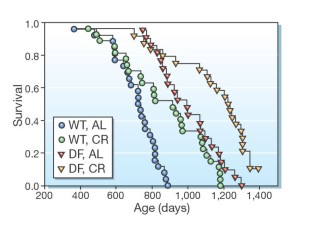
Ames dwarf mice are mutant mice that live about 50% longer than their normal siblings1,2,3 because they carry a 'longevity' gene, _Prop1_df, and in some phenotypic respects they resemble normal mice whose lifespan has been extended by restricted food intake2,4,5. Here we investigate whether these factors influence lifespan by similar or independent mechanisms, by deliberately reducing the number of calories consumed by Ames dwarf mice. We show that calorie restriction confers a further lifespan increase in the dwarfs, indicating that the two factors may act through different pathways.
This is a preview of subscription content, access via your institution
Access options
Subscribe to this journal
Receive 52 print issues and online access
$199.00 per year
only $3.83 per issue
Buy this article
- Purchase on SpringerLink
- Instant access to the full article PDF.
USD 39.95
Prices may be subject to local taxes which are calculated during checkout
Additional access options:
Figure 1
References
- Brown-Borg, H. M., Borg, K. E., Meliska, C. J. & Bartke, A. Nature 384, 33 (1996).
Article ADS CAS Google Scholar - Bartke, A. in The Molecular Genetics of Aging (ed. Hekimi, S.) Vol. 29, 181–202 (Springer, New York, 2000).
- Flurkey, K., Papaconstantinou, J., Miller, R. A. & Harrison, D. E. Proc Natl Acad. Sci. USA 98, 6736–6741 (2001).
Article ADS CAS Google Scholar - Harris, S. B., Gunion, M. W., Rosenthal, M. J. & Walford, R. L. Mech. Ageing Dev. 73, 209–221 (1994).
Article CAS Google Scholar - Weindruch, R. Toxicol. Pathol. 24, 742–745 (1996).
Article CAS Google Scholar - Mattison, J. A. et al. J. Am. Aging Assoc. 23, 9–16 (2000).
CAS PubMed PubMed Central Google Scholar - Coschigano, K. T., Clemmons, D., Bellush, L. L. & Kopchick, J. J. Endocrinology 141, 2608–2613 (2000).
Article CAS Google Scholar - Clancy, D. J. et al. Science 292, 104–106 (2001).
Article ADS CAS Google Scholar - Tatar, M. et al. Science 292, 107–110 (2001).
Article ADS CAS Google Scholar - Kimura, K. D., Tissenbaum, H. A., Liu, Y. & Ruvkun, G. Science 277, 942–946 (1997).
Article CAS Google Scholar - Fabrizio, P., Pozza, F., Pletcher, S. D., Gendron, C. M. & Longo, V. D. Science 292, 288–290 (2001).
Article ADS CAS Google Scholar
Author information
Authors and Affiliations
- Department of Physiology, School of Medicine, Southern Illinois University, Carbondale, 62901, Illinois, USA
Andrzej Bartke & J. Chris Wright - National Institute on Aging, NIH Animal Center, 16701 Elmer School Road, Poolesville, 20837, Maryland, USA
Julie A. Mattison & Donald K. Ingram - University of Michigan, 1500 East Medical Center Drive, Ann Arbor, 48109, Michigan, USA
Richard A. Miller - Gerontology Research Center, 5600 Nathan Shock Drive, Baltimore, 21224, Maryland, USA
George S. Roth
Authors
- Andrzej Bartke
- J. Chris Wright
- Julie A. Mattison
- Donald K. Ingram
- Richard A. Miller
- George S. Roth
Corresponding author
Correspondence toAndrzej Bartke.
Rights and permissions
About this article
Cite this article
Bartke, A., Wright, J., Mattison, J. et al. Extending the lifespan of long-lived mice.Nature 414, 412 (2001). https://doi.org/10.1038/35106646
- Issue date: 22 November 2001
- DOI: https://doi.org/10.1038/35106646