Towards robust regional estimates of CO2 sources and sinks using atmospheric transport models (original) (raw)
- Letter
- Published: 07 February 2002
- Rachel M. Law2,
- A. Scott Denning1,
- Peter J. Rayner2,
- David Baker3,
- Philippe Bousquet4,
- Lori Bruhwiler5,
- Yu-Han Chen6,
- Philippe Ciais4,
- Songmiao Fan7,
- Inez Y. Fung8,
- Manuel Gloor9,
- Martin Heimann9,
- Kaz Higuchi10,
- Jasmin John8,
- Takashi Maki11,
- Shamil Maksyutov12,
- Ken Masarie5,
- Philippe Peylin4,
- Michael Prather13,
- Bernard C. Pak13,
- James Randerson14,
- Jorge Sarmiento7,
- Shoichi Taguchi15,
- Taro Takahashi16 &
- …
- Chiu-Wai Yuen9
Nature volume 415, pages 626–630 (2002) Cite this article
- 5488 Accesses
- 1180 Citations
- 46 Altmetric
- Metrics details
Abstract
Information about regional carbon sources and sinks can be derived from variations in observed atmospheric CO2 concentrations via inverse modelling with atmospheric tracer transport models. A consensus has not yet been reached regarding the size and distribution of regional carbon fluxes obtained using this approach, partly owing to the use of several different atmospheric transport models1,2,3,4,5,6,7,8,9. Here we report estimates of surface–atmosphere CO2 fluxes from an intercomparison of atmospheric CO2 inversion models (the TransCom 3 project), which includes 16 transport models and model variants. We find an uptake of CO2 in the southern extratropical ocean less than that estimated from ocean measurements, a result that is not sensitive to transport models or methodological approaches. We also find a northern land carbon sink that is distributed relatively evenly among the continents of the Northern Hemisphere, but these results show some sensitivity to transport differences among models, especially in how they respond to seasonal terrestrial exchange of CO2. Overall, carbon fluxes integrated over latitudinal zones are strongly constrained by observations in the middle to high latitudes. Further significant constraints to our understanding of regional carbon fluxes will therefore require improvements in transport models and expansion of the CO2 observation network within the tropics.
This is a preview of subscription content, access via your institution
Access options
Subscribe to this journal
Receive 52 print issues and online access
$199.00 per year
only $3.83 per issue
Buy this article
- Purchase on SpringerLink
- Instant access to the full article PDF.
USD 39.95
Prices may be subject to local taxes which are calculated during checkout
Additional access options:
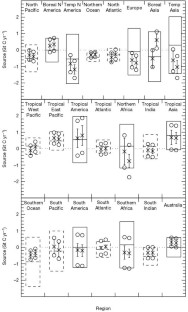
Figure 1: Mean estimated sources and uncertainties for two inversions.
The alternative text for this image may have been generated using AI.
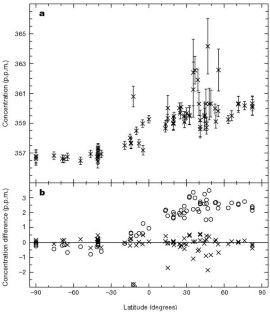
Figure 2: CO2concentrations input to, and as fitted by, the inversion.
The alternative text for this image may have been generated using AI.
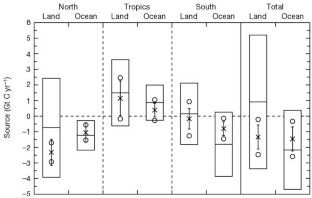
Figure 3: Mean sources and uncertainties for six aggregated regions and global land and ocean.
The alternative text for this image may have been generated using AI.
References
- Enting, I. G., Trudinger, C. M. & Francey, R. J. A synthesis inversion of the concentration and δ13C of atmospheric CO2. Tellus B 47, 35–52 (1995).
Article ADS Google Scholar - Fan, S. et al. A large terrestrial carbon sink in North America implied by atmospheric and oceanic carbon dioxide data and models. Science 282, 442–446 (1998).
Article ADS CAS Google Scholar - Kaminski, T., Heimann, M. & Giering, R. A coarse grid three-dimensional global inverse model of the atmospheric transport, 2, inversion of the transport of CO2 in the 1980s. J. Geophys. Res. 104, 18555–18581 (1999).
Article ADS CAS Google Scholar - Bousquet, P., Ciais, P., Peylin, P., Ramonet, M. & Monfrey, P. Inverse modelling of annual atmospheric CO2 sources and sinks. Part 1: method and control inversion. J. Geophys. Res. 104, 26161–26193 (1999).
Article ADS CAS Google Scholar - Baker, D. F. Sources and Sinks of Atmospheric CO2 Estimated from Batch Least-Squares Inversions of CO2 Concentration Measurements. Thesis, Princeton Univ. (2001).
Google Scholar - Taguchi, S. Synthesis inversion of atmospheric CO2 using the NIRE chemical transport model. Geophys. Monogr. 114, 239–254 (2000).
Google Scholar - Peylin, P., Baker, D., Sarmiento, J., Ciais, P. & Bousquet, P. Influence of transport uncertainty on annual mean and seasonal inversions of atmospheric CO2 data. J. Geophys. Res. (submitted).
- Rayner, P. J., Enting, I. G., Francey, R. J. & Langenfelds, R. Reconstructing the recent carbon cycle from atmospheric CO2, δ13C and O2/N2 observations. Tellus B 51, 213–232 (1999).
Article ADS Google Scholar - Bousquet, P. et al. Regional changes in carbon dioxide fluxes of land and ocean since 1980. Science 290, 1342–1346 (2000).
Article ADS CAS Google Scholar - Takahashi, T. et al. Global sea-air CO2 flux based on climatological surface ocean pCO2, and seasonal biological end temperature effects. Deep-Sea Res. I. (submitted).
- Tans, P., Fung, I. & Takahashi, T. Observational constraints on the global atmospheric CO2 budget. Science 247, 1431–1438 (1990)
Article ADS CAS Google Scholar - Denning, S. et al. Three-dimensional transport and concentration of SF6: A model intercomparison study (Transcom 2). Tellus B 51, 266–297 (1999).
Article ADS Google Scholar - Metzl, N., Brunet, C., Jabaud-Jan, A., Poisson, A. & Schauer, B. in Extended Abstr. 6th Int. Carbon Dioxide Conf. 685–688 (Organizing Committee of Sixth Carbon Dioxide Conference, Sendai, 2001).
Google Scholar - Kaminski, T., Rayner, P. J., Heimann, M. & Enting, I. G. On aggregation errors in atmospheric transport inversions. J. Geophys. Res. 106, 4703–4715 (2001).
Article ADS CAS Google Scholar - Denning, A. S., Fung, I. Y. & Randall, D. A. Latitudinal gradient of atmospheric CO2 due to seasonal exchange with land biota. Nature 376, 240–243 (1995).
Article ADS CAS Google Scholar - Tarantola, A. Inverse Problem Theory: Methods for Data Fitting and Model Parameter Estimation 3rd impr. (Elsevier, Amsterdam, 1998).
MATH Google Scholar - Andres, R. J., Marland, G., Fung, I. & Matthews, E. Distribution of carbon dioxide emissions from fossil fuel consumption and cement manufacture, 1950-1990. Glob. Biogeochem. Cycles 10, 419–429 (1996).
Article ADS CAS Google Scholar - Brenkert, A. L. Carbon dioxide emission estimates from fossil-fuel burning, hydraulic cement production, and gas flaring for 1995 on a one degree grid cell basis. 〈http://cdiac.esd.ornl.gov/ndps/ndp058a.html〉 (1998; accessed Oct. 1998).
- Randerson, J. et al. The contribution of terrestrial sources and sinks to trends in the seasonal cycle of atmospheric carbon dioxide. Glob. Biogeochem. Cycles 11, 535–560 (1997).
Article ADS CAS Google Scholar - GLOBALVIEW-CO2: Cooperative Atmospheric Data Integration Project - Carbon Dioxide CD-ROM (NOAA CMDL, Boulder, Colorado, 2000); also available at 〈ftp://ftp.cmdl.noaa.gov/ccg/co2/GLOBALVIEW〉 (2000).
- De Fries, R. S. & Townshend, J. R. G. NDVI-derived land cover classifications at a global scale. Int. J. Remote Sensing 15, 3567–3586 (1994).
Article ADS Google Scholar - Taylor, K. E., Williamson, D. & Zwiers, F. AMIP II sea surface temperature and sea ice concentration boundary conditions. 〈http://www–pcmdi.llnl.gov/amip/AMIP2EXPDSN/BCS/amip2bcs.html〉 (1997).
- Apps, M. J. & Kurz, W. A. in Carbon Balance on World's Forested Ecosystems: Towards a Global Assessment (ed. Kanninen, M.) 14–39 (Publications of the Academy of Finland, Helsinki, 1994).
Google Scholar - Kurz, W. A. & Apps, M. J. A 70 year retrospective analysis of carbon fluxes in the Canadian forest sector. Ecol. Applicat. 9, 526–547 (1999).
Article Google Scholar - Greenhouse Gas Inventory Data from 1990 to 1998 (Secretariat of the United Nations Framework Convention on Climate Change, National Communications from Parties Included in Annex 1 to the Convention, FCCC/SBI/2000/11, Bonn, 2000).
- Pacala, S. et al. Convergence of land- and atmosphere-based U.S. carbon sink estimates. Science 292, 2316–2320 (2001).
Article ADS CAS Google Scholar - Houghton, R. A. The annual net flux of carbon to the atmosphere from changes in land use 1850-1990. Tellus B 51, 298–313 (1999).
Article ADS Google Scholar - Dixon, R. K. et al. Carbon pools and flux of global forest ecosystems. Science 263, 185–190 (1990).
Article ADS MathSciNet Google Scholar - Houghton, R. A. & Hackler, J. L. Emissions of carbon from forestry and land-use change in tropical Asia. Glob. Change Biol. 5, 481–492 (1999).
Article ADS Google Scholar - Kauppi, P. E., Mielikainen, K. & Kuusela, K. Biomass and carbon budget of European forests, 1971 to 1990. Science 256, 70–74 (1992).
Article ADS CAS Google Scholar
Acknowledgements
We thank B. Stephens for comments and suggestions on earlier versions of the manuscript. This work was supported by the NSF, NOAA and the International Geosphere Biosphere Program/Global Analysis, Interpretation, and Modeling Project. S.F. and J.S. were supported by NOAA's Office of Global Programs for the Carbon Modeling Consortium.
Author information
Authors and Affiliations
- Department of Atmospheric Science, Colorado State University, Fort Collins, 80523, Colorado, USA
Kevin Robert Gurney & A. Scott Denning - CSIRO Atmospheric Research, PMB 1, Aspendale, 3195, Victoria, Australia
Rachel M. Law & Peter J. Rayner - National Center for Atmospheric Research (NCAR), Boulder, 80303, Colorado, USA
David Baker - Laboratoire des Sciences du Climat et de l’Environnement (LSCE), Gif-sur-Yvette Cedex, F-91198, France
Philippe Bousquet, Philippe Ciais & Philippe Peylin - Climate Monitoring and Diagnostics Laboratory, National Oceanic and Atmospheric Administration (NOAA), 326 Broadway R/CG1, Boulder, 80303, Colorado, USA
Lori Bruhwiler & Ken Masarie - Department of Earth, Atmospheric, and Planetary Science, Massachusetts Institute of Technology, Cambridge, 02141, Massachusetts, US
Yu-Han Chen - AOS Program, Princeton University, Sayre Hall, Forrestal Campus, PO Box CN710, Princeton, 08544-0710, New Jersey, USA
Songmiao Fan & Jorge Sarmiento - Center for Atmospheric Sciences, McCone Hall, University of California, Berkeley, 94720-4767, California, USA
Inez Y. Fung & Jasmin John - Max-Planck-Institut fur Biogeochemie, Jena, D-07701, Germany
Manuel Gloor, Martin Heimann & Chiu-Wai Yuen - Meteorological Service of Canada, Environment Canada, Toronto, M3H 5T4, Ontario, Canada
Kaz Higuchi - Atmospheric Environment Division, Observations Department, Quality Assurance Section, Japan Meteorological Agency, 1-3-4 Otemachi, Chiyoda-ku, 100-8122, Tokyo, Japan
Takashi Maki - Institute for Global Change Research, Frontier Research System for Global Change, Yokohama, 236-0001, Japan
Shamil Maksyutov - Earth System Science, University of California, Irvine, 92697-3100, California, USA
Michael Prather & Bernard C. Pak - Divisions of Engineering and Applied Science and Geological and Planetary Sciences, California Institute of Technology, Mail Stop 100-23, Pasadena, 91125, California, USA
James Randerson - National Institute of Advanced Industrial Science and Technology, 16-1 Onogawa Tsukuba, Ibaraki, 305-8569, Japan
Shoichi Taguchi - Lamont-Doherty Earth Observatory of Columbia University, Palisades, 10964, New York, USA
Taro Takahashi
Authors
- Kevin Robert Gurney
- Rachel M. Law
- A. Scott Denning
- Peter J. Rayner
- David Baker
- Philippe Bousquet
- Lori Bruhwiler
- Yu-Han Chen
- Philippe Ciais
- Songmiao Fan
- Inez Y. Fung
- Manuel Gloor
- Martin Heimann
- Kaz Higuchi
- Jasmin John
- Takashi Maki
- Shamil Maksyutov
- Ken Masarie
- Philippe Peylin
- Michael Prather
- Bernard C. Pak
- James Randerson
- Jorge Sarmiento
- Shoichi Taguchi
- Taro Takahashi
- Chiu-Wai Yuen
Corresponding author
Correspondence toA. Scott Denning.
Supplementary information
Rights and permissions
About this article
Cite this article
Gurney, K., Law, R., Denning, A. et al. Towards robust regional estimates of CO2 sources and sinks using atmospheric transport models.Nature 415, 626–630 (2002). https://doi.org/10.1038/415626a
- Received: 14 June 2001
- Accepted: 11 December 2001
- Issue date: 07 February 2002
- DOI: https://doi.org/10.1038/415626a