Thickness constraints on the icy shells of the galilean satellites from a comparison of crater shapes (original) (raw)
- Letter
- Published: 23 May 2002
Nature volume 417, pages 419–421 (2002)Cite this article
- 2089 Accesses
- 250 Citations
- 11 Altmetric
- Metrics details
Abstract
A thin outer ice shell on Jupiter's large moon Europa would imply easy exchange between the surface and any organic or biotic material in its putative subsurface ocean1,2,3,4. The thickness of the outer ice shell is poorly constrained, however, with model-dependent estimates ranging from a few kilometres5,6 to ten or more kilometres7. Here I present measurements of depths of impact craters on Europa, Ganymede and Callisto that reveal two anomalous transitions in crater shape with diameter. The first transition is probably related to temperature-dependent ductility of the crust at shallow depths (7–8 km on Europa). The second transition is attributed to the influence of subsurface oceans on all three satellites3,8,9, which constrains Europa's icy shell to be at least 19 km thick. The icy lithospheres of Ganymede and Callisto are equally ice-rich, but Europa's icy shell has a thermal structure about 0.25–0.5 times the thicknesses of Ganymede's or Callisto's shells, depending on epoch. The appearances of the craters on Europa are inconsistent with thin-ice-shell models1 and indicate that exchange of oceanic and surface material could be difficult.
This is a preview of subscription content, access via your institution
Access options
Subscribe to this journal
Receive 51 print issues and online access
$199.00 per year
only $3.90 per issue
Buy this article
- Purchase on SpringerLink
- Instant access to the full article PDF.
USD 39.95
Prices may be subject to local taxes which are calculated during checkout
Additional access options:
Figure 1: Impact crater landforms on the icy galilean satellites, representing the major morphologic types.

The alternative text for this image may have been generated using AI.
Figure 2: Depth/diameter measurements for fresh impact craters on the icy galilean satellites.
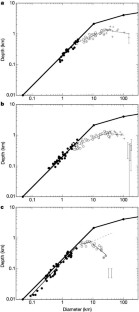
The alternative text for this image may have been generated using AI.
References
- Greenberg, R. Tides and the biosphere of Europa. Am. Sci. 90, 48–55 (2002)
Article ADS Google Scholar - Pappalardo, R. et al. Does Europa have a subsurface ocean? Evaluation of the geologic evidence. J. Geophys. Res. 104, 24015–24056 (1999)
Article ADS CAS Google Scholar - Kivelson, M. et al. Galileo magnetometer measurements: A stronger case for a subsurface ocean on Europa. Science 289, 1340–1343 (2000)
Article ADS CAS Google Scholar - Zimmer, C., Khurana, K. & Kivelson, M. Subsurface oceans on Europa and Callisto: Constraints from Galileo magnetometer observations. Icarus 147, 329–347 (2000)
Article ADS CAS Google Scholar - Greenberg, R., Geissler, P., Tufts, B. R. & Hoppa, G. Habitability of Europa's crust: The role of tidal-tectonic processes. J. Geophys. Res. 105, 17551–17562 (2000)
Article ADS Google Scholar - Hoppa, G., Tufts, B. R., Greenberg, R. & Geissler, P. Formation of cycloidal features on Europa. Science 285, 1899–1903 (1999)
Article ADS CAS Google Scholar - Rathbun, J., Musser, G. & Squyres, S. Ice diapirs on Europa: Implications for liquid water. Geophys. Res. Lett. 25, 4157–4160 (1998)
Article ADS Google Scholar - Kivelson, M., Khurana, K. & Volwerk, M. Icarus (in the press)
- Kivelson, M. et al. Europa and Callisto: Induced or intrinsic fields in a periodically varying plasma environment. J. Geophys. Res. 104, 4609–4625 (1999)
Article ADS Google Scholar - McKinnon, W. Convective instability in Europa's floating ice shell. Geophys. Res. Lett. 26, 951–954 (1999)
Article ADS Google Scholar - Pike, R. in Mercury (eds Vilas, F., Chapman, C. & Matthews, M.) 165–273 (Univ. Arizona Press, Tucson, 1988)
Google Scholar - Schenk, P. Ganymede and Callisto: Complex crater formation and planetary crusts. J. Geophys. Res. 96, 15635–15664 (1991)
Article ADS Google Scholar - McKinnon, W. & Melosh, H. J. Evolution of planetary lithospheres: Evidence from multiring basins on Ganymede and Callisto. Icarus 44, 454–471 (1998)
Article ADS Google Scholar - Moore, J. M. et al. Large impact features on Europa: Results from the Galileo nominal mission. Icarus 135, 127–145 (1998)
Article ADS Google Scholar - Moore, J. M. et al. Large impact features on Europa: Results from the Galileo GEM mission. Icarus 151, 93–111 (2001)
Article ADS Google Scholar - Turtle, E. & Pierazzo, E. Thickness of a Europan ice shell from impact crater simulations. Science 294, 1326–1328 (2001)
Article ADS CAS Google Scholar - Williams, K. & Zuber, M. Measurement and analysis of lunar basin depths from Clementine data. Icarus 131, 107–122 (1998)
Article ADS Google Scholar - Melosh, H. J. Impact Cratering (Oxford Press, Oxford, 1989)
Google Scholar - Schenk, P. Central pit and dome crater: Exposing the interiors of Ganymede and Callisto. J. Geophys. Res. 98, 7475–7498 (1993)
Article ADS Google Scholar - Schenk, P. & Ridolfi, F. Morphology and scaling of ejecta deposits on icy satellites. Geophys. Res. Lett. (in the press)
- Dombard, A. & McKinnon, W. Long-term retention of impact crater topography on Ganymede. Geophys. Res. Lett. 27, 3663–3666 (2000)
Article ADS Google Scholar - Durham, W., Kirby, S. & Stern, L. Creep of water ices under planetary conditions: A compilation. J. Geophys. Res. 102, 16293–16301 (1997)
Article ADS CAS Google Scholar - Turtle, E. & Ivanov, B. Numerical simulations of crater excavation and collapse on Europa: Implications for ice thickness. Lunar Planet. Sci. XXXIII abstr. no. 1431 (2002).
- Melosh, H. J. & Gaffney, E. Acoustic fluidization and the scale dependence of impact crater morphology. J. Geophys. Res. 88, A830–A834 (1983)
Article Google Scholar - McKinnon, W. & Schenk, P. Estimates of comet fragment masses from impact crater chains on Callisto and Ganymede. Geophys. Res. Lett. 22, 1829–1832 (1995)
Article ADS Google Scholar - Anderson, J., Lau, E., Sjogren, W., Schubert, G. & Moore, W. Gravitational constraints on the internal structure of Ganymede. Nature 384, 541–543 (1996)
Article ADS CAS Google Scholar - Anderson, J. et al. Shape, mean radius, gravity field and internal structure of Callisto. Icarus 153, 157–161 (2001)
Article ADS Google Scholar - Passey, Q. & Shoemaker, E. in Satellites of Jupiter (ed. Morrison, D.) 379–433 (Univ. Arizona Press, Tucson, 1982)
Google Scholar - Collins, G., Head, J., Pappalardo, R. & Spaun, N. Evaluation of models for the formation of chaotic terrain on Europa. J. Geophys. Res. 105, 1709–1716 (2000)
Article ADS Google Scholar
Acknowledgements
This work was supported by NASA Planetary Geology and Geophysics.
Author information
Authors and Affiliations
- Lunar and Planetary Institute, 3600 Bay Area Boulevard, Houston, Texas, 77058, USA
Paul M. Schenk
Corresponding author
Correspondence toPaul M. Schenk.
Ethics declarations
Competing interests
The author declares that he has no competing financial interests.
Rights and permissions
About this article
Cite this article
Schenk, P. Thickness constraints on the icy shells of the galilean satellites from a comparison of crater shapes.Nature 417, 419–421 (2002). https://doi.org/10.1038/417419a
- Received: 21 January 2002
- Accepted: 08 April 2002
- Issue date: 23 May 2002
- DOI: https://doi.org/10.1038/417419a