Effects of non-nutritive (artificial vs natural) sweeteners on 24-h glucose profiles (original) (raw)
- Short Communication
- Published: 05 April 2017
European Journal of Clinical Nutrition volume 71, pages 1129–1132 (2017) Cite this article
- 5196 Accesses
- 38 Citations
- 58 Altmetric
- Metrics details
Subjects
Abstract
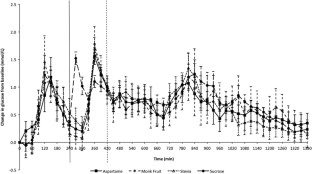
Replacing nutritive sweetener with non-nutritive sweeteners (NNS) has the potential to improve glycaemic control. The objective of this study was to investigate the effects of consuming artificial NNS (that is, aspartame), natural NNS (that is, monk fruit and stevia), and sucrose-sweetened beverages on 24-h glucose profiles. Ten healthy males took part in this randomised, crossover study with the following four treatments: aspartame-, monk fruit-, stevia-, and sucrose- (65 g) sweetened beverages. Participants were asked to consume the test beverage as a preload mid-morning. Medtronic iPro2 continuous glucose monitoring system was used to measure mean 24-h glucose, incremental area under the curve (iAUC) and total area under the curve (AUC) for glucose, and 24-h glycaemic variability. Overall no significant differences were found in mean 24-h glucose, iAUC and total AUC for glucose, and 24-h glycaemic variability between the four test beverages. Twenty-four-hour glucose profiles did not differ between beverages sweetened with non-nutritive (artificial vs natural) and nutritive sweeteners. The simple exchange of a single serving of sucrose-sweetened beverage with NNS over a day appears to have minimal effect on 24-h glucose profiles in healthy males.
This is a preview of subscription content, access via your institution
Access options
Subscribe to this journal
Receive 12 print issues and online access
$259.00 per year
only $21.58 per issue
Buy this article
- Purchase on SpringerLink
- Instant access to the full article PDF.
USD 39.95
Prices may be subject to local taxes which are calculated during checkout
Additional access options:
Figure 1
The alternative text for this image may have been generated using AI.
References
- NCD Risk Factor Collaboration. Worldwide trends in diabetes since 1980: a pooled analysis of 751 population-based studies with 4·4 million participants. Lancet 2016; 387: 1513–1530.
Article Google Scholar - Gardner C, Wylie-Rosett J, Gidding SS, Steffen LM, Johnson RK, Reader D et al. Nonnutritive sweeteners: current use and health perspectives: a scientific statement from the American Heart Association and the American Diabetes Association. Circulation 2012; 126: 509–519.
Article Google Scholar - Zheng M, Allman-Farinelli M, Heitmann BL, Rangan A . Substitution of sugar-sweetened beverages with other beverage alternatives: a review of long-term health outcomes. J Acad Nutr Diet 2015; 115: 767–779.
Article Google Scholar - Brynes AE, Adamson J, Dornhorst A, Frost GS . The beneficial effect of a diet with low glycaemic index on 24 h glucose profiles in healthy young people as assessed by continuous glucose monitoring. Br J Nutr 2005; 93: 179–182.
Article CAS Google Scholar - Kaur B, Ranawana V, Teh A-L, Henry CJK . The impact of a low glycemic index (GI) breakfast and snack on daily blood glucose profiles and food intake in young Chinese adult males. J Clin Transl Endocrinol 2015; 2: 92–98.
PubMed PubMed Central Google Scholar - Kahlhofer J, Karschin J, Silberhorn-Buhler H, Breusing N, Bosy-Westphal A . Effect of low-glycemic-sugar-sweetened beverages on glucose metabolism and macronutrient oxidation in healthy men. Int J Obes 2016; 40: 990–997.
Article CAS Google Scholar - Johnston CA, Stevens B, Foreyt J . The role of low-calorie sweeteners in diabetes. US Endocrinol 2013; 9: 13–15.
Article Google Scholar - Henry CJK, Newens KJ, Lightowler HJ . Low-glycaemic index sweetener-based beverages reduce 24- h glucose profiles in healthy adults. J Hum Nutr Diet 2009; 22: 77–80.
Article CAS Google Scholar - Tey SL, Salleh NB, Henry J, Forde CG . Effects of aspartame-, monk fruit-, stevia-, and sucrose-sweetened beverages on postprandial glucose, insulin and energy intake. Int J Obes 2017; 41: 450–457.
Article CAS Google Scholar - Brynes AE, Lee JL, Brighton RE, Leeds AR, Dornhorst A, Frost GS . A low glycemic diet significantly improves the 24- h blood glucose profile in people with type 2 diabetes, as assessed using the continuous glucose MiniMed monitor. Diabetes Care 2003; 26: 548–549.
Article Google Scholar - Sylvetsky AC, Brown RJ, Blau JE, Walter M, Rother KI . Hormonal responses to non-nutritive sweeteners in water and diet soda. Nutr Metab 2016; 13: 71.
Article Google Scholar - Bryant CE, Wasse LK, Astbury N, Nandra G, McLaughlin JT . Non-nutritive sweeteners: no class effect on the glycaemic or appetite responses to ingested glucose. Eur J Clin Nutr 2014; 68: 629–631.
Article CAS Google Scholar
Acknowledgements
We would like to thank the participants for taking part in the study. This work was supported by the Singapore Institute for Clinical Sciences, A*STAR, Singapore.
Author contributions
SLT, JH, and CF designed the research; SLT and NS conducted the research; SLT performed statistical analyses and drafted the manuscript; all authors approved the final manuscript.
Author information
Authors and Affiliations
- Clinical Nutrition Research Centre, Singapore Institute for Clinical Sciences, Agency for Science, Technology and Research (A*STAR), Singapore
S L Tey, N B Salleh, C J Henry & C G Forde - Department of Biochemistry, Yong Loo Lin School of Medicine, National University of Singapore, Singapore
C J Henry - Department of Physiology, Yong Loo Lin School of Medicine, National University of Singapore, Singapore
C G Forde
Authors
- S L Tey
- N B Salleh
- C J Henry
- C G Forde
Corresponding author
Correspondence toC G Forde.
Ethics declarations
Competing interests
The authors declare no conflict of interest.
Rights and permissions
About this article
Cite this article
Tey, S., Salleh, N., Henry, C. et al. Effects of non-nutritive (artificial vs natural) sweeteners on 24-h glucose profiles.Eur J Clin Nutr 71, 1129–1132 (2017). https://doi.org/10.1038/ejcn.2017.37
- Received: 20 November 2016
- Revised: 27 January 2017
- Accepted: 24 February 2017
- Published: 05 April 2017
- Issue date: September 2017
- DOI: https://doi.org/10.1038/ejcn.2017.37