High levels of atmospheric carbon dioxide necessary for the termination of global glaciation (original) (raw)
- Letter
- Published: 10 June 2004
Nature volume 429, pages 646–649 (2004)Cite this article
- 2168 Accesses
- 177 Citations
- 148 Altmetric
- Metrics details
Abstract
The possibility that the Earth suffered episodes of global glaciation as recently as the Neoproterozoic period, between about 900 and 543 million years ago, has been widely discussed1,2,3. Termination of such ‘hard snowball Earth’ climate states has been proposed to proceed from accumulation of carbon dioxide in the atmosphere4. Many salient aspects of the snowball scenario depend critically on the threshold of atmospheric carbon dioxide concentrations needed to trigger deglaciation2,5. Here I present simulations with a general circulation model, using elevated carbon dioxide levels to estimate this deglaciation threshold. The model simulates several phenomena that are expected to be significant in a ‘snowball Earth’ scenario, but which have not been considered in previous studies with less sophisticated models, such as a reduction of vertical temperature gradients in winter, a reduction in summer tropopause height, the effect of snow cover and a reduction in cloud greenhouse effects. In my simulations, the system remains far short of deglaciation even at atmospheric carbon dioxide concentrations of 550 times the present levels (0.2 bar of CO2). I find that at much higher carbon dioxide levels, deglaciation is unlikely unless unknown feedback cycles that are not captured in the model come into effect.
This is a preview of subscription content, access via your institution
Access options
Subscribe to this journal
Receive 51 print issues and online access
$199.00 per year
only $3.90 per issue
Buy this article
- Purchase on SpringerLink
- Instant access to the full article PDF.
USD 39.95
Prices may be subject to local taxes which are calculated during checkout
Additional access options:
Figure 1: January zonal-mean air temperature at the lowest model level, for various concentrations of atmospheric CO2.

The alternative text for this image may have been generated using AI.
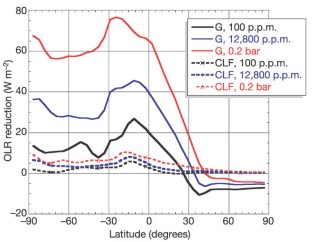
Figure 2: January zonal-mean clear-sky greenhouse trapping (solid lines) and cloud longwave forcing (CLF) (dashed lines), for various CO2 concentrations.
The alternative text for this image may have been generated using AI.
Figure 3: Typical January vertical temperature profiles for the 100 p.p.m.

The alternative text for this image may have been generated using AI.
References
- Hoffman, P. F., Kaufman, A. J., Halverson, G. P. & Schrag, D. P. A Neoproterozoic snowball earth. Science 281, 1342–1346 (1998)
Article ADS CAS Google Scholar - Hoffman, P. F. & Schrag, D. P. The snowball Earth hypothesis: testing the limits of global change. Terra Nova 14, 129–155 (2002)
Article ADS CAS Google Scholar - Kennedy, M. J., Christie-Blick, N. & Sohl, L. E. Are Proterozoic cap carbonates and isotopic excursions a record of gas hydrate destabilization following Earth's coldest intervals? Geology 29(5), 443–446 (2001)
Article ADS CAS Google Scholar - Kirschvink, J. L. in The Proterozoic Biosphere; a Multidisciplinary Study (eds Schorf, J. W. & Klein, C.) 51–52 (Cambridge Univ. Press, Cambridge, UK, 1992)
Google Scholar - Higgins, J. A. & Schrag, D. P. Aftermath of a snowball Earth. Geochem. Geophys. Geosyst. 4(3), doi:10.1029/2002GC000403 (2003)
- Chandler, M. A. & Sohl, L. E. Climate forcings and the initiation of low-latitude ice sheets during the Neoproterozoic Varanger glacial interval. J. Geophys. Res. D 105, 20737–20756 (2000)
Article ADS CAS Google Scholar - Hyde, W. T., Crowley, T. J., Baum, S. K. & Peltier, W. R. Neoproterozoic “snowball Earth” simulations with a coupled climate/ice-sheet model. Nature 405, 425–429 (2000)
Article ADS CAS Google Scholar - Poulsen, C., Pierrehumbert, R. T. & Jacob, R. Impact of ocean dynamics on the simulation of the Neoproterozoic “Snowball Earth”. Geophys. Res. Lett. 28(8), 1575–1578 (2001)
Article ADS Google Scholar - Caldeira, K. & Kasting, J. F. Susceptibility of the early Earth to irreversible glaciation caused by carbon dioxide clouds. Nature 359, 226–228 (1992)
Article ADS CAS Google Scholar - Tajika, E. Faint young Sun and the carbon cycle: implication for the Proterozoic global glaciations. Earth Planet. Sci. Lett. 214, 443–453 (2003)
Article ADS CAS Google Scholar - Pierrehumbert, R. T. The hydrologic cycle in deep-time climate problems. Nature 419, 191–198 (2002)
Article ADS CAS Google Scholar - Warren, S. G., Brandt, R. E., Grenfell, T. C. & McKay, C. P. Snowball Earth: ice thickness on the tropical ocean. J. Geophys. Res. C 107, doi:101029/2001JC001123 (2002)
- Walker, J. C. G. Earth System Processes, Abstr 110–111 (Geological Society, London, 2001)
Google Scholar - Jenkins, G. S. GCM greenhouse and high-obliquity solutions for early Proterozoic glaciation and middle Proterozoic warmth. J. Geophys. Res. D 108, doi:101029/2001JD001582 (2003)
- Goodman, J. C. & Pierrehumbert, R. T. Glacial flow of floating marine ice in Snowball Earth. J. Geophys. Res. C 108, doi:101029/2002JC001471 (2003)
- Donnadieu, Y., Fluteau, F., Ramstein, G., Ritz, C. & Besse, J. Is there a conflict between the Neoproterozoic glacial deposits and the snowball Earth interpretation: an improved understanding with numerical modeling. Earth Planet. Sci. Lett. 208, 101–112 (2003)
Article ADS CAS Google Scholar - Zhang, Y. X. & Zindler, A. Distribution and evolution of carbon and nitrogen in Earth. Earth Planet. Sci. Lett. 117, 331–345 (1993)
Article ADS CAS Google Scholar - Forget, F. & Pierrehumbert, R. T. Warning early Mars with carbon dioxide clouds that scatter infrared radiation. Science 278, 1273–1276 (1997)
Article ADS CAS Google Scholar - Goodman, J. C., Collins, G. C., Marshall, J. & Pierrehumbert, R. T. Hydrothermal plume dynamics on Europa: Implications for chase formation. J. Geophys. Res. E 109, doi:101029/2003JE002073 (2004)
- Jacob, R. Low Frequency Variability in a Simulated Atmosphere Ocean System. Thesis, Univ. Wisconsin-Madison (1997)
Google Scholar - Kiehl, J. T. et al. The National Center for Atmospheric Research Community. Climate Model: CCM3. J. Clim. 11, 1131–1149 (1998)
Article ADS Google Scholar - Kasting, J. F., Pollack, J. B. & Ackerman, T. P. Response of Earth's atmosphere to increases in solar flux and implications for loss of water from Venus. Icarus 57, 335–355 (1984)
Article ADS CAS Google Scholar
Acknowledgements
We thank P. Hoffman and S. Warren for discussions on a range of matters relating to the Neoproterzoic and to surface albedo in general; J.C.G. Walker for sharing additional thoughts concerning the Mars analogy; and LMD/Paris for providing a congenial environment in which to carry out this work. This work was funded by the National Science Foundation.
Author information
Authors and Affiliations
- Department of the Geophysical Sciences, The University of Chicago, Chicago, 5734 South Ellis Avenue, Illinois, 60637, USA
Raymond T. Pierrehumbert
Authors
- Raymond T. Pierrehumbert
Corresponding author
Correspondence toRaymond T. Pierrehumbert.
Ethics declarations
Competing interests
The author declares that he has no competing financial interests.
Supplementary information
Rights and permissions
About this article
Cite this article
Pierrehumbert, R. High levels of atmospheric carbon dioxide necessary for the termination of global glaciation.Nature 429, 646–649 (2004). https://doi.org/10.1038/nature02640
- Received: 12 November 2003
- Accepted: 07 May 2004
- Issue date: 10 June 2004
- DOI: https://doi.org/10.1038/nature02640
This article is cited by
Climate extremes likely to drive land mammal extinction during next supercontinent assembly
- Alexander Farnsworth
- Y. T. Eunice Lo
- Hannah R. Wakeford
Nature Geoscience (2023)
Quantitative comparison of geological data and model simulations constrains early Cambrian geography and climate
- Thomas W. Wong Hearing
- Alexandre Pohl
- Thijs R. A. Vandenbroucke
Nature Communications (2021)
Snowfall-albedo feedbacks could have led to deglaciation of snowball Earth starting from mid-latitudes
- Philipp de Vrese
- Tobias Stacke
- Victor Brovkin
Communications Earth & Environment (2021)
Weak tides during Cryogenian glaciations
- J. A. Mattias Green
- Hannah S. Davies
- Christopher Scotese
Nature Communications (2020)
Is the Faint Young Sun Problem for Earth Solved?
- Benjamin Charnay
- Eric T. Wolf
- François Forget
Space Science Reviews (2020)