The vertical profile of winds on Titan (original) (raw)
- Huygens Letters
- Published: 30 November 2005
- M. Allison2,
- S. W. Asmar3,
- D. H. Atkinson4,5,
- I. M. Avruch6,
- R. Dutta-Roy1,
- Y. Dzierma1,
- P. Edenhofer7,
- W. M. Folkner3,
- L. I. Gurvits6,
- D. V. Johnston3,
- D. Plettemeier8,
- S. V. Pogrebenko6,
- R. A. Preston3 &
- …
- G. L. Tyler9
Nature volume 438, pages 800–802 (2005)Cite this article
- 3328 Accesses
- 203 Citations
- Metrics details
Abstract
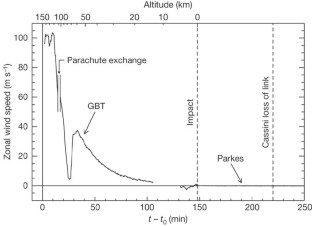
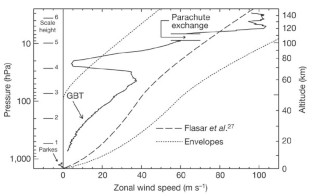
One of Titan's most intriguing attributes is its copious but featureless atmosphere. The Voyager 1 fly-by and occultation in 1980 provided the first radial survey of Titan's atmospheric pressure and temperature1,2 and evidence for the presence of strong zonal winds3. It was realized that the motion of an atmospheric probe could be used to study the winds, which led to the inclusion of the Doppler Wind Experiment4 on the Huygens probe5. Here we report a high resolution vertical profile of Titan's winds, with an estimated accuracy of better than 1 m s-1. The zonal winds were prograde during most of the atmospheric descent, providing in situ confirmation of superrotation on Titan. A layer with surprisingly slow wind, where the velocity decreased to near zero, was detected at altitudes between 60 and 100 km. Generally weak winds (∼1 m s-1) were seen in the lowest 5 km of descent.
This is a preview of subscription content, access via your institution
Access options
Subscribe to this journal
Receive 51 print issues and online access
$199.00 per year
only $3.90 per issue
Buy this article
- Purchase on SpringerLink
- Instant access to the full article PDF.
USD 39.95
Prices may be subject to local taxes which are calculated during checkout
Additional access options:
Figure 1: Zonal wind velocity during the Huygens mission.
The alternative text for this image may have been generated using AI.
Figure 2: Titan zonal wind height profile.
The alternative text for this image may have been generated using AI.
References
- Tyler, G. L. et al. Radio science investigations of the Saturn system with Voyager 1: Preliminary results. Science 212, 201–206 (1981)
Article ADS CAS PubMed Google Scholar - Lindal, G. F. et al. The atmosphere of Titan: An analysis of the Voyager 1 radio occultation measurements. Icarus 53, 348–363 (1983)
Article ADS CAS Google Scholar - Flasar, F. M., Samuelson, R. E. & Conrath, B. J. Titan's atmosphere: temperature and dynamics. Nature 292, 693–698 (1981)
Article ADS Google Scholar - Bird, M. K. et al. The Huygens Doppler Wind Experiment. Space Sci. Rev. 104, 613–640 (2002)
Article ADS Google Scholar - Lebreton, J.-P. et al. An overview of the descent and landing of the Huygens probe. Nature doi:10.1038/nature04347 (this issue)
- Del Genio, A. D., Zhou, W. & Eichler, T. P. Equatorial superrotation in a slowly rotating GCM: Implications for Titan and Venus. Icarus 101, 1–17 (1993)
Article ADS Google Scholar - Hourdin, F. et al. Numerical simulation of the general circulation of the atmosphere of Titan. Icarus 117, 358–374 (1995)
Article ADS CAS PubMed Google Scholar - Tokano, T., Neubauer, F. M., Laube, M. & McKay, C. P. Seasonal variation of Titan's atmospheric structure simulated by a general circulation model. Planet. Space Sci. 47, 493–520 (1999)
Article ADS CAS PubMed Google Scholar - Luz, D., Hourdin, F., Rannou, P. & Lebonnois, S. Latitudinal transport by baroclinic waves in Titan's stratosphere. II. Results from a coupled dynamics-microphysics-photochemistry GCM. Icarus 166, 343–358 (2003)
Article ADS CAS Google Scholar - Hubbard, W. B. et al. The occultation of 28 Sgr by Titan. Astron. Astrophys. 269, 541–563 (1993)
ADS Google Scholar - Bouchez, A. H. Seasonal Trends in Titan's Atmosphere: Haze, Wind and Clouds PhD thesis, California Inst. Technol. (2003); available at http://www.gps.caltech.edu/(antonin/thesis
Google Scholar - Kostiuk, T. et al. Direct measurement of winds on Titan. Geophys. Res. Lett. 28, 2361–2364 (2000)
Article ADS Google Scholar - Porco, C. C. et al. Imaging of Titan from the Cassini spacecraft. Nature 434, 159–168 (2005)
Article ADS CAS PubMed Google Scholar - Fulchignoni, M. et al. In situ measurements of the physical characteristics of Titan's atmosphere. Nature doi:10.1038/nature04314 (this issue)
- Atkinson, D. H., Pollack, J. B. & Seiff, A. Measurement of a zonal wind profile on Titan by Doppler tracking of the Cassini entry probe. Radio Sci. 25, 865–882 (1990)
Article ADS Google Scholar - Counselman, C. C. III, Gourevitch, S. A., King, R. W. & Loriot, G. B. Zonal and meridional circulation of the lower atmosphere of Venus determined by radio interferometry. J. Geophys. Res. 85, 8026–8030 (1980)
Article ADS Google Scholar - Allison, M., Del Genio, A. D. & Zhou, W. Zero potential vorticity envelopes for the zonal-mean velocity of the Venus/Titan atmospheres. J. Atmos. Sci. 51, 694–702 (1994)
Article ADS Google Scholar - Brown, M. E., Bouchez, A. H. & Griffith, C. A. Direct detection of variable tropospheric clouds near Titan's south pole. Nature 420, 795–797 (2002)
Article ADS CAS PubMed Google Scholar - Flasar, F. M. et al. Exploring the Saturn system in the thermal infrared: The Composite Infrared Spectrometer. Space Sci. Rev. 115, 169–297 (2004)
Article ADS CAS Google Scholar - Flasar, F. M. et al. Titan's atmospheric temperatures, winds, and composition. Science 308, 975–978 (2005)
Article ADS CAS PubMed Google Scholar - Kliore, A. J. et al. Cassini radio science. Space Sci. Rev. 115, 1–70 (2004)
Article ADS Google Scholar - Tomasko, M. G. et al. Rain, winds and haze during the Huygens probe's descent to Titan's surface. Nature doi:10.1038/nature04126 (this issue)
- Flasar, F. M. & Conrath, B. J. in Proc. Symposium on Titan (ed. Kaldeich, B.) 89–99 (ESA-SP 338, ESA Publications, ESTEC, Noordwijk, The Netherlands, 1992)
Google Scholar - Del Genio, A. D. & Zhou, W. Simulations of superrotation on slowly rotating planets: Sensitivity to rotation and initial condition. Icarus 120, 332–343 (1996)
Article ADS Google Scholar - Allison, M. in Proc. Symposium on Titan (ed. Kaldeich, B.) 113–118 (ESA SP-338, ESA Publications, ESTEC, Noordwijk, The Netherlands, 1992)
Google Scholar - Tokano, T. Meteorological assessment of the surface temperatures on Titan: Constraints on the surface type. Icarus 173, 222–242 (2005)
Article ADS CAS Google Scholar - Flasar, F. M., Allison, M. & Lunine, J. I. in Huygens Science Payload and Mission (ed. Wilson, A.) 287–298 (ESA-SP 1177, ESA Publications, ESTEC, Noordwijk, The Netherlands, 1997)
Google Scholar - Dutta-Roy, R. & Bird, M. K. in Planetary Probe Atmospheric Entry and Descent Trajectory Analysis and Science (ed. Wilson, A.) 109–116 (ESA SP-544, ESA Publications, ESTEC, Noordwijk, The Netherlands, 2004)
Google Scholar
Acknowledgements
This Letter presents results of a research project partially funded by the Deutsches Zentrum für Luft- und Raumfahrt (DLR). Parts of the research described here were carried out by the Jet Propulsion Laboratory, California Institute of Technology, under contract with NASA, and by NASA's Goddard Institute for Space Studies. We thank R. Kohl, K.-P. Wagner and M. Heyl for their efforts during the DWE development programme. We appreciate the support provided by the National Radio Astronomy Observatory (NRAO) and the Australia Telescope National Facility (ATNF). NRAO is operated by Associated Universities, Inc., under a cooperative agreement with the NSF. The ATNF, managed by the Commonwealth Scientific and Industrial Research Organization (CSIRO), is funded by the Commonwealth of Australia.
Author information
Authors and Affiliations
- Radioastronomisches Institut, Universität Bonn, Auf dem Hügel 71, 53125, Bonn, Germany
M. K. Bird, R. Dutta-Roy & Y. Dzierma - NASA Goddard Institute for Space Studies, 2880 Broadway, New York, 10025, New York, USA
M. Allison - Jet Propulsion Laboratory, California Institute of Technology, 4800 Oak Grove Drive, California, 91109, Pasadena, USA
S. W. Asmar, W. M. Folkner, D. V. Johnston & R. A. Preston - Department of Electrical & Computer Engineering, University of Idaho, Idaho, 83844-1023, Moscow, USA
D. H. Atkinson - Computer Engineering, University of Idaho,
D. H. Atkinson - Joint Institute for VLBI in Europe, PO Box 2, 7990, AA Dwingeloo, The Netherlands
I. M. Avruch, L. I. Gurvits & S. V. Pogrebenko - Institut für HF-Technik, Universität Bochum, 44780, Bochum, Germany
P. Edenhofer - Elektrotechnisches Institut, Technische Universität Dresden, 01062, Dresden, Germany
D. Plettemeier - Center for Radar Astronomy, Stanford University, California, 94305, Stanford, USA
G. L. Tyler
Authors
- M. K. Bird
- M. Allison
- S. W. Asmar
- D. H. Atkinson
- I. M. Avruch
- R. Dutta-Roy
- Y. Dzierma
- P. Edenhofer
- W. M. Folkner
- L. I. Gurvits
- D. V. Johnston
- D. Plettemeier
- S. V. Pogrebenko
- R. A. Preston
- G. L. Tyler
Corresponding author
Correspondence toM. K. Bird.
Ethics declarations
Competing interests
Reprints and permissions information is available at npg.nature.com/reprintsandpermissions. The authors declare no competing financial interests.
Supplementary information
Supplementary Notes (download PDF )
This file contains the Supplementary Discussion, Supplementary Figures 1–3, Supplementary Tables 1–2. Supplementary Figure 1 details Huygens signal frequency measurements at the Green Bank and Parkes radio telescopes. Supplementary Figure 2 presents Huygens frequency measurements and predictions at the Green Bank Telescope. Supplementary Figure 3 details Huygens frequency measurements and predictions at the Parkes Telescope. Supplementary Table 1 lists radio telescopes participating in the Earth-based DWE network. Supplementary Table 2 presents the Radio link budget: Huygens-to-Green Bank Telescope. (PDF 70 kb)
Rights and permissions
About this article
Cite this article
Bird, M., Allison, M., Asmar, S. et al. The vertical profile of winds on Titan.Nature 438, 800–802 (2005). https://doi.org/10.1038/nature04060
- Received: 20 May 2005
- Accepted: 20 July 2005
- Published: 30 November 2005
- Issue date: 08 December 2005
- DOI: https://doi.org/10.1038/nature04060
This article is cited by
Editorial Summary
New views of Titan
The Huygens probe landed on Titan on 14 January this year, and seven papers published in this issue record the encounter. They describe a world that resembles a primitive Earth, complete with weather systems and geological activity. The ‘Huygens on Titan’ section opens with an overview of the descent and landing and a News and Views piece. Tomasko et al. describe the dry riverbed and drainage channels seen during Huygens' descent, evidence that liquid methane falls as rain or erupts from cryovolcanoes, periodically flooding the surface. This paper includes the images used on the cover to the Huygens section. Niemann et al. measured the abundances of isotopes of argon, nitrogen and carbon in the atmosphere, and conclude that there is no evidence that Titan's methane comes from biological activity. Fulchignoni et al. obtained precise measurements of temperature and pressure from the upper atmosphere right down to the surface. On the way down Huygens recorded evidence for lightning. Zarnecki et al. report that the probe landed on a relatively smooth surface of icy grains with the consistency of wet clay or sand. Isräl et al. report that the aerosols in Titan's clouds have solid cores made from complex organic molecules containing carbon and nitrogen. And Bird et al. found that on average Titan's winds blow in the same direction as the moon rotates, and that close to the surface these winds are very weak, travelling at around walking speed.