Low sea level rise projections from mountain glaciers and icecaps under global warming (original) (raw)
- Letter
- Published: 19 January 2006
Nature volume 439, pages 311–313 (2006) Cite this article
- 4902 Accesses
- 273 Citations
- 18 Altmetric
- Metrics details
Abstract
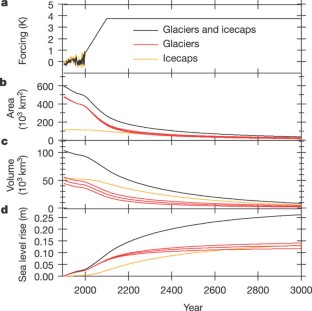
The mean sea level has been projected to rise in the 21st century as a result of global warming1. Such projections of sea level change depend on estimated future greenhouse emissions and on differing models, but model-average results from a mid-range scenario (A1B) suggests a 0.387-m rise by 2100 (refs 1, 2). The largest contributions to sea level rise are estimated to come from thermal expansion (0.288 m) and the melting of mountain glaciers and icecaps (0.106 m), with smaller inputs from Greenland (0.024 m) and Antarctica (- 0.074 m)1. Here we apply a melt model3 and a geometric volume model4 to our lower estimate of ice volume5,6,7 and assess the contribution of glaciers to sea level rise, excluding those in Greenland and Antarctica. We provide the first separate assessment of melt contributions from mountain glaciers and icecaps, as well as an improved treatment of volume shrinkage. We find that icecaps melt more slowly than mountain glaciers, whose area declines rapidly in the 21st century, making glaciers a limiting source for ice melt. Using two climate models, we project sea level rise due to melting of mountain glaciers and icecaps to be 0.046 and 0.051 m by 2100, about half that of previous projections1,8.
This is a preview of subscription content, access via your institution
Access options
Subscribe to this journal
Receive 52 print issues and online access
$199.00 per year
only $3.83 per issue
Buy this article
- Purchase on SpringerLink
- Instant access to the full article PDF.
USD 39.95
Prices may be subject to local taxes which are calculated during checkout
Additional access options:
Figure 1

The alternative text for this image may have been generated using AI.
Figure 2: Altitudinal gradients of mass balance in accumulation and ablation areas plotted against annual precipitation for all grid cells.

The alternative text for this image may have been generated using AI.
Figure 3: Time evolution of mountain glacier and icecap metrics.
The alternative text for this image may have been generated using AI.
Figure 4: Temperature forcing and SLR contribution for mountain glaciers and icecaps over the 21st century.

The alternative text for this image may have been generated using AI.
References
- Church, J. A. et al. in Climate Change 2001: The Scientific Basis (eds Houghton, J. T. et al.) 639–693 (Cambridge Univ. Press, Cambridge, UK, 2001)
Google Scholar - Nakićenović, N. & Swart, R. (eds) Special Report on Emissions Scenarios 570 (Cambridge Univ. Press, Cambridge, UK, 2000)
- Braithwaite, R. J., Zhang, Y. & Raper, S. C. B. Temperature sensitivity of the mass balance of mountain glaciers and icecaps as a climatological characteristic. Z. Gletscherkunde Glazialgeol. 38, 35–61 (2002)
Google Scholar - Raper, S. C. B., Brown, O. & Braithwaite, R. J. A geometric glacier model for sea level change calculations. J. Glaciol. 46, 357–368 (2000)
Article ADS Google Scholar - Raper, S. C. B. & Braithwaite, R. J. The potential for sea level rise: New estimates from glacier and ice cap area and volume distributions. Geophys. Res. Lett. 32, L05502, doi:10.1029/2004GL021981 (2005)
Article ADS Google Scholar - Meier, F., Bahr, D. B., Dyurgerov, M. B. & Pfeffer, W. T. Comment on ‘The potential for sea level rise: New estimates from glacier and ice cap area and volume distributions’. Geophys. Res. Lett. 32, L17501, doi:10.1029/2005GL023319 (2005)
Article ADS Google Scholar - Raper, S. C. B. & Braithwaite, R. J. Reply to comment by M. F. Meier et al. on ‘The potential for sea level rise: New estimates from glacier and ice cap area and volume distributions’. Geophys. Res. Lett. 32, L17502, doi: 10.1029/2005GL023460 (2005).
- Van de Wal, R. S. W. & Wild, M. Modelling the response of glaciers to climate change by applying the volume-area scaling in combination with a high resolution GCM. Clim. Dyn. 18, 359–366 (2001)
Article Google Scholar - Oerlemans, J. in Ice in the Climate System (ed. Peltier, W. R.) 101–116 (Springer, Berlin/Heidelberg, 1993)
Book Google Scholar - Cogley, J. G. GGHYDRO_—_Global Hydrographic Data Release 2.3, Trent Technical Note 2003–1 (Department of Geography, Trent Univ., Peterborough, Ontario, 2003); available at http://www.trentu.ca/geography/glaciology/glaciology.htm.
- Kotlyakov, V. M. et al. World Atlas of Snow and Ice Resources 1–392 (Russian Academy of Sciences, Institute of Geography, Moscow, 1997)
Google Scholar - National Snow and Ice Data Center (NSIDC). World Glacier Inventory http://www.nsidc.org/data/glacier_inventory/ (NSIDC, Boulder, Colorado, 1999)
Google Scholar - Meier, M. F. & Bahr, D. B. in Glaciers, Ice Sheets and Volcanoes: A Tribute to Mark F. Meier (ed. Colbeck, S. C.) 89–94 (Cold Regions Research Engineering Laboratory Special Report 96–27, Hanover, New Hampshire, 1996); available at http://www.stormingmedia.us/24/2431/A243123.html.
- New, M., Hulme, M. & Jones, P. J. Representing twentieth century space-time climate variability. 1. Development of a 1961–1990 mean monthly terrestrial climatology. J. Clim. 12, 829–856 (1999)
Article ADS Google Scholar - National Geodetic Survey data set. GLOBE. Available at the National Geophysical Data Center http://www.ngdc.noaa.gov/mgg/global/global.html (NGS, 1997).
- Paterson, W. S. B. The Physics of Glaciers 480 (Pergamon, Oxford, 1994)
Google Scholar - Dyurgerov, M. B. & Meier, M. F. Mass balance of mountain and subpolar glaciers: a new assessment for 1961–1990. Arct. Alp. Res. 29, 379–391 (1997)
Article Google Scholar - Braithwaite, R. J. & Raper, S. C. B. Glaciers and their contribution to sea level change. Phys. Chem. Earth 27, 1445–1454 (2002)
Article Google Scholar - Dyurgerov, M. B. & Meier, M. F. Twentieth century climate change: evidence from small glaciers. Proc. Natl Acad. Sci. USA 97, 1406–1411 (2000)
Article CAS ADS Google Scholar - Arendt, A. A., Echelmeyer, K. A., Harrison, W. D., Lingle, C. S. & Valentine, V. B. Rapid wastage of Alaska glaciers and their contribution to rising sea level. Science 297, 382–386 (2002)
Article CAS ADS Google Scholar - Rignot, E., Rivera, A. & Casassa, G. Contribution of the Patagonia Icefields of South America to sea level rise. Science 302, 434–437 (2003)
Article CAS ADS Google Scholar - Meehl, G. A. et al. How much more global warming and sea level rise? Science 307, 1769–1772 (2005)
Article CAS ADS Google Scholar - Geophysical Fluid Dynamics Laboratory. GFDL CM2 Modelhttp://data1.gfdl.noaa.gov/nomads/forms/deccen/ (GFDL, 2005).
Acknowledgements
Much of this work was supported by the HGF Strategiefonds Projekt (S.C.B.R.). We acknowledge the international modelling groups for providing their data for analysis, the Program for Climate Model Diagnosis and Intercomparison (PCMDI) for collecting and archiving the model data, the JSC/CLIVAR Working Group on Coupled Modelling (WGCM) and their Coupled Model Intercomparison Project (CMIP) and Climate Simulation Panel for organizing the model data analysis activity, and the IPCC WG1 TSU for technical support. The IPCC Data Archive at Lawrence Livermore National Laboratory is supported by the Office of Science, US Department of Energy.
Author information
Author notes
- Sarah C. B. Raper
Present address: CATE, Dalton Research Institute, Manchester Metropolitan University, Manchester, M1 5GD, UK
Authors and Affiliations
- Alfred Wegener Institute for Polar and Marine Research, 27515, Bremerhaven, Germany
Sarah C. B. Raper - School of Environment and Development, University of Manchester, M13 9PL, Manchester, UK
Roger J. Braithwaite
Authors
- Sarah C. B. Raper
- Roger J. Braithwaite
Corresponding author
Correspondence toSarah C. B. Raper.
Ethics declarations
Competing interests
Reprints and permissions information is available at npg.nature.com/reprintsandpermissions. The authors declare no competing financial interests.
Supplementary information
Rights and permissions
About this article
Cite this article
Raper, S., Braithwaite, R. Low sea level rise projections from mountain glaciers and icecaps under global warming.Nature 439, 311–313 (2006). https://doi.org/10.1038/nature04448
- Received: 01 June 2005
- Accepted: 14 November 2005
- Issue date: 19 January 2006
- DOI: https://doi.org/10.1038/nature04448
This article is cited by
Editorial Summary
Low tide
The prospect that melting of the polar icecaps and mountain glaciers could cause a global rise in sea level in the event of global warming is always in the news. Yet the predictions based on the commonly used climate scenarios still involve a great deal of uncertainty. New estimates reduce this uncertainty by taking better account of the shrinkage in glacier area than previous methods. A key result is that the projected sea level rise by 2100 due to water from melting ice caps and mountain glaciers is about half the previous estimate.