Bone histology indicates insular dwarfism in a new Late Jurassic sauropod dinosaur (original) (raw)
- Letter
- Published: 08 June 2006
Nature volume 441, pages 739–741 (2006) Cite this article
- 2190 Accesses
- 205 Citations
- 36 Altmetric
- Metrics details
Abstract
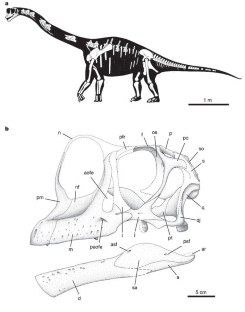
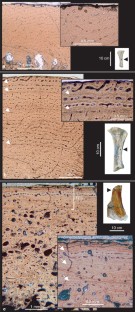
Sauropod dinosaurs were the largest animals ever to inhabit the land, with truly gigantic forms in at least three lineages1,2,3. Small species with an adult body mass less than five tonnes are very rare4,5, and small sauropod bones generally represent juveniles. Here we describe a new diminutive species of basal macronarian sauropod, Europasaurus holgeri gen. et sp. nov., and on the basis of bone histology we show it to have been a dwarf species. The fossils, including excellent skull material, come from Kimmeridgian marine beds of northern Germany6,7, and record more than 11 individuals of sauropods 1.7 to 6.2 m in total body length. Morphological overlap between partial skeletons and isolated bones links all material to the same new taxon. Cortical histology of femora and tibiae indicates that size differences within the specimens are due to different ontogenetic stages, from juveniles to fully grown individuals. The little dinosaurs must have lived on one of the large islands around the Lower Saxony basin8. Comparison with the long-bone histology of large-bodied sauropods suggests that the island dwarf species evolved through a decrease in growth rate from its larger ancestor.
This is a preview of subscription content, access via your institution
Access options
Subscribe to this journal
Receive 51 print issues and online access
$199.00 per year
only $3.90 per issue
Buy this article
- Purchase on SpringerLink
- Instant access to the full article PDF.
USD 39.95
Prices may be subject to local taxes which are calculated during checkout
Additional access options:
Figure 1: Europasaurus holgeri gen. et sp. nov.
The alternative text for this image may have been generated using AI.
Figure 2: Histological growth series and sampled bones of Europasaurus holgeri gen. et sp. nov.
The alternative text for this image may have been generated using AI.
References
- Wilson, J. A. Sauropod dinosaur phylogeny: critique and cladistic analysis. Zool. J. Linn. Soc. 136, 217–276 (2002)
Article Google Scholar - Wedel, M. J., Cifelli, R. L. & Sanders, R. K. Sauroposeidon proteles, a new sauropod from the Early Cretaceous of Oklahoma. J. Vertebr. Paleontol. 20, 109–114 (2000)
Article Google Scholar - Smith, J. B. et al. A giant sauropod dinosaur from an Upper Cretaceous mangrove deposit in Egypt. Science 292, 1704–1706 (2001)
Article ADS CAS Google Scholar - Upchurch, P., Barrett, P. M. & Dodson, P. in The Dinosauria 2nd edn (eds Weishampel, D. B., Dodson, P. & Osmólska, H.) 259–322 (Univ. of California Press, Berkeley, 2004)
Book Google Scholar - Rauhut, O. W. M. et al. Discovery of a short-necked sauropod dinosaur from the Late Jurassic period of Patagonia. Nature 435, 670–672 (2005)
Article ADS CAS Google Scholar - Lotze, F. Zum Jura des Langenberges zwischen Oker und Bad Harzburg (nördl. Harzrand). Neues Jb. Geol. Paläont. Mh. 1968, 730–732 (1968)
Google Scholar - Pape, H. Die Malmschichtenfolge vom Langenberg bei Oker (nördl. Harzvorland). Mitt. Geol. Inst. Tech. Univ. Hann. 9, 41–134 (1970)
Google Scholar - Ziegler, P. A. Geological Atlas of Western and Central Europe 2nd edn (Shell International Petroleum Company, Amsterdam, 1990)
Google Scholar - Sander, P. M. Long bone histology of the Tendaguru sauropods: implications for growth and biology. Paleobiology 26, 466–488 (2000)
Article Google Scholar - Horner, J. R., Padian, K. & de Ricqlès, A. Comparative osteohistology of some embryonic and neonatal archosaurs: implications for variable life histories among dinosaurs. Paleobiology 27, 39–58 (2001)
Article Google Scholar - Erickson, G. M. Assessing dinosaur growth patterns: a microscopic revolution. Trends Ecol. Evol. 20, 677–684 (2005)
Article Google Scholar - Chinsamy-Turan, A. The Microstructure of Dinosaur Bone (Johns Hopkins Univ. Press, Baltimore, 2005)
Google Scholar - Turvey, S. P., Green, O. R. & Holdaway, R. N. Cortical growth marks reveal extended juvenile development in New Zealand moa. Nature 435, 940–943 (2005)
Article ADS CAS Google Scholar - Nopcsa, F. Über das Vorkommen der Dinosaurier in Siebenbürgen. Verh. Zool. Bot. Ges. Wien 54, 12–14 (1914)
Google Scholar - Weishampel, D., Grigorescu, D. & Norman, D. B. The dinosaurs of Transsylvania. Natl Geogr. Res. 7, 196–215 (1991)
Google Scholar - Jianu, C. M. & Weishampel, D. B. The smallest of the largest: a new look at possible dwarfing in sauropod dinosaurs. Geol. Mijnbouw 78, 335–343 (1999)
Article Google Scholar - Dalla Vecchia, F. M. et al. Dinosaur track sites in the upper Cenomanian (Late Cretaceous) of the Istrian Peninsula (Croatia). Bol. Soc. Paleont. Ital. 40, 25–53 (2001)
Google Scholar - Weishampel, D. B., Norman, D. B. & Grigorescu, D. Telmatosaurus transsylvanicus from the Late Cretaceous of Romania: the most basal hadrosaurid dinosaur. Palaeontology 36, 361–385 (1993)
Google Scholar - Le Loeuff, J. Romanian Late Cretaceous dinosaurs: big dwarfs or small giants? Hist. Biol. 17, 15–17 (2005)
Article Google Scholar - Padian, K., de Ricqlès, A. & Horner, J. R. Dinosaurian growth rates and bird origins. Nature 412, 405–408 (2001)
Article ADS CAS Google Scholar - de Ricqlès, A. et al. in _Bone_Vol. 3 Bone Matrix and Bone Specific Products (ed. Hall, B. K.) 1–78 (CRC, Boca Raton, 1991)
Google Scholar - Sander, P. M. & Tückmantel, C. Bone lamina thickness, bone apposition rates, and age estimates in sauropod humeri and femora. Paläontol. Z. 76, 161–172 (2003)
Article Google Scholar - Erickson, G. M. et al. Gigantism and comparative life-history parameters of tyrannosaurid dinosaurs. Nature 430, 772–774 (2004)
Article ADS CAS Google Scholar - Sander, P. M. et al. Adaptive radiation in sauropod dinosaurs: bone histology indicates rapid evolution of giant body size through acceleration. Org. Divers. Evol. 4, 165–173 (2004)
Article Google Scholar - Antunes, M. T. & Mateus, O. Dinosaurs of Portugal. C R. Palevol. 2, 77–95 (2003)
Article Google Scholar
Acknowledgements
We thank O. Dülfer, W. Fink, D. Flemming, W. Fricke, A. Hänel, O. Heumann, D. Kranz, M. Lorsch, M. Mastroianni, R. Nimser, G. Oleschinski, U. Resch, D. Rössler, H.-J. Siber, S. Thiele, D. Unwin, F. Wesling, J. Wilson and R. Windolf. We especially appreciate the support of J. McIntosh, F. von Pupka, B. Wolter and H. Lüdtke. This research was supported by the Jurassic Foundation, the Deutsche Forschungsgemeinschaft (DFG) and the Portuguese “Fundação para a Ciência e Tecnologia”. This paper is contribution number 9 of the DFG Research Unit 533 “Biology of the Sauropod Dinosaurs: The Evolution of Gigantism”. Author Contributions P.M.S. was responsible for the bone histology work presented as part of this study. The morphology, systematics and taphonomy of the new sauropod was studied by the remaining authors, who are to be considered the sole authors of the name Europasaurus holgeri gen. et sp. nov.
Author information
Authors and Affiliations
- Institute of Paleontology, University of Bonn, Nussallee 8, D-53115, Bonn, Germany
P. Martin Sander - Centro de Estudos Geológicos da Universidade Nova de Lisboa and Museu da Lourinhã, Rua João Luis de Moura, Lourinhã, 2530-157, Portugal
Octávio Mateus - Dinosaurier-Freilichtmuseum Münchehagen, Germany, Alte Zollstrasse 5, D-31547, Rehburg-Loccum
Thomas Laven & Nils Knötschke
Authors
- P. Martin Sander
- Octávio Mateus
- Thomas Laven
- Nils Knötschke
Corresponding authors
Correspondence toP. Martin Sander or Octávio Mateus.
Ethics declarations
Competing interests
Reprints and permissions information is available at npg.nature.com/reprintsandpermissions. The authors declare no competing financial interests.
Supplementary information
Supplementary Notes (download DOC )
This file contains information on the geology and taphonomy of the Langenberg quarry locality, details of the phylogenetic analysis including the data matrix, an extended diagnosis of Europasaurus holgeri gen. et sp. nov., information on body length (BL) estimates for Europasaurus and on methods of histologic study of Europasaurus long bones. This file also contains four figures. Supplementary Figure 1 provides a palaeogeographic map of Central Europe during the Kimmeridgian. Supplementary Figure 2 illustrates the various parts of the skeleton, including autapomorphic features. Supplementary Figures 3 illustrates the premaxilla bearing the cranial autapomorphy of Europasaurus. Supplementary Figure 4 illustrates the results of the phylogenetic analysis in a cladogram. (DOC 2708 kb)
*The legend to Supplementary Fig. 2 has been modified on 7 July 2006 by addition of ref. 14 to give due credit for the reconstruction of Brachiosaurus.
Rights and permissions
About this article
Cite this article
Martin Sander, P., Mateus, O., Laven, T. et al. Bone histology indicates insular dwarfism in a new Late Jurassic sauropod dinosaur.Nature 441, 739–741 (2006). https://doi.org/10.1038/nature04633
- Received: 20 December 2005
- Accepted: 07 February 2006
- Issue date: 08 June 2006
- DOI: https://doi.org/10.1038/nature04633
This article is cited by
Editorial Summary
A small dinosaur in Germany
The idea that dwarf species tend to evolve among island populations has received recent publicity in the context of Homo floresiensis and the dwarf animals (mainly elephants) found on the island of Flores. Now it seems that the same thing may have happened with sauropod dinosaurs. Newly discovered fossils from northern Germany have been identified as dwarf adult sauropods, possibly evolved on islands in the Lower Saxony basin from their larger mainland cousins. Sauropods were previously considered almost universally large — they include Diplodocus and Titanosaurus for example — and any small sauropod bones were assumed to be juvenile. In these new finds though, the bone histology suggests that they were adults.