Experience-dependent representation of visual categories in parietal cortex (original) (raw)
- Letter
- Published: 27 August 2006
Nature volume 443, pages 85–88 (2006)Cite this article
- 6146 Accesses
- 514 Citations
- 6 Altmetric
- Metrics details
Abstract
Categorization is a process by which the brain assigns meaning to sensory stimuli. Through experience, we learn to group stimuli into categories, such as ‘chair’, ‘table’ and ‘vehicle’, which are critical for rapidly and appropriately selecting behavioural responses1,2. Although much is known about the neural representation of simple visual stimulus features (for example, orientation, direction and colour), relatively little is known about how the brain learns and encodes the meaning of stimuli. We trained monkeys to classify 360° of visual motion directions into two discrete categories, and compared neuronal activity in the lateral intraparietal (LIP) and middle temporal (MT) areas, two interconnected brain regions3 known to be involved in visual motion processing4,5,6. Here we show that neurons in LIP—an area known to be centrally involved in visuo-spatial attention7,8,9, motor planning10,11,12,13 and decision-making14,15,16—robustly reflect the category of motion direction as a result of learning. The activity of LIP neurons encoded directions of motion according to their category membership, and that encoding shifted after the monkeys were retrained to group the same stimuli into two new categories. In contrast, neurons in area MT were strongly direction selective but carried little, if any, explicit category information. This indicates that LIP might be an important nexus for the transformation of visual direction selectivity to more abstract representations that encode the behavioural relevance, or meaning, of stimuli.
This is a preview of subscription content, access via your institution
Access options
Subscribe to this journal
Receive 51 print issues and online access
$199.00 per year
only $3.90 per issue
Buy this article
- Purchase on SpringerLink
- Instant access to the full article PDF.
USD 39.95
Prices may be subject to local taxes which are calculated during checkout
Additional access options:
Figure 1: Behavioural task.
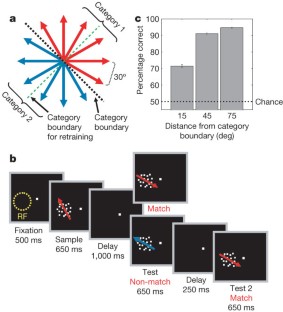
The alternative text for this image may have been generated using AI.
Figure 2: Examples of three category-selective LIP neurons.

The alternative text for this image may have been generated using AI.
Figure 3: Category effects across the LIP population.

The alternative text for this image may have been generated using AI.
Figure 4: LIP category selectivity followed retraining.
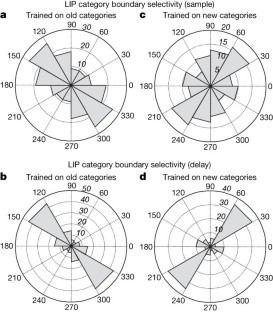
The alternative text for this image may have been generated using AI.
References
- Ashby, F. G. & Maddox, W. T. Human category learning. Annu. Rev. Psychol. 56, 149–178 (2005)
Article PubMed Google Scholar - Barsalou, L. W. Cognitive Psychology: An Overview for Cognitive Scientists (Erlbaum, Hillsdale, New Jersey, 1992)
Google Scholar - Lewis, J. W. & Van Essen, D. C. Corticocortical connections of visual, sensorimotor, and multimodal processing areas in the parietal lobe of the macaque monkey. J. Comp. Neurol. 428, 112–137 (2000)
Article CAS PubMed Google Scholar - Born, R. T. & Bradley, D. C. Structure and function of visual area MT. Annu. Rev. Neurosci. 28, 157–189 (2005)
Article CAS PubMed Google Scholar - Eskandar, E. N. & Assad, J. A. Dissociation of visual, motor and predictive signals in parietal cortex during visual guidance. Nature Neurosci. 2, 88–93 (1999)
Article CAS PubMed Google Scholar - Williams, Z. M., Elfar, J. C., Eskandar, E. N., Toth, L. J. & Assad, J. A. Parietal activity and the perceived direction of ambiguous apparent motion. Nature Neurosci. 6, 616–623 (2003)
Article CAS PubMed Google Scholar - Colby, C. L., Duhamel, J. R. & Goldberg, M. E. Visual, presaccadic, and cognitive activation of single neurons in monkey lateral intraparietal area. J. Neurophysiol. 76, 2841–2852 (1996)
Article CAS PubMed Google Scholar - Colby, C. L. & Goldberg, M. E. Space and attention in parietal cortex. Annu. Rev. Neurosci. 22, 319–349 (1999)
Article CAS PubMed Google Scholar - Bisley, J. W. & Goldberg, M. E. Neuronal activity in the lateral intraparietal area and spatial attention. Science 299, 81–86 (2003)
Article ADS CAS PubMed Google Scholar - Snyder, L. H., Batista, A. P. & Andersen, R. A. Coding of intention in the posterior parietal cortex. Nature 386, 167–170 (1997)
Article ADS CAS PubMed Google Scholar - Batista, A. P., Buneo, C. A., Snyder, L. H. & Andersen, R. A. Reach plans in eye-centered coordinates. Science 285, 257–260 (1999)
Article CAS PubMed Google Scholar - Buneo, C. A., Jarvis, M. R., Batista, A. P. & Andersen, R. A. Direct visuomotor transformations for reaching. Nature 416, 632–636 (2002)
Article ADS CAS PubMed Google Scholar - Andersen, R. A. & Buneo, C. A. Intentional maps in posterior parietal cortex. Annu. Rev. Neurosci. 25, 189–220 (2002)
Article CAS PubMed Google Scholar - Platt, M. L. & Glimcher, P. W. Neural correlates of decision variables in parietal cortex. Nature 400, 233–238 (1999)
Article ADS CAS PubMed Google Scholar - Shadlen, M. N. & Newsome, W. T. Neural basis of a perceptual decision in the parietal cortex (area LIP) of the rhesus monkey. J. Neurophysiol. 86, 1916–1936 (2001)
Article CAS PubMed Google Scholar - Huk, A. C. & Shadlen, M. N. Neural activity in macaque parietal cortex reflects temporal integration of visual motion signals during perceptual decision making. J. Neurosci. 25, 10420–10436 (2005)
Article CAS PubMed PubMed Central Google Scholar - Ghose, G. M. Learning in mammalian sensory cortex. Curr. Opin. Neurobiol. 14, 513–518 (2004)
Article CAS PubMed Google Scholar - Freedman, D. J., Riesenhuber, M., Poggio, T. & Miller, E. K. Categorical representation of visual stimuli in the primate prefrontal cortex. Science 291, 312–316 (2001)
Article ADS CAS PubMed Google Scholar - Freedman, D. J., Riesenhuber, M., Poggio, T. & Miller, E. K. Visual categorization and the primate prefrontal cortex: neurophysiology and behavior. J. Neurophysiol. 88, 914–928 (2002)
Article Google Scholar - Miller, E. K. & Cohen, J. D. An integrative theory of prefrontal cortex function. Annu. Rev. Neurosci. 24, 167–202 (2001)
Article CAS PubMed Google Scholar - Sigala, N. & Logothetis, N. K. Visual categorization shapes feature selectivity in the primate temporal cortex. Nature 415, 318–320 (2002)
Article ADS CAS PubMed Google Scholar - Freedman, D. J., Riesenhuber, M., Poggio, T. & Miller, E. K. Experience-dependent sharpening of visual shape selectivity in inferior temporal cortex. Cereb. Cortex (in the press)
- Vogels, R. Categorization of complex visual images by rhesus monkeys. Eur. J. Neurosci. 11, 1223–1238 (1999)
Article CAS PubMed Google Scholar - Freedman, D. J., Riesenhuber, M., Poggio, T. & Miller, E. K. A comparison of primate prefrontal and inferior temporal cortices during visual categorization. J. Neurosci. 23, 5235–5246 (2003)
Article CAS PubMed PubMed Central Google Scholar - Bisley, J. W., Krisna, B. S. & Goldberg, M. E. A rapid and precise on-response in posterior parietal cortex. J. Neurosci. 24, 1833–1838 (2004)
Article CAS PubMed PubMed Central Google Scholar - Toth, L. J. & Assad, J. A. Dynamic coding of behaviorally relevant stimuli in parietal cortex. Nature 415, 165–168 (2002)
Article ADS CAS PubMed Google Scholar - Nieder, A. & Miller, E. K. A parieto-frontal network for visual numerical information in the monkey. Proc. Natl Acad. Sci. USA 101, 7457–7462 (2004)
Article ADS CAS PubMed PubMed Central Google Scholar - Stoet, G. & Snyder, L. H. Single neurons in posterior parietal cortex (PPC) of monkeys encode cognitive set. Neuron 42, 1003–1012 (2004)
Article CAS PubMed Google Scholar
Acknowledgements
We thank J. Ditterich, A. Fanini, V. Ferrera, J. Fitzgerald, C. Freedman, T. Herrington, M. Histed, G. Maimon, E. Miller, C. Pack, C. Padoa-Schioppa, A. Seitz and J. Wallis for comments, help and discussions, and K. Irwin, T. Lafratta and J. LeBlanc for technical assistance. This work was supported by the National Eye Institute (NEI) and the McKnight Endowment Fund for Neuroscience, and a Kirschstein postdoctoral National Research Service Award from the NEI to D.J.F. Author Contributions D.J.F. performed all aspects of this study including the experimental design, data collection and analysis, and writing the manuscript. J.A.A. assisted in experimental design, data analysis and manuscript preparation.
Author information
Authors and Affiliations
- Department of Neurobiology, Harvard Medical School, 220 Longwood Avenue, Massachusetts, 02115, Boston, USA
David J. Freedman & John A. Assad
Authors
- David J. Freedman
- John A. Assad
Corresponding author
Correspondence toDavid J. Freedman.
Ethics declarations
Competing interests
Reprints and permissions information is available at www.nature.com/reprints. The authors declare no competing financial interests.
Supplementary information
Rights and permissions
About this article
Cite this article
Freedman, D., Assad, J. Experience-dependent representation of visual categories in parietal cortex.Nature 443, 85–88 (2006). https://doi.org/10.1038/nature05078
- Received: 05 May 2006
- Accepted: 13 July 2006
- Published: 27 August 2006
- Issue date: 07 September 2006
- DOI: https://doi.org/10.1038/nature05078