Effects of biodiversity on the functioning of trophic groups and ecosystems (original) (raw)
- Letter
- Published: 26 October 2006
- Diane S. Srivastava2,
- J. Emmett Duffy3,
- Justin P. Wright4,
- Amy L. Downing5,
- Mahesh Sankaran6,7 &
- …
- Claire Jouseau8
Nature volume 443, pages 989–992 (2006) Cite this article
- 21k Accesses
- 1577 Citations
- 48 Altmetric
- Metrics details
Abstract
Over the past decade, accelerating rates of species extinction have prompted an increasing number of studies to reduce species diversity experimentally and examine how this alters the efficiency by which communities capture resources and convert those into biomass1,2. So far, the generality of patterns and processes observed in individual studies have been the subjects of considerable debate3,4,5,6,7. Here we present a formal meta-analysis of studies that have experimentally manipulated species diversity to examine how it affects the functioning of numerous trophic groups in multiple types of ecosystem. We show that the average effect of decreasing species richness is to decrease the abundance or biomass of the focal trophic group, leading to less complete depletion of resources used by that group. At the same time, analyses reveal that the standing stock of, and resource depletion by, the most species-rich polyculture tends to be no different from that of the single most productive species used in an experiment. Of the known mechanisms that might explain these trends, results are most consistent with what is called the ‘sampling effect’, which occurs when diverse communities are more likely to contain and become dominated by the most productive species. Whether this mechanism is widespread in natural communities is currently controversial. Patterns we report are remarkably consistent for four different trophic groups (producers, herbivores, detritivores and predators) and two major ecosystem types (aquatic and terrestrial). Collectively, our analyses suggest that the average species loss does indeed affect the functioning of a wide variety of organisms and ecosystems, but the magnitude of these effects is ultimately determined by the identity of species that are going extinct.
This is a preview of subscription content, access via your institution
Access options
Subscribe to this journal
Receive 51 print issues and online access
$199.00 per year
only $3.90 per issue
Buy this article
- Purchase on SpringerLink
- Instant access to the full article PDF.
USD 39.95
Prices may be subject to local taxes which are calculated during checkout
Additional access options:
Figure 1: Effects of species richness on the standing stock abundance or biomass of trophic group t , and the depletion of resources consumed by t.
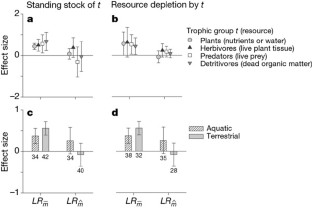
The alternative text for this image may have been generated using AI.
Figure 2: The general form of the diversity–function relationship.
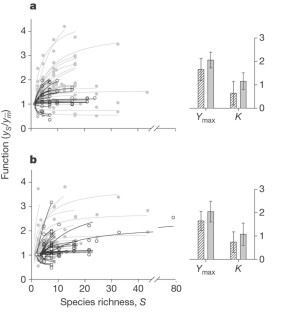
The alternative text for this image may have been generated using AI.
References
- Loreau, M. et al. Biodiversity and ecosystem functioning: Current knowledge and future challenges. Science 294, 804–808 (2001)
Article ADS CAS Google Scholar - Chapin, F. S. et al. Biotic control over the functioning of ecosystems. Science 277, 500–504 (1997)
Article CAS Google Scholar - Huston, M. A. Hidden treatments in ecological experiments: Re-evaluating the ecosystem function of biodiversity. Oecologia 110, 449–460 (1997)
Article ADS Google Scholar - Schwartz, M. W. et al. Linking biodiversity to ecosystem function: Implications for conservation ecology. Oecologia 122, 297–305 (2000)
Article ADS CAS Google Scholar - Schlapfer, F. & Schmid, B. Ecosystem effects of biodiversity: A classification of hypotheses and exploration of empirical results. Ecol. Appl. 9, 893–912 (1999)
Article Google Scholar - Hooper, D. U. et al. Effects of biodiversity on ecosystem functioning: A consensus of current knowledge. Ecol. Monogr. 75, 3–35 (2005)
Article Google Scholar - Srivastava, D. S. & Vellend, M. Biodiversity-ecosystem function research: Is it relevant to conservation?. Annu. Rev. Ecol. Evol. Syst. 36, 267–294 (2006)
Article Google Scholar - Sala, O. E. et al. Global biodiversity scenarios for the year 2100. Science 287, 1770–1774 (2000)
Article CAS Google Scholar - Vitousek, P. M., Mooney, H. A., Lubchenco, J. & Melillo, J. M. Human domination of Earth’s ecosystems. Science 277, 494–499 (1997)
Article CAS Google Scholar - Pimm, S. L., Russell, G. J., Gittleman, J. L. & Brooks, T. M. The future of biodiversity. Science 269, 347–350 (1995)
Article ADS CAS Google Scholar - Millennium Ecosystem Assessment. Ecosystems and Human Well-being: Biodiversity Synthesis (World Resources Institute, Washington DC, 2005)
- Naeem, S., Thompson, L. J., Lawler, S. P., Lawton, J. H. & Woodfin, R. M. Declining biodiversity can alter the performance of ecosystems. Nature 368, 734–737 (1994)
Article ADS Google Scholar - Tilman, D., Wedin, D. & Knops, J. Productivity and sustainability influenced by biodiversity in grassland ecosystems. Nature 379, 718–720 (1996)
Article ADS CAS Google Scholar - Hector, A. et al. Plant diversity and productivity experiments in European grasslands. Science 286, 1123–1127 (1999)
Article CAS Google Scholar - Wardle, D. A., Bonner, K. I. & Nicholson, K. S. Biodiversity and plant litter: Experimental evidence which does not support the view that enhanced species richness improves ecosystem function. Oikos 79, 247–258 (1997)
Article Google Scholar - Downing, A. L. & Leibold, M. A. Ecosystem consequences of species richness and composition in pond food webs. Nature 416, 837–841 (2002)
Article ADS CAS Google Scholar - Fridley, J. D. Resource availability dominates and alters the relationship between species diversity and ecosystem productivity in experimental plant communities. Oecologia 132, 271–277 (2002)
Article ADS Google Scholar - Finke, D. L. & Denno, R. F. Predator diversity dampens trophic cascades. Nature 429, 407–410 (2004)
Article ADS CAS Google Scholar - Petchey, O. L., McPhearson, P. T., Casey, T. M. & Morin, P. J. Environmental warming alters food-web structure and ecosystem function. Nature 402, 69–72 (1999)
Article ADS CAS Google Scholar - Raffaelli, D. et al. in Biodiversity and Ecosystem Functioning: Synthesis and Perspectives (eds Loreau, M., Naeem, S. & Inchausti, P.) 147–154 (Oxford Univ. Press, Oxford, 2002)
- Covich, A. P. et al. The role of biodiversity in the functioning of freshwater and marine benthic ecosystems. Bioscience 54, 767–775 (2004)
Article Google Scholar - Emmerson, M. C., Solan, M., Emes, C., Paterson, D. M. & Raffaelli, D. Consistent patterns and the idiosyncratic effects of biodiversity in marine ecosystems. Nature 411, 73–77 (2001)
Article ADS CAS Google Scholar - Duffy, J. E. Biodiversity loss, trophic skew and ecosystem functioning. Ecol. Lett. 6, 680–687 (2003)
Article Google Scholar - Hector, A., Bazeley-White, E., Loreau, M., Otway, S. & Schmid, B. Overyielding in grassland communities: testing the sampling effect hypothesis with replicated biodiversity experiments. Ecol. Lett. 5, 502–511 (2002)
Article Google Scholar - Loreau, M. & Hector, A. Partitioning selection and complementarity in biodiversity experiments. Nature 412, 72–76 (2001)
Article ADS CAS Google Scholar - Hutchinson, G. E. Population studies—animal ecology and demography—concluding remarks. Cold Spring Harb. Symp. Quant. Biol. 22, 415–427 (1957)
Article Google Scholar - Gause, G. F. The Struggle for Existence (Williams & Wilkins, Baltimore, Maryland, 1936)
- Tilman, D., Lehman, D. & Thompson, K. Plant diversity and ecosystem productivity: Theoretical considerations. Proc. Natl Acad. Sci. USA 94, 1857–1861 (1997)
Article ADS CAS Google Scholar - Cardinale, B. J., Ives, A. R. & Inchausti, P. Effects of species diversity on the primary productivity of ecosystems: Extending our spatial and temporal scales of inference. Oikos 104, 437–450 (2004)
Article Google Scholar - Hedges, L. V., Gurevitch, J. & Curtis, P. S. The meta-analysis of response ratios in experimental ecology. Ecology 80, 1150–1156 (1999)
Article Google Scholar
Acknowledgements
We thank S. Gaines, H. Hillebrand, M. Huston, J. Hille Ris-Lambers, J. Levine, J. Melack, B. Starzomski, D. Tilman and D. Wardle for comments that improved this manuscript. This work was supported by grants from the US National Science Foundation and is a product of the BioMERGE diversity-synthesis network.
Author information
Authors and Affiliations
- Department of Ecology, Evolution and Marine Biology, University of California at Santa Barbara, Santa Barbara, California, 93106, USA
Bradley J. Cardinale - Department of Zoology, University of British Columbia, Vancouver, British Columbia, V6T 1Z4, Canada
Diane S. Srivastava - Virginia Institute of Marine Science, The College of William and Mary, Gloucester Point, Virginia, 23062, USA
J. Emmett Duffy - Department of Biology, Duke University, Durham, North Carolina, 27708, USA
Justin P. Wright - Department of Zoology, Ohio Wesleyan University, Delaware, Ohio, 43015, USA
Amy L. Downing - Institute of Integrative & Comparative Biology, Faculty of Biological Sciences, University of Leeds, Leeds, LS2 9JT, UK
Mahesh Sankaran - Comparative Biology, Faculty of Biological Sciences, University of Leeds, Leeds, LS2 9JT
Mahesh Sankaran - Department of Ecology, Evolution and Environmental Biology, Columbia University, New York, New York, 10027, USA
Claire Jouseau
Authors
- Bradley J. Cardinale
- Diane S. Srivastava
- J. Emmett Duffy
- Justin P. Wright
- Amy L. Downing
- Mahesh Sankaran
- Claire Jouseau
Corresponding author
Correspondence toBradley J. Cardinale.
Ethics declarations
Competing interests
Reprints and permissions information is available at www.nature.com/reprints. The authors declare no competing financial interests.
Supplementary information
Rights and permissions
About this article
Cite this article
Cardinale, B., Srivastava, D., Emmett Duffy, J. et al. Effects of biodiversity on the functioning of trophic groups and ecosystems.Nature 443, 989–992 (2006). https://doi.org/10.1038/nature05202
- Received: 08 July 2006
- Accepted: 05 September 2006
- Issue date: 26 October 2006
- DOI: https://doi.org/10.1038/nature05202
This article is cited by
Editorial Summary
Species loss and productivity
The question of whether species extinction alters the productivity of communities and ecosystem function is the subject of heated controversy. Work performed in the 1990s suggested that species loss can reduce productivity of communities and their efficiency in capturing and consuming limited resources. The interpretation of these studies was disputed, and subsequent work produced counter-examples that question the generality of biodiversity effects. Now Cardinale et al. report a meta-analysis of experimental studies of species diversity and ecological function. They conclude that species loss does impair ecological functioning, but that the magnitude of the effect depends on which species are actually lost.