Climate-driven trends in contemporary ocean productivity (original) (raw)
- Letter
- Published: 07 December 2006
- Robert T. O’Malley1,
- David A. Siegel3,
- Charles R. McClain4,
- Jorge L. Sarmiento5,
- Gene C. Feldman4,
- Allen J. Milligan1,
- Paul G. Falkowski6,
- Ricardo M. Letelier2 &
- …
- Emmanuel S. Boss7
Nature volume 444, pages 752–755 (2006) Cite this article
- 29k Accesses
- 2180 Citations
- 193 Altmetric
- Metrics details
Abstract
Contributing roughly half of the biosphere’s net primary production (NPP)1,2, photosynthesis by oceanic phytoplankton is a vital link in the cycling of carbon between living and inorganic stocks. Each day, more than a hundred million tons of carbon in the form of CO2 are fixed into organic material by these ubiquitous, microscopic plants of the upper ocean, and each day a similar amount of organic carbon is transferred into marine ecosystems by sinking and grazing. The distribution of phytoplankton biomass and NPP is defined by the availability of light and nutrients (nitrogen, phosphate, iron). These growth-limiting factors are in turn regulated by physical processes of ocean circulation, mixed-layer dynamics, upwelling, atmospheric dust deposition, and the solar cycle. Satellite measurements of ocean colour provide a means of quantifying ocean productivity on a global scale and linking its variability to environmental factors. Here we describe global ocean NPP changes detected from space over the past decade. The period is dominated by an initial increase in NPP of 1,930 teragrams of carbon a year (Tg C yr-1), followed by a prolonged decrease averaging 190 Tg C yr-1. These trends are driven by changes occurring in the expansive stratified low-latitude oceans and are tightly coupled to coincident climate variability. This link between the physical environment and ocean biology functions through changes in upper-ocean temperature and stratification, which influence the availability of nutrients for phytoplankton growth. The observed reductions in ocean productivity during the recent post-1999 warming period provide insight on how future climate change can alter marine food webs.
This is a preview of subscription content, access via your institution
Access options
Subscribe to this journal
Receive 52 print issues and online access
$199.00 per year
only $3.83 per issue
Buy this article
- Purchase on SpringerLink
- Instant access to the full article PDF.
USD 39.95
Prices may be subject to local taxes which are calculated during checkout
Additional access options:
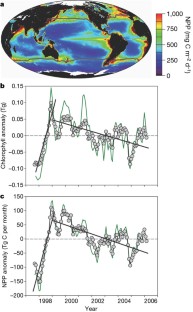
Figure 1: Distribution and trends in global ocean phytoplankton productivity (NPP) and chlorophyll standing stocks.
The alternative text for this image may have been generated using AI.
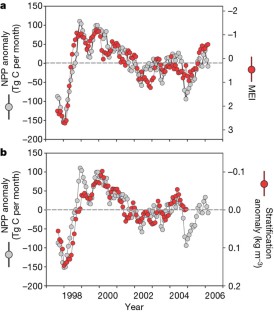
Figure 2: Ocean productivity is closely coupled to climate variability.
The alternative text for this image may have been generated using AI.
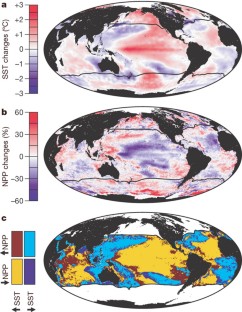
Figure 3: Climate controls on ocean productivity cause NPP to vary inversely with changes in SST.
The alternative text for this image may have been generated using AI.
References
- Field, C. B., Behrenfeld, M. J., Randerson, J. T. & Falkowski, P. G. Primary production of the biosphere: Integrating terrestrial and oceanic components. Science 281, 237–240 (1998)
Article ADS CAS PubMed Google Scholar - Behrenfeld, M. J. et al. Biospheric primary production during an ENSO transition. Science 291, 2594–2597 (2001)
Article ADS CAS PubMed Google Scholar - McClain, C. R., Feldman, G. C. & Hooker, S. B. An overview of the SeaWiFS project and strategies for producing a climate research quality global ocean bio-optical time series. Deep-Sea Res. II 51, 5–42 (2004)
Article ADS Google Scholar - Bailey, S. W. & Werdell, P. J. A multi-sensor approach for the on-orbit validation of ocean color satellite data products. Remote Sens. Environ. 102, 12–23 (2006)
Article ADS Google Scholar - Morel, A. & Berthon, J-F. Surface pigments, algal biomass profiles, and potential production of the euphotic layer: relationships reinvestigated in view of remote-sensing applications. Limnol. Oceanogr. 34, 1545–1562 (1989)
Article ADS CAS Google Scholar - Behrenfeld, M. J. & Falkowski, P. G. Photosynthetic rates derived from satellite-based chlorophyll concentration. Limnol. Oceanogr. 42, 1–20 (1997)
Article ADS CAS Google Scholar - Wolter, K. The Southern Oscillation in surface circulation and climate over the tropical Atlantic, Eastern Pacific, and Indian Oceans as captured by cluster analysis. J. Clim. Appl. Meteorol. 26, 540–558 (1987)
Article ADS Google Scholar - Wolter, K. & Timlin, M. S. Monitoring ENSO in COADS with a seasonally adjusted principal component index. In Proc. 17th Climate Diagnostics Workshop (Norman, Oklahoma) 52–57 (NOAA/N MC/CAC, NSSL, Oklahoma Climate Survey, CIMMS and the School of Meteorology, Univ. Oklahoma, 1993)
Google Scholar - Barber, R. T. & Chavez, F. P. Biological consequences of El Niño. Science 222, 1203–1210 (1983)
Article ADS CAS PubMed Google Scholar - Chavez, F. P. et al. Biological and chemical response of the equatorial Pacific ocean to the 1997–98 El Niño. Science 286, 2126–2131 (1999)
Article CAS PubMed Google Scholar - Turk, D., McPhaden, M. J., Lewis, M. R. & Busalacchi, A. J. Remotely-sensed biological production in the Tropical Pacific during 1992–1999. Science 293, 471–474 (2001)
Article ADS CAS PubMed Google Scholar - Chavez, F. P., Ryan, J., Lluch-Cota, S. E. & Niquen, M. C. From anchovies to sardines and back: Multidecadal change in the Pacific ocean. Science 299, 217–221 (2003)
Article ADS CAS PubMed Google Scholar - Boyd, P. W. & Doney, S. C. Modelling regional responses by marine pelagic ecosystems to global climate change. Geophys. Res. Lett. 29 1806 doi: 10.1029/2001GL014130 (2002)
Article ADS Google Scholar - Bopp, L. et al. Potential impact of climate change on marine export production. Glob. Biogeochem. Cycles 15, 81–99 (2001)
Article ADS CAS Google Scholar - Le Quéré, C., Aumont, O., Monfray, P. & Orr, J. Propagation of climatic events on ocean stratification, marine biology, and CO2: Case studies over the 1979–1999 period. J. Geophys. Res. 108 3375 doi: 10.1029/2001JC000920 (2003)
Article ADS CAS Google Scholar - Sarmiento, J. L. et al. Response of ocean ecosystems to climate warming. Glob. Biogeochem. Cycles 18 GB3003 doi: 10.1029/2003GB002134 (2004)
Article ADS CAS Google Scholar - Behrenfeld, M. J., Boss, E., Siegel, D. A. & Shea, D. M. Carbon-based ocean productivity and phytoplankton physiology from space. Glob. Biogeochem. Cycles 19 GB1006 doi: 10.1029/2004GB002299 (2005)
Article ADS CAS Google Scholar - Siegel, D. A., Maritorena, S., Nelson, N. B. & Behrenfeld, M. J. Independence and interdependences of global ocean optical properties viewed using satellite color imagery. J. Geophys. Res. 110 C07011 doi: 10.1029/2004JC002527 (2005)
Article ADS Google Scholar - Levitus, S., Antonov, J. I., Boyer, T. P. & Stephens, C. Warming of the world ocean. Science 287, 2225–2229 (2000)
Article ADS CAS Google Scholar - Barnett, T. P., Pierce, D. W. & Schnur, R. Detection of anthropogenic climate change in the world’s oceans. Science 292, 270–274 (2001)
Article ADS CAS PubMed Google Scholar - Levitus, S. et al. Anthropogenic warming of Earth's climate system. Science 292, 267–270 (2001)
Article ADS CAS PubMed Google Scholar - Barnett, T. P. et al. Penetration of human-induced warming into the world's oceans. Science 309, 284–287 (2005)
Article ADS CAS PubMed Google Scholar - Wara, M. W., Ravelo, A. C. & DeLaney, M. L. Permanent El Niño-like conditions during the Pliocene warm period. Science 309, 758–761 (2005)
Article ADS CAS PubMed Google Scholar - Sarmiento, J. L., Hughes, T. M. C., Stouffer, R. J. & Manabe, S. Simulated response of the ocean carbon cycle to anthropogenic climate warming. Nature 393, 245–249 (1998)
Article ADS CAS Google Scholar - Laws, E. A., Falkowski, P. G., Smith, W. O. & McCarthy, J. J. Temperature effects on export production in the open ocean. Glob. Biogeochem. Cycles 14, 1231–1246 (2000)
Article ADS CAS Google Scholar - Ware, D. M. & Thomson, R. E. Bottom-up ecosystem trophic dynamics determine fish production in the Northeast Pacific. Science 308, 1280–1284 (2005)
Article ADS CAS PubMed Google Scholar
Acknowledgements
We thank the Ocean Biology Processing Group at the Goddard Space Flight Center, Greenbelt, Maryland for their diligence in providing the highest quality ocean colour products possible and the NASA Ocean Biology and Biogeochemistry Program for support.
Author information
Authors and Affiliations
- Department of Botany and Plant Pathology, 2082 Cordley Hall
Michael J. Behrenfeld, Robert T. O’Malley & Allen J. Milligan - College of Oceanographic and Atmospheric Sciences, Oregon State University, Corvallis, Oregon, 97331, USA
Ricardo M. Letelier - Institute for Computational Earth System Science and Department of Geography, University of California, Santa Barbara, Santa Barbara, California, 93106-3060, USA
David A. Siegel - NASA Goddard Space Flight Center, Greenbelt, Maryland, 20771, USA
Charles R. McClain & Gene C. Feldman - Atmospheric and Oceanic Sciences Program, Princeton University, Princeton, PO Box CN710, New Jersey, 08544, USA
Jorge L. Sarmiento - Environmental Biophysics and Molecular Ecology Program, Institute of Marine and Coastal Sciences and Department of Geological Sciences, Rutgers University 71 Dudley Rd, New Jersey, 08901, New Brunswick, USA
Paul G. Falkowski - School of Marine Sciences, 209 Libby Hall, University of Maine, Orono, Maine, 04469-5741, USA
Emmanuel S. Boss
Authors
- Michael J. Behrenfeld
- Robert T. O’Malley
- David A. Siegel
- Charles R. McClain
- Jorge L. Sarmiento
- Gene C. Feldman
- Allen J. Milligan
- Paul G. Falkowski
- Ricardo M. Letelier
- Emmanuel S. Boss
Corresponding author
Correspondence toMichael J. Behrenfeld.
Ethics declarations
Competing interests
Reprints and permissions information is available at www.nature.com/reprints. The authors declare no competing financial interests.
Supplementary information
Rights and permissions
About this article
Cite this article
Behrenfeld, M., O’Malley, R., Siegel, D. et al. Climate-driven trends in contemporary ocean productivity.Nature 444, 752–755 (2006). https://doi.org/10.1038/nature05317
- Received: 18 August 2006
- Accepted: 06 October 2006
- Issue date: 07 December 2006
- DOI: https://doi.org/10.1038/nature05317
This article is cited by
Editorial Summary
Warm colours
The SeaWiFS instrument on board the OrbView-2 satellite has accumulated a unique series of high-resolution colour measurements of the world's oceans during the past decade. Ocean colour reflects the abundance of photosynthetic phytoplankton in surface waters, which in turn is a measure of ocean productivity on a global scale. Comparison with environmental factors reveals a close link between ocean productivity and global climate trends during this period, with a notable reduction in ocean productivity during the post-1999 period of warming. This dataset will provide important background on how future climate change can alter marine food webs.