Volcanic carbon dioxide vents show ecosystem effects of ocean acidification (original) (raw)
- Letter
- Published: 08 June 2008
- Riccardo Rodolfo-Metalpa1,
- Sophie Martin2,
- Emma Ransome1,
- Maoz Fine3,4,
- Suzanne M. Turner5,
- Sonia J. Rowley1,
- Dario Tedesco6,7 &
- …
- Maria-Cristina Buia8
Nature volume 454, pages 96–99 (2008) Cite this article
- 19k Accesses
- 1166 Citations
- 72 Altmetric
- Metrics details
Abstract
The atmospheric partial pressure of carbon dioxide ( p CO 2 ) will almost certainly be double that of pre-industrial levels by 2100 and will be considerably higher than at any time during the past few million years1. The oceans are a principal sink for anthropogenic CO2 where it is estimated to have caused a 30% increase in the concentration of H+ in ocean surface waters since the early 1900s and may lead to a drop in seawater pH of up to 0.5 units by 2100 (refs 2, 3). Our understanding of how increased ocean acidity may affect marine ecosystems is at present very limited as almost all studies have been in vitro, short-term, rapid perturbation experiments on isolated elements of the ecosystem4,5. Here we show the effects of acidification on benthic ecosystems at shallow coastal sites where volcanic CO2 vents lower the pH of the water column. Along gradients of normal pH (8.1–8.2) to lowered pH (mean 7.8–7.9, minimum 7.4–7.5), typical rocky shore communities with abundant calcareous organisms shifted to communities lacking scleractinian corals with significant reductions in sea urchin and coralline algal abundance. To our knowledge, this is the first ecosystem-scale validation of predictions that these important groups of organisms are susceptible to elevated amounts of p CO 2 . Sea-grass production was highest in an area at mean pH 7.6 (1,827 μatm p CO 2 ) where coralline algal biomass was significantly reduced and gastropod shells were dissolving due to periods of carbonate sub-saturation. The species populating the vent sites comprise a suite of organisms that are resilient to naturally high concentrations of p CO 2 and indicate that ocean acidification may benefit highly invasive non-native algal species. Our results provide the first in situ insights into how shallow water marine communities might change when susceptible organisms are removed owing to ocean acidification.
This is a preview of subscription content, access via your institution
Access options
Subscribe to this journal
Receive 52 print issues and online access
$199.00 per year
only $3.83 per issue
Buy this article
- Purchase on SpringerLink
- Instant access to the full article PDF.
USD 39.95
Prices may be subject to local taxes which are calculated during checkout
Additional access options:
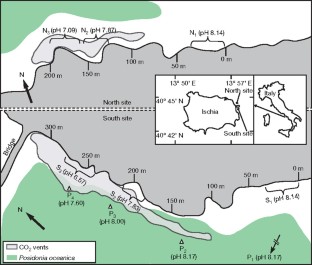
Figure 1: Map of CO 2 vent sites north and south of Castello d’Aragonese, off Ischia Island, Italy.
The alternative text for this image may have been generated using AI.
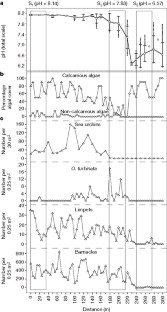
Figure 2: Variation in pH, cover of algae and abundance of species at CO 2 vents south of Castello d’Aragonese.
The alternative text for this image may have been generated using AI.
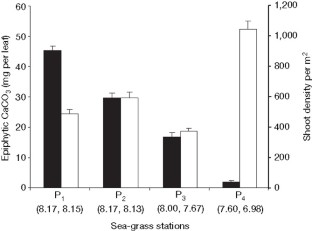
Figure 3: Sea-grass shoot density and amount of epiphytic CaCO 3 on leaves growing at differing pH levels south of Castello d’Aragonese.
The alternative text for this image may have been generated using AI.
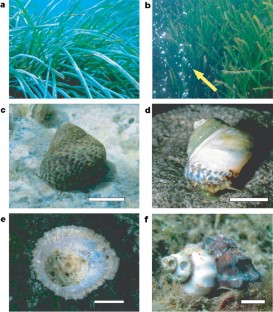
Figure 4: Dissolution of calcified organisms due to naturally acidified sea water.
The alternative text for this image may have been generated using AI.
References
- Pearson, P. N. & Palmer, M. R. Atmospheric carbon dioxide concentrations over the past 60 million years. Nature 406, 695–699 (2000)
Article CAS ADS Google Scholar - Intergovernmental Panel on Climate Change. Summary for Policymakers. In Climate Change 2007: The Physical Sciences Basis. Working Group I Contribution to the Fourth Assessment Report of the IPCC (eds Solomon, S. et al.) (Cambridge Univ. Press, Cambridge, 2007)
- Caldeira, K. & Wickett, M. E. Ocean model predictions of chemistry changes from carbon dioxide emissions to the atmosphere and ocean. J. Geophys. Res. 110 C09S04 doi: 10.1029/2004JC002671 (2005)
Article CAS ADS Google Scholar - The Royal Society. Ocean acidification due to increasing atmospheric carbon dioxide. Policy document 12/05 (The Royal Society, London, 2005)
- Riebesell, U. et al. Enhanced biological carbon consumption in a high CO2 ocean. Nature 450, 545–548 (2007)
Article CAS ADS Google Scholar - Feely, R. A. et al. Impact of anthropogenic CO2 on the CaCO3 system in the oceans. Science 305, 362–366 (2004)
Article CAS ADS Google Scholar - Orr, J. C. et al. Anthropogenic ocean acidification over the twenty-first century and its impact on calcifying organisms. Nature 437, 681–686 (2005)
Article CAS ADS Google Scholar - Hoegh-Guldberg, O. et al. Coral reefs under rapid climate change and ocean acidification. Science 318, 1737–1742 (2007)
Article CAS ADS Google Scholar - Kerrick, D. M., McKibben, M. A., Seward, T. M. & Caldeira, K. Convective hydrothermal CO2 emission from high heat-flow regions. Chem. Geol. 121, 285–293 (1995)
Article CAS ADS Google Scholar - Williams, S. N., Schaefer, S. J., Calvache v, M. L & Lopez, D. Global carbon dioxide emission to the atmosphere by volcanoes. Geochim. Cosmochim. Acta 56, 1765–1770 (1992)
Article CAS ADS Google Scholar - Dando, P. R., Stuben, D. & Varnavas, S. P. Hydrothermalism in the Mediterranean Sea. Prog. Oceanogr. 44, 333–367 (1999)
Article ADS Google Scholar - Ambiente. Marino Costiero e Territorio Delle Isole Flegree (eds Gambi, M. C., Lauro, M. & Jannuzzi, F.) (Accademia di Scienze Fische e Matematiche, Italy, 2003)
- Davies, A. J., Roberts, J. M. & Hall-Spencer, J. Preserving deep-sea natural heritage: emerging issues in offshore conservation and management. Biol. Conserv. 138, 299–312 (2007)
Article Google Scholar - Fine, M. & Tchernov, D. Scleractinian coral species survive and recover from decalcification. Science 315, 1811 (2007)
Article CAS ADS Google Scholar - Kleypas, J. A. et al. Impacts of Ocean Acidification on Coral Reefs and Other Marine Calcifiers: A Guide for Future Research. Report of a workshop held 18–20 April 2005, St. Petersburg, FL, sponsored by NSF, NOAA, and the US Geological Survey. (2006)
Google Scholar - Kuffner, I. B. et al. Decreased abundance of crustose coralline algae due to ocean acidification. Nature Geosci 1, 114–117 (2008)
Article CAS ADS Google Scholar - Boudouresque, C. F. & Verlaque, M. Biological pollution in the Meditterranean Sea: invasive versus introduced macrophytes. Mar. Pollut. Bull. 44, 32–38 (2002)
Article CAS Google Scholar - Levitan, O. et al. Elevated CO2 enhances nitrogen fixation and growth in the marine cyanobacterium Trichodesmium . Glob. Change Biol. 13, 531–538 (2007)
Article ADS Google Scholar - Palacios, S. L. & Zimmerman, R. C. Response of eelgrass Zostera marina to CO2 enrichment: possible impacts of climate change and potential for remediation of coastal habitats. Mar. Ecol. Prog. Ser. 344, 1–13 (2007)
Article ADS Google Scholar - Miles, H., Widdicombe, S., Spicer, J. I. & Hall-Spencer, J. M. Effects of anthropogenic seawater acidification on acid-base balance in the sea urchin Psammechinus miliaris . Mar. Pollut. Bull. 54, 89–96 (2007)
Article CAS Google Scholar - Scheffer, M. et al. Catastrophic shifts in ecosystems. Nature 413, 591–596 (2001)
Article CAS ADS Google Scholar - Bibby, R. et al. Ocean acidification disrupts induced defences in the intertidal gastropod Littorina littorea . Biol. Lett. 3, 699–701 (2007)
Article Google Scholar
Acknowledgements
We thank the staff of Anton Dohrn Benthic laboratory, Ischia for technical help. J.M.H.-S. was funded by a Royal Society University Research Fellowship and was first shown the gas vent sites by M. Taviani in 2002; R.R.-M. and S.M.T. were funded by the Leverhulme Trust. A. de Simone, A. Ferrara and M. Laurenti helped with field measurements, V. King took photo 4d, and O. Hoegh Guldberg and P. Liss helped improve the manuscript.
Author Contributions All authors were involved with fieldwork and sample analyses. J.M.H.-S. designed the study and wrote the paper along with R.R.-M., M.F. and S.M.T. D.T. analysed gases, S.M. analysed sea-grass epiphytes and seawater chemistry, E.R. and S.J.R. collected intertidal and subtidal data respectively, and M.-C.B. provided sea-grass expertise. All authors discussed results and commented on the manuscript.
Author information
Authors and Affiliations
- Marine Institute, Marine Biology and Ecology Research Centre, University of Plymouth, Plymouth PL4 8AA, UK
Jason M. Hall-Spencer, Riccardo Rodolfo-Metalpa, Emma Ransome & Sonia J. Rowley - CNRS-Université de Paris 6, Villefranche-sur-Mer 06234, France
Sophie Martin - Faculty of Life Sciences, Bar-Ilan University, Ramat-Gan 52900, Israel
Maoz Fine - The Interuniversity Institute for Marine Science, Eilat 88103, Israel
Maoz Fine - School of Environmental Sciences, University of East Anglia, Norwich NR4 7TJ, UK
Suzanne M. Turner - Department of Environmental Sciences, 2nd University of Naples, Caserta 81100, Italy
Dario Tedesco - Istituto di Geologia Ambientale e Geoingegneria, CNR, Rome 00138, Italy
Dario Tedesco - Laboratorio di Ecologia del Benthos, Stazione Zoologica Anton Dohrn, Naples 80077, Italy ,
Maria-Cristina Buia
Authors
- Jason M. Hall-Spencer
- Riccardo Rodolfo-Metalpa
- Sophie Martin
- Emma Ransome
- Maoz Fine
- Suzanne M. Turner
- Sonia J. Rowley
- Dario Tedesco
- Maria-Cristina Buia
Corresponding author
Correspondence toJason M. Hall-Spencer.
Supplementary information
Supplementary information (download PDF )
The file contains Supplementary Methods with additional references, Supplementary Tables 2 (A,B,C)-4 and Legend to Supplementary Movie 1 (PDF 222 kb)
Supplementary information
The file contains Supplementary Movie 1. Underwater video showing Posidonia oceanica meadow at the CO2 vent site of Castello d`Aragonese (Gulf of Naples, Italy), gas collection from the vents, and Cerithium vulgatum gastropods showing shell dissolution due to the effects of acidified seawater. (WMV 18646 kb)
Rights and permissions
About this article
Cite this article
Hall-Spencer, J., Rodolfo-Metalpa, R., Martin, S. et al. Volcanic carbon dioxide vents show ecosystem effects of ocean acidification.Nature 454, 96–99 (2008). https://doi.org/10.1038/nature07051
- Received: 13 March 2008
- Accepted: 01 May 2008
- Published: 08 June 2008
- Issue date: 03 July 2008
- DOI: https://doi.org/10.1038/nature07051
This article is cited by
Editorial Summary
An ecosystem acid test
A high-profile Royal Society report in 2005, followed by similar reports worldwide, high-lighted the fact that relatively little is known about the ecosystem effects of ocean acidification. Work to date has been largely limited to short-term experiments on isolated aspects of marine communities. Hall-Spencer et al. adopted an alternative approach, tracking the response to CO2 release from volcanic vent sites off the island of Ischia in the Bay of Naples, where ocean acidification has prevailed perhaps for centuries. Typical rocky shore communities rich in calcareous organisms thrive at normal pH, shifting to communities lacking scleractinian corals and low in sea urchin and algal numbers at low pH. The results show that such sites can act as natural experiments against which to test laboratory and modelled predictions of the effects of ocean acidification.