Robust warming of the global upper ocean (original) (raw)
- Letter
- Published: 20 May 2010
- Simon A. Good3,
- Viktor V. Gouretski4,
- Masayoshi Ishii5,6,
- Gregory C. Johnson2,
- Matthew D. Palmer3,
- Doug M. Smith3 &
- …
- Josh K. Willis7
Nature volume 465, pages 334–337 (2010) Cite this article
- 5091 Accesses
- 340 Citations
- 121 Altmetric
- Metrics details
Subjects
Abstract
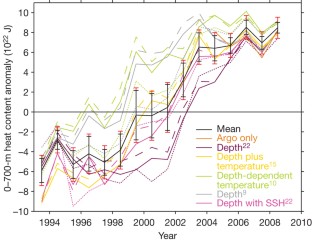
A large (∼1023 J) multi-decadal globally averaged warming signal in the upper 300 m of the world’s oceans was reported roughly a decade ago1 and is attributed to warming associated with anthropogenic greenhouse gases2,3. The majority of the Earth’s total energy uptake during recent decades has occurred in the upper ocean3, but the underlying uncertainties in ocean warming are unclear, limiting our ability to assess closure of sea-level budgets4,5,6,7, the global radiation imbalance8 and climate models5. For example, several teams have recently produced different multi-year estimates of the annually averaged global integral of upper-ocean heat content anomalies (hereafter OHCA curves) or, equivalently, the thermosteric sea-level rise5,9,10,11,12,13,14,15,16. Patterns of interannual variability, in particular, differ among methods. Here we examine several sources of uncertainty that contribute to differences among OHCA curves from 1993 to 2008, focusing on the difficulties of correcting biases in expendable bathythermograph (XBT) data. XBT data constitute the majority of the in situ measurements of upper-ocean heat content from 1967 to 2002, and we find that the uncertainty due to choice of XBT bias correction dominates among-method variability in OHCA curves during our 1993–2008 study period. Accounting for multiple sources of uncertainty, a composite of several OHCA curves using different XBT bias corrections still yields a statistically significant linear warming trend for 1993–2008 of 0.64 W m-2 (calculated for the Earth’s entire surface area), with a 90-per-cent confidence interval of 0.53–0.75 W m-2.
This is a preview of subscription content, access via your institution
Access options
Subscribe to this journal
Receive 52 print issues and online access
$199.00 per year
only $3.83 per issue
Buy this article
- Purchase on SpringerLink
- Instant access to the full article PDF.
USD 39.95
Prices may be subject to local taxes which are calculated during checkout
Additional access options:
Figure 1: OHCA curves using published methods.

The alternative text for this image may have been generated using AI.
Figure 2: OHCA curves produced using the same mapping technique.
The alternative text for this image may have been generated using AI.
Figure 3: Uncertainties in OHCA.

The alternative text for this image may have been generated using AI.
References
- Levitus, S., Antonov, J., Boyer, T. P. & Stephens, C. Warming of the world ocean. Science 287, 2225–2229 (2000)
Article ADS CAS Google Scholar - Barnett, T. P. et al. Penetration of human-induced warming into the world’s oceans. Science 309, 284–287 (2005)
Article ADS CAS Google Scholar - Levitus, S. et al. Anthropogenic warming of Earth’s climate system. Science 292, 267–270 (2001)
Article ADS CAS Google Scholar - Willis, J. K., Chambers, D. P. & Nerem, R. S. Assessing the globally averaged sea level budget on seasonal to interannual timescales. J. Geophys. Res. 113, C06015 (2008)
Article ADS Google Scholar - Domingues, C. M. et al. Improved estimates of upper-ocean warming and multi-decadal sea-level rise. Nature 453, 1090–1093 (2008)
Article ADS CAS Google Scholar - Cazenave, A. et al. Sea level budget over 2003–2008: a reevaluation from GRACE space gravimetry, satellite altimetry and Argo. Global Planet. Change 65, 83–88 (2009)
Article ADS Google Scholar - Leuliette, E. W. & Miller, L. Closing the sea level rise budget with altimetry, Argo, and GRACE. Geophys. Res. Lett. 36, L04608 (2009)
Article ADS Google Scholar - Murphy, D. M. et al. An observationally based energy balance for the Earth since 1950. J. Geophys. Res. 114, D17107 (2009)
Article ADS Google Scholar - Ishii, M. & Kimoto, M. Revaluation of historical ocean heat content variations with time-varying XBT and MBT depth bias corrections. J. Oceanogr. 65, 287–299 (2009)
Article Google Scholar - Levitus, S. et al. Global ocean heat content 1955–2007 in light of recently revealed instrumentation problems. Geophys. Res. Lett. 36, L07608 (2009)
ADS Google Scholar - Lyman, J. M. & Johnson, G. C. Estimating annual global upper-ocean heat content anomalies despite irregular in situ ocean sampling. J. Clim. 21, 5629–5641 (2008)
Article ADS Google Scholar - Palmer, M. D., Haines, K., Tett, S. F. B. & Ansell, T. J. Isolating the signal of ocean global warming. Geophys. Res. Lett. 34, L23610 (2007)
Article ADS Google Scholar - Smith, D. M. & Murphy, J. M. An objective ocean temperature and salinity analysis using covariances from a global climate model. J. Geophys. Res. 112, C02022 (2007)
Article ADS Google Scholar - Willis, J. K., Roemmich, D. & Cornuelle, B. Interannual variability in upper ocean heat content, temperature, and thermosteric expansion on global scales. J. Geophys. Res. 109, C12036 (2004)
Article ADS Google Scholar - Gouretski, V. & Reseghetti, F. On depth and temperature biases in bathythermograph data: development of a new correction scheme based on the analysis of a global ocean database. Deep-Sea Res. I 10.1016/j.dsr.2010.03.011 (in the press)
- Palmer, M. et al. in Proc. OceanObs’09: Sustained Ocean Observations Inf. Soc. Vol. 2 (eds Hall, J., Harrison D. E. & Stammer, D.) (European Space Agency, 2010)
Google Scholar - Knight, J. et al. Global oceans: do global temperature trends over the last decade falsify climate predictions? Bull. Am. Meteorol. Soc. 90, S56–S57 (2009)
Google Scholar - Trenberth, K. E. An imperative for climate change planning: tracking Earth's global energy. Curr. Opin. Environ. Sustainability 1, 19–27 (2009)
Article Google Scholar - Trenberth, K. E. et al. in Proc. OceanObs’09: Sustained Ocean Observations Inf. Soc. Vol. 1 (eds Hall, J., Harrison D. E. & Stammer, D.) (European Space Agency, 2010)
Google Scholar - Roemmich, D. et al. Argo: the challenge of continuing 10 years of progress. Oceanography 22, 46–55 (2009)
Article Google Scholar - Gouretski, V. & Koltermann, K. P. How much is the ocean really warming? Geophys. Res. Lett. 34, L01610 (2007)
Article ADS Google Scholar - Wijffels, S. E. et al. Changing expendable bathythermograph fall rates and their impact on estimates of thermosteric sea level rise. J. Clim. 21, 5657–5672 (2008)
Article ADS Google Scholar - Reseghetti, F., Borghini, M. & Manzella, G. M. R. Factors affecting the quality of XBT data – results of analyses on profiles from the Western Mediterranean Sea. Ocean Sci. 3, 59–75 (2007)
Article ADS Google Scholar - Boyer, T. P. et al. World Ocean Database 2005 (ed. Levitus, S.) Ch. 1 (US Government Printing Office, 2006)
Google Scholar - Ingleby, B. & Huddleston, M. Quality control of ocean temperature and salinity profiles – historical and real-time data. J. Mar. Syst. 65, 158–175 (2007)
Article ADS Google Scholar - Gille, S. T. Warming of the Southern Ocean since the 1950s. Science 295, 1275–1277 (2002)
Article ADS CAS Google Scholar - Johnson, G. C. & Doney, S. C. Recent western South Atlantic bottom water warming. Geophys. Res. Lett. 33, L14614 (2006)
Article ADS Google Scholar - Johnson, G. C., Purkey, S. G. & Bullister, J. L. Warming and freshening in the abyssal southeastern Indian Ocean. J. Clim. 21, 5351–5363 (2008)
Article ADS Google Scholar - Johnson, G. C., Mecking, S., Sloyan, B. M. & Wijffels, S. E. Recent bottom water warming in the Pacific Ocean. J. Clim. 20, 5365–5375 (2007)
Article ADS Google Scholar - AchutaRao, K. M. et al. Simulated and observed variability in ocean temperature and heat content. Proc. Natl Acad. Sci. USA 104, 10768–10773 (2007)
Article ADS CAS Google Scholar
Acknowledgements
J.M.L. and G.C.J. were funded by the US National Oceanic and Atmospheric Administration (NOAA) Climate Program Office and NOAA Research. S.A.G., M.D.P. and D.M.S. were supported by the Joint DECC and Defra Integrated Climate Programme DECC/Defra (GA01101). C. Domingues, S. Levitus, T. Boyer, M. Ferrante and D. Trossman provided comments. C. Domingues, S. Levitus, and T. Boyer also provided corrected XBT profiles. This is Pacific Marine Environment Laboratory contribution number 3476 and Joint Institute for Marine and Atmospheric Research contribution number 09-372.
Author information
Authors and Affiliations
- Joint Institute for Marine and Atmospheric Research, University of Hawaii at Manoa, Honolulu, Hawaii 96822, USA ,
John M. Lyman - NOAA/Pacific Marine Environmental Laboratory, Seattle, Washington 98115-6349, USA ,
John M. Lyman & Gregory C. Johnson - Met Office Hadley Centre, Exeter EX1 3PB, UK
Simon A. Good, Matthew D. Palmer & Doug M. Smith - KlimaCampus, University of Hamburg, Grindelberg 5, 20144 Hamburg, Germany ,
Viktor V. Gouretski - Climate Research Department, Meteorological Research Institute, 1-1 Nagamine, Tsukuba, Ibaraki 305-0052, Japan,
Masayoshi Ishii - Japan Agency for Marine-Earth Science and Technology, 3173-25 Showa-machi, Kanazawa-ku, Yokohama 236-0001, Japan ,
Masayoshi Ishii - Jet Propulsion Laboratory, California Institute of Technology, Pasadena, California 91109, USA ,
Josh K. Willis
Authors
- John M. Lyman
- Simon A. Good
- Viktor V. Gouretski
- Masayoshi Ishii
- Gregory C. Johnson
- Matthew D. Palmer
- Doug M. Smith
- Josh K. Willis
Contributions
J.M.L. led the writing and analysis, with writing contributions from G.C.J., J.K.W., M.D.P. and S.A.G., and analysis contributions from S.A.G., V.V.G., M.I., M.D.P., D.M.S. and J.K.W.
Corresponding author
Correspondence toJohn M. Lyman.
Ethics declarations
Competing interests
The authors declare no competing financial interests.
Supplementary information
PowerPoint slides
Rights and permissions
About this article
Cite this article
Lyman, J., Good, S., Gouretski, V. et al. Robust warming of the global upper ocean.Nature 465, 334–337 (2010). https://doi.org/10.1038/nature09043
- Received: 08 December 2009
- Accepted: 22 March 2010
- Issue date: 20 May 2010
- DOI: https://doi.org/10.1038/nature09043
This article is cited by
Editorial Summary
Warming in the oceans
The upper ocean acts as a giant heat sink and has absorbed the majority of excess energy generated by anthropogenic greenhouse gasses. This makes ocean heat content, potentially, a key indicator of climate change. But to be useful for evaluating the global energy balance and as a constraint on climate models, the measurement uncertainties of such a key indicator need to be well understood. At present the magnitude of the oceanic heat uptake is highly uncertain, with patterns of inter-annual variability in particular differing among estimates. In a major international collaboration, Lyman et al. compare the available upper-ocean heat content anomaly curves and examine the sources of uncertainly attached to them — including the difficulties in correcting bias in expendable bathythermograph data. They find that, uncertainties notwithstanding, there is clear and robust evidence for a warming trend of 0.64 watts per square metre between 1993 and 2008.