Comparing the yields of organic and conventional agriculture (original) (raw)
Abstract
Numerous reports have emphasized the need for major changes in the global food system: agriculture must meet the twin challenge of feeding a growing population, with rising demand for meat and high-calorie diets, while simultaneously minimizing its global environmental impacts1,2. Organic farming—a system aimed at producing food with minimal harm to ecosystems, animals or humans—is often proposed as a solution[3](/articles/nature11069#ref-CR3 "McIntyre, B. D., Herren, H. R., Wakhungu, J. & Watson, R. T. International Assessment of Agricultural Knowledge, Science and Technology for Development: Global Report http://www.agassessment.org/
             (Island, 2009)"),[4](/articles/nature11069#ref-CR4 "De Schutter, O. Report Submitted by the Special Rapporteur on the Right to Food
              http://www2.ohchr.org/

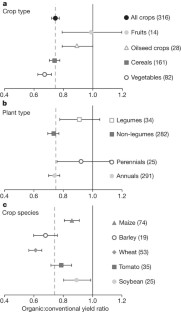
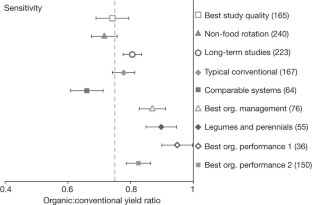
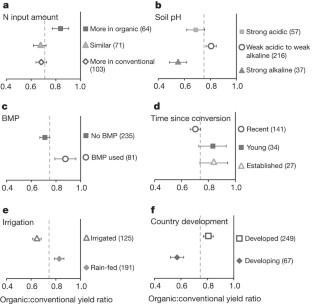
             english/issues/food/docs/A-HRC-16–49.pdf (United Nations, 2010)"). However, critics argue that organic agriculture may have lower yields and would therefore need more land to produce the same amount of food as conventional farms, resulting in more widespread deforestation and biodiversity loss, and thus undermining the environmental benefits of organic practices[5](/articles/nature11069#ref-CR5 "Trewavas, A. Urban myths of organic farming. Nature 410, 409–410 (2001)"). Here we use a comprehensive meta-analysis to examine the relative yield performance of organic and conventional farming systems globally. Our analysis of available data shows that, overall, organic yields are typically lower than conventional yields. But these yield differences are highly contextual, depending on system and site characteristics, and range from 5% lower organic yields (rain-fed legumes and perennials on weak-acidic to weak-alkaline soils), 13% lower yields (when best organic practices are used), to 34% lower yields (when the conventional and organic systems are most comparable). Under certain conditions—that is, with good management practices, particular crop types and growing conditions—organic systems can thus nearly match conventional yields, whereas under others it at present cannot. To establish organic agriculture as an important tool in sustainable food production, the factors limiting organic yields need to be more fully understood, alongside assessments of the many social, environmental and economic benefits of organic farming systems.
This is a preview of subscription content, access via your institution
Access options
Subscribe to this journal
Receive 52 print issues and online access
$199.00 per year
only $3.83 per issue
Buy this article
- Purchase on SpringerLink
- Instant access to the full article PDF.
USD 39.95
Prices may be subject to local taxes which are calculated during checkout
Additional access options:
Figure 1: Influence of different crop types, plant types and species on organic-to-conventional yield ratios.
The alternative text for this image may have been generated using AI.
Figure 2: Sensitivity study of organic-to-conventional yield ratios.
The alternative text for this image may have been generated using AI.
Figure 3: Influence of N input, soil pH, best management practices, time since conversion to organic management, irrigation and country development.
The alternative text for this image may have been generated using AI.
References
- Godfray, H. C. et al. Food security: the challenge of feeding 9 billion people. Science 327, 812–818 (2010)
Article CAS ADS Google Scholar - Foley, J. et al. Solutions for a cultivated planet. Nature 478, 337–342 (2011)
Article CAS ADS Google Scholar - McIntyre, B. D., Herren, H. R., Wakhungu, J. & Watson, R. T. International Assessment of Agricultural Knowledge, Science and Technology for Development: Global Report http://www.agassessment.org/ (Island, 2009)
Google Scholar - De Schutter, O. Report Submitted by the Special Rapporteur on the Right to Food http://www2.ohchr.org/ english/issues/food/docs/A-HRC-16–49.pdf (United Nations, 2010)
Google Scholar - Trewavas, A. Urban myths of organic farming. Nature 410, 409–410 (2001)
Article CAS ADS Google Scholar - Badgley, C. et al. Organic agriculture and the global food supply. Renew. Agr. Food Syst. 22, 86–108 (2007)
Article Google Scholar - Cassman, K. G. Editorial response by Kenneth Cassman: can organic agriculture feed the world-science to the rescue? Renew. Agr. Food Syst. 22, 83–84 (2007)
Google Scholar - Connor, D. J. Organic agriculture cannot feed the world. Field Crops Res. 106, 187–190 (2008)
Article Google Scholar - Berry, P. et al. Is the productivity of organic farms restricted by the supply of available nitrogen? Soil Use Manage. 18, 248–255 (2002)
Article Google Scholar - Pang, X. & Letey, J. Organic farming: challenge of timing nitrogen availability to crop nitrogen requirements. Soil Sci. Soc. Am. J. 64, 247–253 (2000)
Article CAS ADS Google Scholar - Crews, T. E. & Peoples, M. B. Can the synchrony of nitrogen supply and crop demand be improved in legume and fertilizer-based agroecosystems? A review. Nutr. Cycl. Agroecosyst. 72, 101–120 (2005)
Article CAS Google Scholar - Oehl, F. et al. Phosphorus budget and phosphorus availability in soils under organic and conventional farming. Nutr. Cycl. Agroecosyst. 62, 25–35 (2002)
Article CAS Google Scholar - Martini, E., Buyer, J. S., Bryant, D. C., Hartz, T. K. & Denison, R. F. Yield increases during the organic transition: improving soil quality or increasing experience? Field Crops Res. 86, 255–266 (2004)
Article Google Scholar - Letter, D., Seidel, R. & Liebhardt, W. The performance of organic and conventional cropping systems in an extreme climate year. Am. J. Altern. Agric. 18, 146–154 (2003)
Article Google Scholar - Colla, G. et al. Soil physical properties and tomato yield and quality in alternative cropping systems. Agron. J. 92, 924–932 (2000)
Article Google Scholar - Scialabba, N. & Hattam, C. Organic Agriculture, Environment and Food Security (Food and Agriculture Organization, 2002)
Google Scholar - Research Institute of Organic Agriculture (FiBL). Farming System Comparison in the Tropicshttp://www.systems-comparison.fibl.org/ (2011)
- Crowder, D. W., Northfield, T. D., Strand, M. R. & Snyder, W. E. Organic agriculture promotes evenness and natural pest control. Nature 466, 109–112 (2010)
Article CAS ADS Google Scholar - Bengtsson, J., Ahnström, J. & Weibull, A.-C. The effects of organic agriculture on biodiversity and abundance: a meta-analysis. J. Appl. Ecol. 42, 261–269 (2005)
Article Google Scholar - Kirchmann, H. & Bergström, L. Do organic farming practices reduce nitrate leaching? Commun. Soil Sci. Plan. 32, 997–1028 (2001)
Article CAS Google Scholar - Leifeld, J. & Fuhrer, J. Organic farming and soil carbon sequestration: what do we really know about the benefits? Ambio 39, 585–599 (2010)
Article CAS Google Scholar - Valkila, J. Fair trade organic coffee production in Nicaragua—sustainable development or a poverty trap? Ecol. Econ. 68, 3018–3025 (2009)
Article Google Scholar - Raynolds, L. T. The globalization of organic agro-food networks. World Dev. 32, 725–743 (2004)
Article Google Scholar - National Research Council. Toward Sustainable Agricultural Systems in the 21st Century (National Academies, 2010)
Google Scholar - Hedges, L. V., Gurevitch, J. & Curtis, P. S. The meta-analysis of response ratios in experimental ecology. Ecology 80, 1150–1156 (1999)
Article Google Scholar - Rosenberg, M. S., Gurevitch, J. & Adams, D. C. MetaWin: Statistical Software for Meta-analysis: Version 2 (Sinauer, 2000)
Google Scholar - Johnston, M., Foley, J. A., Holloway, T., Kucharik, C. & Monfreda, C. Resetting global expectations from agricultural biofuels. Environ. Res. Lett. 4, 014004 (2009)
Article Google Scholar - Whittaker, R. J. Meta-analyses and mega-mistakes: calling time on meta-analysis of the species richness–productivity relationship. Ecology 91, 2522–2533 (2010)
Article Google Scholar - Hillebrand, H. & Cardinale, B. J. A critique for meta-analyses and the productivity–diversity relationship. Ecology 91, 2545–2549 (2010)
Article Google Scholar - Englund, G., Sarnelle, O. & Cooper, S. D. The importance of data-selection criteria: meta-analyses of stream predation experiments. Ecology 80, 1132–1141 (1999)
Article Google Scholar - Ramankutty, N., Foley, J. A., Norman, J. & McSweeney, K. The global distribution of cultivable lands: current patterns and sensitivity to possible climate change. Glob. Ecol. Biogeogr. 11, 377–392 (2002)
Article Google Scholar - Deryng, D., Sacks, W., Barford, C. & Ramankutty, N. Simulating the effects of climate and agricultural management practices on global crop yield. Glob. Biogeochem. Cycles 25, GB2006 (2011)
Article ADS Google Scholar - IGBP-DIS. Soildata (V 0): A Program for Creating Global Soil-Property Databases (IGBP Global Soils Data Task, 1998)
- Monfreda, C., Ramankutty, N. & Foley, J. A. Farming the planet: 2. Geographic distribution of crop areas, yields, physiological types, and net primary production in the year 2000. Glob. Biogeochem. Cycles 22, GB1022 (2008)
Article ADS Google Scholar - Food and Agriculture Organization of the United Nations (FAO). FAOSTAThttp://faostat.fao.org (2011)
- Gurevitch, J. & Hedges, L. V. Statistical issues in ecological meta-analyses. Ecology 80, 1142–1149 (1999)
Article Google Scholar - Hedges, L. V. & Olkin, I. Statistical Methods for Meta-Analysis. (Academic, 1985)
MATH Google Scholar - Gurevitch, J., Morrow, L. L., Wallace, A. & Walsh, J. S. A meta-analysis of competition in field experiments. Am. Nat. 140, 539–572 (1992)
Article Google Scholar - Liebhardt, W. et al. Crop production during conversion from conventional to low-input methods. Agron. J. 81, 150–159 (1989)
Article Google Scholar - Drinkwater, L., Janke, R. & Rossoni-Longnecker, L. Effects of tillage intensity on nitrogen dynamics and productivity in legume-based grain systems. Plant Soil 227, 99–113 (2000)
Article CAS Google Scholar
Acknowledgements
We are grateful to the authors of the 66 studies whose extensive field work provided the data for this meta-analysis. Owing to space limitations our citations can be found in Supplementary Material. We would like to thank J. Reganold for useful comments on our manuscript. We are grateful to I. Perfecto, T. Moore, C. Halpenny, G. Seufert and S. Lehringer for valuable discussion and/or feedback on the manuscript and L. Gunst for sharing publications on the FiBL trials. D. Plouffe helped with the figures and M. Henry with compiling data. This research was supported by a Discovery Grant awarded to N.R. from the Natural Science and Engineering Research Council of Canada.
Author information
Authors and Affiliations
- Department of Geography and Global Environmental and Climate Change Center, McGill University, Montreal, Quebec H2T 3A3, Canada,
Verena Seufert & Navin Ramankutty - Institute on the Environment (IonE), University of Minnesota, 1954 Buford Avenue, St Paul, Minnesota 55108, USA,
Jonathan A. Foley
Authors
- Verena Seufert
- Navin Ramankutty
- Jonathan A. Foley
Contributions
V.S. and N.R. designed the study. V.S. compiled the data and carried out data analysis. All authors discussed the results and contributed to writing the paper.
Corresponding author
Correspondence toVerena Seufert.
Ethics declarations
Competing interests
The authors declare no competing financial interests.
Supplementary information
Supplementary Information (download PDF )
This file contains Supplementary Figures 1-10, Supplementary Tables 1-14, a Supplementary Discussion and Supplementary References. (PDF 759 kb)
Supplementary Data 1 (download XLS )
This file contains data used in the meta-analysis. The data table shows the raw yield data, yield effect sizes and study information with categorical variables. (XLS 379 kb)
Supplementary Data 2 (download XLS )
This file contains data that could not be used in the meta-analysis. The data table shows, in the spreadsheet ‘exclusion6’, study information and yield data of studies that were excluded because they did not meet selection criteria 6 (i.e. no information on an error term and sample size was available). In the spreadsheet ‘exclusion1-5’ information on studies that were excluded because they did not meet the basic selection criteria 1-5 (see methods) and the reason for exclusion is shown. (XLS 231 kb)
PowerPoint slides
Rights and permissions
About this article
Cite this article
Seufert, V., Ramankutty, N. & Foley, J. Comparing the yields of organic and conventional agriculture.Nature 485, 229–232 (2012). https://doi.org/10.1038/nature11069
- Received: 06 November 2011
- Accepted: 09 March 2012
- Published: 25 April 2012
- Issue date: 10 May 2012
- DOI: https://doi.org/10.1038/nature11069
This article is cited by
Comments
Commenting on this article is now closed.
- Roseann Campbell 16 May 2012, 05:21
Posted on behalf of Maywa Montenegro
We compliment Seufert and colleagues on their thorough evaluation of the available comparative yield data on organic and conventional farming systems (V. Seufert et al. Nature, published online 25 April 2012). Given the expensive ecological and financial subsidies that support conventional systems, we are surprised and encouraged that organic yields so closely approximate them. We remind readers that the ecosystem disservices that flow from conventional agriculture currently threaten the ecological basis of both types of farming systems , as well as other key life support systems (Tilman et al. 2002). Thus, it is good news that, even under current conditions, organic yields measure only 25% lower than conventional ones ? and for some regions, crops, and management systems, considerably less.
A recent synthesis comparing conventional with organic farming systems found the latter to perform better for multiple interrelated ecosystem services, including: floral and faunal biodiversity conservation; soil organic matter and soil retention; soil biochemical and ecological characteristics; and greater energy-use efficiency. Soils in organic farming systems also exhibited higher water-holding and carbon storage capacities, resulting in greater yields under conditions of water scarcity and higher potential for greenhouse gas abatement (Gomiero et al. 2011).
Despite these benefits of agroecological systems, however, conventional systems have been the primary focus of publicly and privately sponsored research since the early twentieth century. We recently analyzed data from the USDA budget for agricultural R&D and found that only 1.65% of funds are directed towards organic farming systems.
In developing world contexts, research has shown that agroecological systems, through combined lower input costs and greater yield, increase food security (Hassanali et al 2008). With greater parity in R&D funding and a transition away from the most ecologically damaging conventional farming systems, we have good reason to believe that organic farming systems can enhance current global food security while preserving the ecological basis of food production for generations to come.
?	Gomiero, T., D. Pimentel, and M. G. Paoletti. 2011. Environmental Impact of Different Agricultural Management Practices: Conventional vs. Organic Agriculture. Critical Reviews in Plant Sciences 30(1):95-124.
?	Hassanali, A., H. Herran, Z. Khan, J. Pickett, C. Woodcock. 2008. ?Integrated Pest Management: The Push?Pull Approach for Controlling Insect Pests and Weeds of Cereals, and Its Potential for Other Agricultural Systems Including Animal Husbandry,? Philosophical Transactions of the Royal Society B: Biological Sciences. 363 (1491): 611?621.
?	Tilman, D., K. G. Cassman, P. A. Matson, R. Naylor, and S. Polasky. 2002. Agricultural sustainability and intensive production practices. Nature (London) 418:671-677.
Albie Miles
Ph.D. Candidate
Environmental Science, Policy and Management (ESPM)
University of California, Berkeley
137 Mulford Hall #3114
Berkeley, Ca. 94720
E-mail: albiemiles@berkeley.edu
Ph: 831-359-2093
Liz Carlisle
Ph.D. Candidate
Department of Geography
507 McCone Hall
University of California, Berkeley
Berkeley, Ca. 94720
E-mail: lizcarlisle@berkeley.edu
Ph: 510-910-6467
Maywa Montenegro
Environmental Science, Policy, and Management (ESPM)
University of California Berkeley
44A Giannini Hall
Berkeley, California 94720
Ph: 423-794-0797
E-mail: maywa@berkeley.edu
Annie Shattuck
Department of Geography
507 McCone Hall
University of California, Berkeley
Berkeley, Ca. 94720
Ph: 423-794-0797
E-mail: ashattuck@berkeley.edu
Dr. Claire Kremen
Associate Professor
Environmental Sciences Policy and Management (ESPM)
University of California, Berkeley
130 Mulford Hall
Berkeley, CA 94720-3114
Ph: 510-643-6339
E-mail: ckremen@berkeley.edu - Peter Cary 12 July 2012, 09:38
On behalf of Mischa Popoff:
The study - "Comparing the yields of organic and conventional agriculture" by Verena Seufert, Navin Ramankutty and Jonathan Foley[i] - indicates that organic yields are 25 percent less overall than conventional yields. We argue this is far too optimistic.
Reduction in pest pressure by neighboring conventional farms is not taken into account. Then there's the issue of fraud. If just 20 percent of organic farmers cheat by using synthetic ammonium nitrate and pesticides, thereby doubling or tripling yield, this handful of charlatans will rival the productivity of the rest of the organic movement.
The use of farm survey data exposes the Seufert study to the great potential for fraud in organic production which federal regulators are prevented from cracking down upon due to a lack of field testing in the $30-billion-per-annum American organic industry.
Thankfully, the Seufert study has the effect of debunking claims by organic activists that organic yields can equal or exceed conventional yields. But if we fail to recognize that organic yields are likely closer to half of conventional and biotech yields, organic activists will, we fear, use Seufert's study to propose that a 25 percent drop in yield is perfectly acceptable.
Indeed, this is precisely the position taken by academics from the University of California, Berkeley, who suggest that since "organic yields so closely approximate" conventional yields, that organic agriculture should therefore be promoted in the developing world in order to facilitate what they say would be "a transition away from the most ecologically damaging conventional farming systems."[ii]
Whatever the shortfall in organic yields, it must be stressed that what we?re talking about is a farming system aimed at producing quality, not quantity. And considering that most of the developing world needs to double its food output from the same land-base in the coming decades, any shortfall in yield would be catastrophic.
Back here in the developed world, organic agriculture remains a perfectly valid, alternative food-production system for those willing to pay more for quality, hopefully in the form of purity and nutrition. But we need to guarantee that organic food is genuine, otherwise consumers risk being duped by organic farmers who cheat when they choose this luxury.
1. Mischa Popoff holds a B.A. in History and is a retired organic farmer and organic inspector. He's also the author of 'Is it Organic?', no5 4805 Oleander Drive, Osoyoos BC V0H 1V1, Canada, 250-495-2902, mischap@telus.net
2. Robert Wager, Biology Department, Vancouver Island University, 900 Fifth Street, Nanaimo, BC V9R 5S5, Canada, (250) 753-3245, Robert.Wager@viu.ca
1 Nature 485, 229-232 (10 May 2012) doi: 10.1038/nature11069.
2 See "Comments" in Nature 485. - Roseann Campbell 29 January 2013, 08:26
Posted on behalf of Udai Pratap Singh
Fruits of Organic Farming are not Sour
Reganold 1 and Seufert et al. 2 in their separate comments on organic farming state that organic yields are mostly lower than those from conventional farming. It is indeed surprising that organic, as we know, is basically a holistic management system which improves the health of entire agro-ecosystem that relates to biodiversity, nutrient biocycles, soil, soil microbial and biochemical activities. It involves substantial use of organic manures, green manure, organic pest management practices and so on. In this system of farming use of synthetic fertilizers and pesticides are completely prohibited. Now the question arises as to what is exactly understood by organic manures. Presently, a number of ingredients constitute organic manure which were earlier not known or used in organic farming, e.g., the earliest use was basically that of raw cow dung manure ( now transformed as compost) in addition to green manure. Addition of cow urine followed the system. Subsequently, in the sequence of scientific progress, poultry manure, followed by vermicompost showed their charisma. With the advent of microbial pesticides, e.g., plant growth promoting rhizobacteria (PGPR) as seed treatment with other bacterial and fungal antagonists (e.g., Trichoderma and other fungal species) emerged as other contributors to organic manure with substantial yield potential. Further, addition of several plant materials/products showed tremendous scope in organic farming with plethoric increase in crop yield in comparison to conventional farming that has well defined nutritional ingredients as well as pesticidal properties. The data taken for comparison by the above authors must look into the ingredients of organic manure otherwise such evidences will unequivocally mar the intrinsic potential of organic farming to meet the challenges of increased crop production over conventional farming. A number of other ingredients are also available which meet the requirements of several debated objectives. Therefore, deep research is needed to explore the new ingredients of organic manure for increasing the yield and other nutritional requirements of the food grains. In recent years there is a lot of debate on whether to go for organic farming or conventional farming or adopt genetically modified crops (GM crops) for higher yield. Human health and environmental safety are the major concerns of the GM technology, and in the absence of assurance by the proponents, my own experimental evidence3 guarantees the potential of higher yield with several other advantages by organic farming as compared to conventional farming. Hence, organic farming indeed gravitates towards its adoption for better yield, environmental safety and global food security.
------------------------------------------------------------------------------------------------------------
U. P. Singh
Retired Professor
Department of Mycology and Plant Pathology
Institute of Agricultural Sciences
Banaras Hindu University
1.	Reganold, J.P. Nature 485, 176 (2012)
2.	Seufert, V.,Ramankutty, N. & Foley, J.A. Nature 458, 229-232 (2012).
3.	Singh, U.P., Singh, Amitabh & Srivastav, Rashmi.JAES 8,150-155 (2012).
4. Mohamed Fathy Salem 30 October 2017, 04:27
Dear Verena Seufert. I appreciate your article but i still have some comments from our real research work on the ground.We working on organic agriculture more than 25 years and we achieved an increase up to 100% more through organic production compared with conventional agriculture or by chemical fertilizers.I am willing to host you and your research team to visit us in Egypt any time and you can see this by your eyes.Moreover, we are willing to share our experience with others worldwide to serve the humanity for safe food and safe feed.We increased the green fodder production i.e. Egyptian clover 10 folds increase by organic technologies to reach 300 Tons per cut/harvest compared with 30 Tons/cut/harvest.
We are willing to start a scientific collaborations with you in near future.
Regards
Mohamed Salem
Assistant Professor , Consultant of Organic Agriculture