Increase in observed net carbon dioxide uptake by land and oceans during the past 50 years (original) (raw)
- Letter
- Published: 01 August 2012
Nature volume 488, pages 70–72 (2012) Cite this article
- 19k Accesses
- 680 Citations
- 202 Altmetric
- Metrics details
Subjects
Abstract
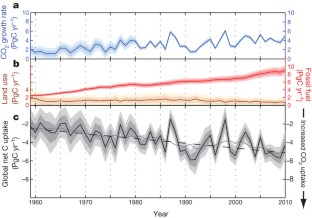
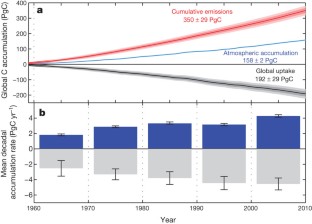
One of the greatest sources of uncertainty for future climate predictions is the response of the global carbon cycle to climate change1. Although approximately one-half of total CO2 emissions is at present taken up by combined land and ocean carbon reservoirs2, models predict a decline in future carbon uptake by these reservoirs, resulting in a positive carbon–climate feedback3. Several recent studies suggest that rates of carbon uptake by the land4,5,6 and ocean7,8,9,10 have remained constant or declined in recent decades. Other work, however, has called into question the reported decline11,12,13. Here we use global-scale atmospheric CO2 measurements, CO2 emission inventories and their full range of uncertainties to calculate changes in global CO2 sources and sinks during the past 50 years. Our mass balance analysis shows that net global carbon uptake has increased significantly by about 0.05 billion tonnes of carbon per year and that global carbon uptake doubled, from 2.4 ± 0.8 to 5.0 ± 0.9 billion tonnes per year, between 1960 and 2010. Therefore, it is very unlikely that both land and ocean carbon sinks have decreased on a global scale. Since 1959, approximately 350 billion tonnes of carbon have been emitted by humans to the atmosphere, of which about 55 per cent has moved into the land and oceans. Thus, identifying the mechanisms and locations responsible for increasing global carbon uptake remains a critical challenge in constraining the modern global carbon budget and predicting future carbon–climate interactions.
This is a preview of subscription content, access via your institution
Access options
Subscribe to this journal
Receive 52 print issues and online access
$199.00 per year
only $3.83 per issue
Buy this article
- Purchase on SpringerLink
- Instant access to the full article PDF.
USD 39.95
Prices may be subject to local taxes which are calculated during checkout
Additional access options:
Figure 1: Trends in the global carbon budget from 1959 to 2010.
The alternative text for this image may have been generated using AI.
Figure 2: Accumulation of carbon emissions in the atmosphere, on land and in the oceans.
The alternative text for this image may have been generated using AI.
References
- Meehl, G. A. et al. in Climate Change 2007: The Physical Science Basis (eds Solomon, S. et al.) 792–802 (Cambridge Univ. Press, 2007)
- Schimel, D. S. et al. Recent patterns and mechanisms of carbon exchange by terrestrial ecosystems. Nature 414, 169–172 (2001)
Article ADS CAS Google Scholar - Friedlingstein, P. et al. Climate-carbon cycle feedback analysis: results from the C4MIP model intercomparison. J. Clim. 19, 3337–3353 (2006)
Article ADS Google Scholar - Pan, Y. et al. A large and persistent carbon sink in the world’s forests. Science 333, 988–993 (2011)
Article ADS CAS Google Scholar - Piao, S. et al. Net carbon dioxide losses of northern ecosystems in response to autumn warming. Nature 451, 49–52 (2008)
Article ADS CAS Google Scholar - Zhao, M. & Running, S. W. Drought-induced reduction in global terrestrial net primary production from 2000 through 2009. Science 329, 940–943 (2010)
Article ADS CAS Google Scholar - McKinley, G. A., Fay, A. R., Takahashi, T. & Metzl, N. Convergence of atmospheric and North Atlantic carbon dioxide trends on multidecadal timescales. Nature Geosci. 4, 606–610 (2011)
Article ADS CAS Google Scholar - Le Quéré, C. et al. Saturation of the Southern Ocean CO2 sink due to recent climate change. Science 316, 1735–1738 (2007)
Article ADS Google Scholar - Schuster, U. & Watson, A. J. A variable and decreasing sink for atmospheric CO2 in the North Atlantic. J. Geophys. Res. 112, C11006 (2007)
Article ADS Google Scholar - Le Quéré, C., Takahashi, T., Buitenhuis, E. T., Rödenbeck, C. & Sutherland, S. C. Impact of climate change and variability on the global oceanic sink of CO2 . Glob. Biogeochem. Cycles 24, GB4007 (2010)
Article ADS Google Scholar - Sarmiento, J. L. et al. Trends and regional distributions of land and ocean carbon sinks. Biogeosciences 7, 2351–2367 (2010)
Article ADS CAS Google Scholar - Knorr, W. Is the airborne fraction of anthropogenic CO2 emissions increasing? Geophys. Res. Lett. 36, L21710 (2009)
Article ADS Google Scholar - Gloor, M., Sarmiento, J. L. & Gruber, N. What can be learned about carbon cycle climate feedbacks from the CO2 airborne fraction? Atmos. Chem. Phys. 10, 7739–7751 (2010)
Article ADS CAS Google Scholar - Boden, T. A., Marland, G. & Andres, R. J. Global, regional, and national fossil-fuel CO2 emissions. Carbon Dioxide Information Analysis Centerhttp://cdiac.ornl.gov/trends/emis/overview.html (2010)
- BP. Statistical Review of World Energy http://www.bp.com/sectionbodycopy.do?categoryId = 7500&contentId = 7068481 (2011)
- European Commission. Emissions Database for Global Atmospheric Research (EDGAR). Europa - EDGAR Overviewhttp://edgar.jrc.ec.europa.eu/overview.php?v = 40 (2009)
- Friedlingstein, P. et al. Update on CO2 emissions. Nature Geosci. 3, 811–812 (2010)
Article ADS CAS Google Scholar - Stocker, B., Strassmann, K. & Joos, F. Sensitivity of Holocene atmospheric CO2 . Biogeosciences 7, 921–952 (2011)
Article Google Scholar - Yang, X., Richardson, T. K. & Jain, A. K. Contributions of secondary forest and nitrogen dynamics to terrestrial carbon uptake. Biogeosciences 7, 3041–3050 (2010)
Article ADS CAS Google Scholar - Marland, G., Hamal, K. & Jonas, M. How uncertain are estimates of CO2 emissions? J. Ind. Ecol. 13, 4–7 (2009)
Article Google Scholar - Canadell, J. G. et al. Contributions to accelerating atmospheric CO2 growth from economic activity, carbon intensity, and efficiency of natural sinks. Proc. Natl Acad. Sci. USA 104, 18866–18870 (2007)
Article ADS CAS Google Scholar - Le Quéré, C. et al. Trends in the sources and sinks of carbon dioxide. Nature Geosci. 2, 831–836 (2009)
Article ADS Google Scholar - Masarie, K. A. & Tans, P. P. Extension and integration of atmospheric carbon dioxide data into a globally consistent measurement record. J. Geophys. Res. 100, 11593–11610 (1995)
Article ADS CAS Google Scholar - Keeling, C. D. et al. A three dimensional model of atmospheric CO2 transport based on observed winds: 1. Analysis of observational data. Geophys. Monogr. 55, 165–236 (1989)
Google Scholar - Griffith, D. W. T., Keeling, C. D., Adams, J. A., Guenther, P. R. & Bacastow, R. B. Calculations of carrier gas effects in non-dispersive infrared analyzers. II. Comparisons with experiment. Tellus 34, 385–397 (1982)
ADS CAS Google Scholar - Andrews, A. E. et al. Empirical age spectra for the midlatitude lower stratosphere from in situ observations of CO2: quantitative evidence for a subtropical barrier to horizontal transport. J. Geophys. Res. 106, 10257–10274 (2001)
Article ADS CAS Google Scholar - Houghton, R. A. Revised estimates of the annual net flux of carbon to the atmosphere from changes in land use and land management 1850–2000. Tellus B 55, 378–390 (2003)
ADS Google Scholar
Acknowledgements
A.P.B. was supported by the US National Research Council and the US National Science Foundation. This manuscript benefitted from comments from J. Neff, N. Lovenduski and G. Marland. We also thank K. Masarie for performing the bootstrap calculations on the atmospheric CO2 sampling network. This work would not have been possible without the careful measurements made by scientists at NOAA ESRL and volunteer sample collectors throughout the world.
Author information
Author notes
- A. P. Ballantyne
Present address: Present address: Department of Ecosystem and Conservation Sciences, University of Montana, Missoula, Montana 59812, USA.,
Authors and Affiliations
- Department of Geology, University of Colorado, Boulder, 80309, Colorado, USA
A. P. Ballantyne & J. W. C. White - Institute of Arctic and Alpine Research, University of Colorado, Boulder, Colorado, 80309, USA
C. B. Alden & J. W. C. White - Cooperative Institute for Research in Environmental Sciences, University of Colorado, Boulder, 80309, Colorado, USA
J. B. Miller - Earth System Research Laboratory, National Oceanographic and Atmospheric Administration, Boulder, 80305, Colorado, USA
J. B. Miller & P. P. Tans
Authors
- A. P. Ballantyne
- C. B. Alden
- J. B. Miller
- P. P. Tans
- J. W. C. White
Contributions
All authors identified the need for this analysis. P.P.T. and J.B.M. contributed to the uncertainty analysis, and P.P.T. and A.P.B. devised the Monte Carlo simulations. A.P.B. and C.B.A. wrote the paper with assistance from all other co-authors.
Corresponding author
Correspondence toA. P. Ballantyne.
Ethics declarations
Competing interests
The authors declare no competing financial interests.
PowerPoint slides
Rights and permissions
About this article
Cite this article
Ballantyne, A., Alden, C., Miller, J. et al. Increase in observed net carbon dioxide uptake by land and oceans during the past 50 years.Nature 488, 70–72 (2012). https://doi.org/10.1038/nature11299
- Received: 06 October 2011
- Accepted: 06 June 2012
- Published: 01 August 2012
- Issue date: 02 August 2012
- DOI: https://doi.org/10.1038/nature11299
This article is cited by
Editorial Summary
Carbon sinks hold firm
The current state of land and ocean carbon sinks has been the subject of intense debate, because it has implications for how the carbon cycle might respond to climate change. About half of the current carbon dioxide emissions are taken up by land and ocean carbon sinks. Model studies predict a decline in future carbon sinks, resulting in a positive carbon-climate feedback, and several recent studies have suggested that land and ocean carbon sinks are beginning to wane. These authors use a global mass balance approach to audit the global carbon cycle, focusing on well-constrained observations of atmospheric carbon dioxide and estimates of anthropogenic emissions and a rigorous analysis of uncertainties. They find that carbon sinks have actually doubled during the past 50 years and continue to increase significantly. There were no signs, as of 2010, that carbon uptake has started to diminish on the global scale