Ploughing the deep sea floor (original) (raw)
- Letter
- Published: 05 September 2012
- Miquel Canals2,
- Joan B. Company1,
- Jacobo Martín1,
- David Amblas2,
- Galderic Lastras2,
- Albert Palanques1 &
- …
- Antoni M. Calafat2
Nature volume 489, pages 286–289 (2012) Cite this article
- 8124 Accesses
- 382 Citations
- 165 Altmetric
- Metrics details
Subjects
Abstract
Bottom trawling is a non-selective commercial fishing technique whereby heavy nets and gear are pulled along the sea floor. The direct impact of this technique on fish populations1,2 and benthic communities3,4 has received much attention, but trawling can also modify the physical properties of seafloor sediments, water–sediment chemical exchanges and sediment fluxes5,6. Most of the studies addressing the physical disturbances of trawl gear on the seabed have been undertaken in coastal and shelf environments7,8, however, where the capacity of trawling to modify the seafloor morphology coexists with high-energy natural processes driving sediment erosion, transport and deposition9. Here we show that on upper continental slopes, the reworking of the deep sea floor by trawling gradually modifies the shape of the submarine landscape over large spatial scales. We found that trawling-induced sediment displacement and removal from fishing grounds causes the morphology of the deep sea floor to become smoother over time, reducing its original complexity as shown by high-resolution seafloor relief maps. Our results suggest that in recent decades, following the industrialization of fishing fleets, bottom trawling has become an important driver of deep seascape evolution. Given the global dimension of this type of fishery, we anticipate that the morphology of the upper continental slope in many parts of the world’s oceans could be altered by intensive bottom trawling, producing comparable effects on the deep sea floor to those generated by agricultural ploughing on land.
This is a preview of subscription content, access via your institution
Access options
Subscribe to this journal
Receive 52 print issues and online access
$199.00 per year
only $3.83 per issue
Buy this article
- Purchase on SpringerLink
- Instant access to the full article PDF.
USD 39.95
Prices may be subject to local taxes which are calculated during checkout
Additional access options:
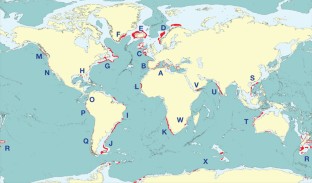
Figure 1: Map of known trawling grounds on the world continental slopes.
The alternative text for this image may have been generated using AI.
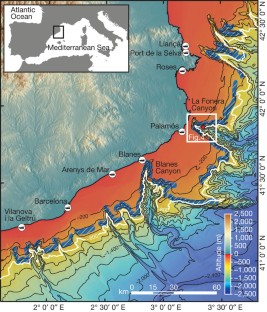
Figure 2: Bathymetric map of the study area.
The alternative text for this image may have been generated using AI.
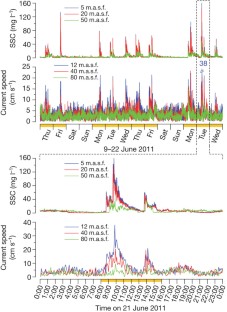
Figure 3: Time series observations of trawling-induced sediment gravity flows.
The alternative text for this image may have been generated using AI.
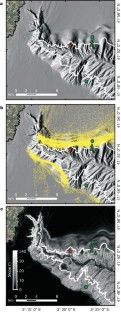
Figure 4: Seafloor morphology and bottom trawling in La Fonera Canyon.
The alternative text for this image may have been generated using AI.
References
- Thurstan, R. H., Brockington, S. & Roberts, C. M. The effects of 118 years of industrial fishing on UK bottom trawl fisheries. Nature Commun. 1, 15 (2010)
Article ADS Google Scholar - Norse, E. A. et al. Sustainability of deep-sea fisheries. Mar. Policy 36, 307–320 (2012)
Article Google Scholar - Watling, L. & Norse, E. A. Effects of mobile fishing gear on marine benthos. Conserv. Biol. 12, 1178–1179 (1998)
Article Google Scholar - Roberts, J. M., Wheeler, A. J. & Freiwald, A. Reefs of the deep: the biology and geology of cold-water coral ecosystems. Science 312, 543–547 (2006)
Article ADS CAS Google Scholar - Jones, J. B. Environmental impact of trawling on the seabed: a review. N. Z. J. Mar. Freshwat. Res. 26, 59–67 (1992)
Article ADS Google Scholar - Churchill, J. H. The effect of commercial trawling on sediment resuspension and transport over the Middle Atlantic Bight continental-shelf. Cont. Shelf Res. 9, 841–865 (1989)
Article ADS Google Scholar - Schwinghamer, P. et al. Effects of experimental otter trawling on surficial sediment properties of a sandy-bottom ecosystem on the Grand Banks of Newfoundland. Conserv. Biol. 12, 1215–1222 (1998)
Article Google Scholar - Brown, E. J., Finney, B., Dommisse, M. & Hills, S. Effects of commercial otter trawling on the physical environment of the southeastern Bering Sea. Cont. Shelf Res. 25, 1281–1301 (2005)
Article ADS Google Scholar - Nittrouer, C. A. & Wright, L. D. Transport of particles across continental shelves. Rev. Geophys. 32, 85–113 (1994)
Article ADS Google Scholar - Pratson, L. F. et al. in Continental-Margin Sedimentation: from Sediment Transport to Sequence Stratigraphy (eds Nittrouer, C. A . et al.) 339–380 (Blackwell, 2007)
- Piper, D. J. W. & Normark, W. R. Processes that initiate turbidity currents and their influence on turbidites: a marine geology perspective. J. Sediment. Res. 79, 347–362 (2009)
Article ADS Google Scholar - Heezen, B. C., Hollister, C. D. & Ruddiman, W. F. Shaping of the continental rise by deep geostrophic contour currents. Science 152, 502–508 (1966)
Article ADS CAS Google Scholar - Cacchione, D. A., Pratson, L. F. & Ogston, A. S. The shaping of continental slopes by internal tides. Science 296, 724–727 (2002)
Article ADS CAS Google Scholar - Canals, M. et al. Flushing submarine canyons. Nature 444, 354–357 (2006)
Article ADS CAS Google Scholar - Gordon, J. D. M., Bergstad, O. A., Figuereido, I. & Menezes, G. Deep-water fisheries of the Northeast Atlantic: I. Description and current trends. J. Northwest Atlantic Fish. Sci. 31, 137–150 (2003)
Article Google Scholar - Morato, T., Watson, R., Pitcher, T. J. & Pauly, D. Fishing down the deep. Fish Fish. 7, 24–34 (2006)
Article Google Scholar - Tobar, R. & Sardà, F. Análisis de la evolución de las capturas de gamba rosada, Aristeus antennatus (Risso, 1816), en los últimos decenios en Cataluña. Inf. Técn. Inv. Pesq. 142, 3–20 (1987)
Google Scholar - Martín, J., Puig, P., Palanques, A., Masqué, P. & García-Orellana, J. Effect of commercial trawling on the deep sedimentation in a Mediterranean submarine canyon. Mar. Geol. 252, 150–155 (2008)
Article ADS Google Scholar - Palanques, A. et al. Evidence of sediment gravity flows induced by trawling in the Palamós (Fonera) submarine canyon (northwestern Mediterranean). Deep-Sea Res. 53, 201–214 (2006)
Article Google Scholar - Palanques, A. et al. Suspended sediment fluxes and transport processes in the Gulf of Lions submarine canyons. The role of storms and dense water cascading. Mar. Geol. 234, 43–61 (2006)
Article ADS Google Scholar - Lastras, G. et al. Understanding sediment dynamics of two large submarine valleys from seafloor data: Blanes and La Fonera canyons, northwestern Mediterranean Sea. Mar. Geol. 280, 20–39 (2011)
Article ADS Google Scholar - Halpern, B. S. et al. A global map of human impact on marine ecosystems. Science 319, 948–952 (2008)
Article ADS CAS Google Scholar - Benn, A. R. et al. Human activities on the deep seafloor in the North East Atlantic: an assessment of spatial extent. PLoS ONE 5, e12730 (2010)
Article ADS Google Scholar - Crutzen, P. J. Geology of mankind. Nature 415, 23 (2002)
Article ADS CAS Google Scholar - Ferré, B., Durrieu de Madron, X., Estournel, C., Ulses, C. & Le Corre, G. Impact of natural (waves and currents) and anthropogenic (trawl) resuspension on the export of particulate matter to the open ocean: application to the Gulf of Lion (NW Mediterranean). Cont. Shelf Res. 28, 2071–2091 (2008)
Article ADS Google Scholar - Levin, L. A., Sibuet, M., Gooday, A. J., Smith, C. R. & Vanreusel, A. The roles of habitat heterogeneity in generating and maintaining biodiversity on continental margins: an introduction. Mar. Ecol. 31, 1–5 (2010)
Article ADS Google Scholar - Csorba, P. in Anthropogenic Geomorphology (eds Szabó, J., Dávid, L. & Dénes, L. ) 39–52 (Springer, 2010)
Book Google Scholar - Watling, L. & Norse, E. A. Disturbance of the seabed by mobile fishing gear: a comparison with forest clear-cutting. Conserv. Biol. 12, 1180–1197 (1998)
Article Google Scholar - Tyrrell, T. Anthropogenic modification of the oceans. Phil. Trans. R. Soc. Lond. A 369, 887–908 (2011)
Article ADS CAS Google Scholar - Price, S. J., Ford, J. R., Cooper, A. H. & Neal, C. Humans as major geological and geomorphological agents in the Anthropocene: the significance of artificial ground in Great Britain. Phil. Trans. R. Soc. A 369, 1056–1084 (2011)
Article ADS Google Scholar - Guillén, J., Palanques, A., Puig, P., Durrieu de Madron, X. & Nyffeler, F. Field calibration of optical sensors for measuring suspended sediment concentration in the western Mediterranean. Sci. Mar. 64, 427–435 (2000)
Article Google Scholar - Commission Regulation (EC) No. 2244/2003 of 18 December 2003 laying down detailed provisions regarding satellite-based Vessel Monitoring Systems. Official J. Eur. Union L333, 17–27 (2003); http://eur-lex.europa.eu/LexUriServ/LexUriServ.do?uri = OJ:L:2003:333:0017:0027:EN:PDF.
Acknowledgements
This work was supported by various research projects: HERMIONE (226354 and CTM2010-11084-E), DOS MARES (CTM2010-21810-C03), OASIS DEL MAR—Obra Social “la Caixa”, GRACCIE-CONSOLIDER (CSD2007-00067) and REDECO (CTM2008-04973-E). We also received support from Catalan Government Grups de Recerca Consolidats grants (2009 SGR 899 and 1305). VMS data and support were provided by the Spanish General Secretariat of Maritime Fishing (SEGEMAR). Assistance at sea by the crews of RV Hespérides, RV Sarmiento de Gamboa and RV García del Cid is also acknowledged. J.M. was funded through a JAE-DOC contract granted by Consejo Superior de Investigaciones Científicas and co-financed by the European Social Fund. F. Sardà and T. Milligan provided comments on the manuscript. The final document benefited from a review by P. Talling.
Author information
Authors and Affiliations
- Marine Sciences Institute, CSIC, E-, Spain ,
Pere Puig, Joan B. Company, Jacobo Martín & Albert Palanques - CRG Marine Geosciences, University of Barcelona, E-08028 Barcelona, Spain ,
Miquel Canals, David Amblas, Galderic Lastras & Antoni M. Calafat
Authors
- Pere Puig
- Miquel Canals
- Joan B. Company
- Jacobo Martín
- David Amblas
- Galderic Lastras
- Albert Palanques
- Antoni M. Calafat
Contributions
All authors contributed to the design and implementation of the experimental strategy. P.P., M.C. and J.B.C. steered the integration and joint analysis of the data. P.P. and J.M. drafted the manuscript, which was critically revised and implemented by M.C. and J.B.C. M.C. designed and coordinated the acquisition of seafloor data, including multibeam bathymetry and ROV observations, and obtained VMS data. P.P., J.M. and A.P. acquired and processed the mooring time series and the sediment cores. J.M. and J.B.C. conducted the bibliographical survey of global slope fishing grounds. D.A., M.C. and P.P. produced the various maps in the paper, to which J.M and J.B.C. contributed. G.L. coordinated the multibeam bathymetry processing and, jointly with M.C., created the slope failures table. J.B.C. provided knowledge about local fishing activities. M.C., D.A., G.L. and A.M.C. described and interpreted the whole set of seafloor data. All authors discussed the results and commented on the final version of the manuscript.
Corresponding author
Correspondence toPere Puig.
Ethics declarations
Competing interests
The authors declare no competing financial interests.
Supplementary information
PowerPoint slides
Rights and permissions
About this article
Cite this article
Puig, P., Canals, M., Company, J. et al. Ploughing the deep sea floor.Nature 489, 286–289 (2012). https://doi.org/10.1038/nature11410
- Received: 20 January 2012
- Accepted: 10 July 2012
- Published: 05 September 2012
- Issue date: 13 September 2012
- DOI: https://doi.org/10.1038/nature11410
This article is cited by
Comments
Commenting on this article is now closed.
- M Herbert 28 September 2012, 10:02
I had no idea trawling was reducing the sea floor to a shapeless mass. Does this not entail destroying things of scientific interest? Ancient shipwrecks for instance. And humanity was already astir during the last ice age when sea levels were lower. One would have to assume that the littoral environment was important then as it is now. Of course most things would have been obliterated as the surf line rose past sites of human activity, but some things might have survived that would be of great interest. Are we losing something here?
Editorial Summary
Sea-floor disturbance due to bottom trawling
The direct impact of bottom trawling on local fish populations has received much attention, but trawling also affects other aspects of the ocean environment. This paper shows that bottom trawling — a commercial practice in which heavy nets and gear are dragged along the ocean floor — induces sediment reworking and erosion, causing the gradient of the sea floor to become smoother over time. This reduces the morphological complexity of deep-sea environments. The authors draw parallels between the effects of bottom trawling at sea and intensive agriculture on land, with the important difference that, on land, ploughing takes place once or twice a year, whereas, at sea, bottom trawling can be a frequent occurrence.