Sensitivity of tropical carbon to climate change constrained by carbon dioxide variability (original) (raw)
Abstract
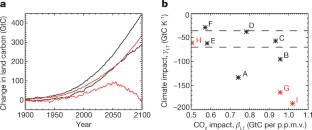
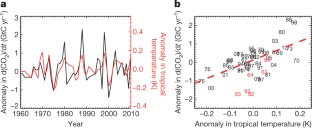
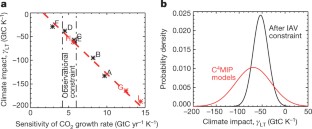
The release of carbon from tropical forests may exacerbate future climate change1, but the magnitude of the effect in climate models remains uncertain2. Coupled climate–carbon-cycle models generally agree that carbon storage on land will increase as a result of the simultaneous enhancement of plant photosynthesis and water use efficiency under higher atmospheric CO2 concentrations, but will decrease owing to higher soil and plant respiration rates associated with warming temperatures3. At present, the balance between these effects varies markedly among coupled climate–carbon-cycle models, leading to a range of 330 gigatonnes in the projected change in the amount of carbon stored on tropical land by 2100. Explanations for this large uncertainty include differences in the predicted change in rainfall in Amazonia4,5 and variations in the responses of alternative vegetation models to warming6. Here we identify an emergent linear relationship, across an ensemble of models7, between the sensitivity of tropical land carbon storage to warming and the sensitivity of the annual growth rate of atmospheric CO2 to tropical temperature anomalies8. Combined with contemporary observations of atmospheric CO2 concentration and tropical temperature, this relationship provides a tight constraint on the sensitivity of tropical land carbon to climate change. We estimate that over tropical land from latitude 30° north to 30° south, warming alone will release 53 ± 17 gigatonnes of carbon per kelvin. Compared with the unconstrained ensemble of climate–carbon-cycle projections, this indicates a much lower risk of Amazon forest dieback under CO2-induced climate change if CO2 fertilization effects are as large as suggested by current models9. Our study, however, also implies greater certainty that carbon will be lost from tropical land if warming arises from reductions in aerosols10 or increases in other greenhouse gases11.
This is a preview of subscription content, access via your institution
Access options
Subscribe to this journal
Receive 52 print issues and online access
$199.00 per year
only $3.83 per issue
Buy this article
- Purchase on SpringerLink
- Instant access to the full article PDF.
USD 39.95
Prices may be subject to local taxes which are calculated during checkout
Additional access options:
Figure 1: Projected changes in land carbon storage in the tropics from coupled climate–carbon-cycle models.
The alternative text for this image may have been generated using AI.
Figure 2: Observed relationship between variations in the growth rate of atmospheric CO 2 and tropical temperature.
The alternative text for this image may have been generated using AI.
Figure 3: Emergent constraint on the sensitivity of tropical land carbon to climate change.
The alternative text for this image may have been generated using AI.
References
- Cox, P. M., Betts, R. A., Jones, C. D., Spall, S. A. & Totterdell, I. J. Acceleration of global warming due to carbon cycle feedbacks in a coupled climate model. Nature 408, 184–187 (2000)
Article CAS ADS Google Scholar - Malhi, Y. et al. Climate change, deforestation, and the fate of the Amazon. Science 319, 169–172 (2008)
Article CAS ADS Google Scholar - Friedlingstein, P. et al. Climate-carbon cycle feedback analysis: results from the C4MIP model intercomparison. J. Clim. 19, 3337–3353 (2006)
Article ADS Google Scholar - Jupp, T. E. et al. Development of probability density functions for future South American rainfall. New Phytol. 187, 682–693 (2010)
Article Google Scholar - Rammig, A. et al. Estimating the risk of Amazonian forest dieback. New Phytol. 187, 694–706 (2010)
Article CAS Google Scholar - Galbraith, D. et al. Multiple mechanisms of Amazonian forest biomass losses in three dynamic global vegetation models under climate change. New Phytol. 187, 647–665 (2010)
Article Google Scholar - Hall, A. & Qu, X. Using the current seasonal cycle to constrain snow albedo feedback in future climate change. Geophys. Res. Lett. 33, L03502 (2006)
ADS Google Scholar - Bacastow, R. Modulation of atmospheric carbon dioxide by the Southern Oscillation. Nature 261, 116–118 (1976)
Article CAS ADS Google Scholar - Cox, P. M. et al. Amazon dieback under climate-carbon cycle projections for the 21st century. Theor. Appl. Climatol. 78, 137–156 (2004)
Article ADS Google Scholar - Cox, P. M. et al. Increasing risk of Amazonian drought due to decreasing aerosol pollution. Nature 453, 212–215 (2008)
Article CAS ADS Google Scholar - Huntingford, C. et al. Highly contrasting effects of different climate forcing agents on ecosystem services. Phil. Trans. R. Soc. A 369, 2026–2037 (2011)
Article CAS ADS Google Scholar - Nakicenovic, N. et al. Emissions Scenarios: Summary for Policymakers. Spec. Report (Intergovernmental Panel on Climate Change, 2000)
- Friedlingstein, P., Dufresne, J.-L., Cox, P. M. & Rayner, P. How positive is the feedback between climate change and the carbon cycle? Tellus 55B, 692–700 (2003)
Article CAS ADS Google Scholar - Booth, B. B. B. et al. High sensitivity of future global warming to land carbon cycle processes. Environ. Res. Lett. 7, 024002 (2012)
Article ADS Google Scholar - Moss, R. H. et al. The next generation of scenarios for climate change research and assessment. Nature 463, 747–756 (2010)
Article CAS ADS Google Scholar - Hungate, B. A. et al. Nitrogen and climate change. Science 302, 1512–1513 (2003)
Article CAS Google Scholar - Zaehle, S., Friedlingstein, P. & Friend, A. D. Terrestrial nitrogen feedbacks may accelerate future climate change. Geophys. Res. Lett. 37, L01401 (2010)
Article ADS Google Scholar - Baker, T. R. et al. Increasing biomass in Amazonian forest plots. Phil. Trans. R. Soc. Lond. B 359, 353–365 (2004)
Article Google Scholar - Lewis, S. L. et al. Increasing carbon storage in intact African tropical forests. Nature 457, 1003–1006 (2009)
Article CAS ADS Google Scholar - Marengo, J. A. et al. The drought of Amazonia in 2005. J. Clim. 21, 495–516 (2008)
Article ADS Google Scholar - Marengo, J. A. et al. The drought of 2010 in the context of historical droughts in the Amazon region. Geophys. Res. Lett. 38, L12703 (2011)
Article ADS Google Scholar - Phillips, O. et al. Drought sensitivity of the Amazon rainforest. Science 323, 1344–1347 (2009)
Article CAS ADS Google Scholar - Lenton, T. M. et al. Tipping elements in the Earth’s climate system. Proc. Natl Acad. Sci. USA 105, 1786–1793 (2008)
Article CAS ADS Google Scholar - Jones, C. D. & Cox, P. M. On the significance of atmospheric CO2 growth rate anomalies in 2002–2003. Geophys. Res. Lett. 32, L14816 (2005)
ADS Google Scholar - Denman, K. L. et al. in Climate Change 2007: The Physical Science Basis (eds Solomon, S. et al.) 499–587 (Cambridge Univ. Press, 2007)
- Masarie, K. A. & Tans, P. P. Extension and integration of atmospheric carbon dioxide data into a globally consistent measurement record. J. Geophys. Res. 100, 11593–11610 (1995)
Article CAS ADS Google Scholar - Meinshausen, M. et al. The RCP greenhouse gas concentrations and their extensions from 1765 to 2500. Clim. Change 109, 213–241 (2011)
Article CAS ADS Google Scholar - Smith, T. M. et al. Improvements to NOAA’s historical merged land-ocean surface temperature analysis (1880–2006). J. Clim. 21, 2283–2296 (2008)
Article ADS Google Scholar - Mercado, L. M. et al. Impact of changes in diffuse radiation on the global land carbon sink. Nature 458, 1014–1017 (2009)
Article CAS ADS Google Scholar
Acknowledgements
We acknowledge funding from the NERC NCEO programme (P.M.C. and C.M.L.); the EU Greencycles II project (P.M.C. and P.F.); the EU FP7 ‘CARBONES’ project (D.P. and C.D.J.); the Joint DECC/Defra Met Office Hadley Centre Climate Programme (GA01101) (D.P., B.B.B. and C.D.J.); the CEH Science Budget (C.H.) and the Newton Institute programme on ‘Mathematical and Statistical Approaches to Climate Modelling and Prediction’, during which this research was first formulated (P.M.C., B.B.B. and C.H.). We also acknowledge the modelling groups that provided results to C4MIP.
Author information
Authors and Affiliations
- College of Engineering, Mathematics and Physical Science, University of Exeter, Exeter EX4 4QF, UK ,
Peter M. Cox, Pierre Friedlingstein & Catherine M. Luke - Hadley Centre, Met Office, Exeter EX1 3PB, UK ,
David Pearson, Ben B. Booth & Chris D. Jones - Centre for Ecology and Hydrology, Wallingford OX10 8BB, UK ,
Chris Huntingford
Authors
- Peter M. Cox
- David Pearson
- Ben B. Booth
- Pierre Friedlingstein
- Chris Huntingford
- Chris D. Jones
- Catherine M. Luke
Contributions
P.M.C. led the study and drafted the manuscript. D.P. assisted with the statistical analysis, especially the estimation of the observationally constrained PDF in Fig. 3b. P.F. provided data and guidance on the C4MIP model ensemble, and B.B.B. did likewise for the HadCM3 carbon-cycle ensemble. C.H. processed observational climate data sets to produce time series of tropical mean temperature anomalies. P.M.C., C.D.J., P.F. and C.H. have had discussions over many years concerning the relationship between the interannual variability and the long-term sensitivity of the land carbon cycle to climate change. C.M.L. provided invaluable insights into the interpretation of the regression line in Fig. 3a. All co-authors commented on and provided edits to the original manuscript.
Corresponding author
Correspondence toPeter M. Cox.
Ethics declarations
Competing interests
The authors declare no competing financial interests.
Supplementary information
PowerPoint slides
Rights and permissions
About this article
Cite this article
Cox, P., Pearson, D., Booth, B. et al. Sensitivity of tropical carbon to climate change constrained by carbon dioxide variability.Nature 494, 341–344 (2013). https://doi.org/10.1038/nature11882
- Received: 31 May 2012
- Accepted: 28 December 2012
- Published: 06 February 2013
- Issue date: 21 February 2013
- DOI: https://doi.org/10.1038/nature11882
This article is cited by
Comments
Commenting on this article is now closed.
- philip fearnside 12 February 2013, 15:37
Vines, CO2 and Amazon forest dieback
	The paper by Cox et al. (1) brings good news of a less-catastrophic dieback of Amazonian forest in the face of predicted climate change, as compared to that shown by the group?s earlier models (2). However, it would be risky to conclude that climate-induced dieback would be cancelled out by increased growth rates stimulated by CO2 fertilization. The paper emphasizes that the ?magnitude of long-term CO2 fertilization effects? is one of the ?remaining uncertainties?. I am wary of the global generalization that ?carbon storage on land will increase ?. under higher CO2? being applied to Amazonia. Cox et al. (1) point out that recent increased growth of Amazonian trees (3) may be due to higher CO2. This increased growth, which is primarily in forests on relatively fertile soils near the Andes at the western edge of Amazonia (4), does not mean that the effects of CO2 fertilization are uniformly positive for Amazonian forest biomass, especially in eastern Amazonia where dieback is expected to begin and be most severe. Vines generally make better use of the extra CO2 than do trees (e.g., 5), with the result that increased vine loads could slow tree growth or kill trees outright (6). CO2-enrichment may explain why vine loads have increased at five of the six locations for which measurements are available across tropical forests worldwide, leading to higher tree mortality rates and consequent turnover (7). Amazonian forests vary tremendously in terms of the prevalence of vines, and the extremes found in virtually impenetrable patches of ?liana forest? (mostly in eastern Amazonia) really have to be experienced to be appreciated (Figure 1).
1. Cox, P. M. et al. Sensitivity of tropical carbon to climate change constrained by carbon dioxide variability. Nature Published online 06 February 2013. doi:10.1038/nature11882 (2013).
2. Cox, P. M., Betts, R. A., Jones, C. D., Spall, S. A. &Totterdell, I. J. Acceleration of global warming due to carbon cycle feedbacks in a coupled climate model. Nature 408, 184?187 (2000).
3. Baker, T. R. et al. Increasing biomass in Amazonian forest plots. Phil. Trans. R. Soc. Lond. B 359, 353?365 (2004).
4. Malhi, Y. et al. The regional variation of aboveground live biomass in old-growth Amazonian forest. Global Change Biol. 12, 1?32 (2006).
5. Condon, M. A., Sasek, T. W. & Strain, B. R. Allocation patterns in two tropical vines in response to increased atmospheric CO2. Funct. Ecol. 6, 680-685 (1992).
6. Fearnside, P. M. Potential impacts of climatic change on natural forests and forestry in Brazilian Amazonia. Forest Ecol. Manage. 78, 51-70 (1995).
7. Phillips, O. & Gentry, A. H. Increasing turnover through time in tropical forests. Science 263, 954-958 (1994).
Philip M. Fearnside
National Institute for Research in Amazonia (INPA)
Manaus, Amazonas, Brazil
Email: pmfearn@inpa.gov.br
Fig. 1. Vines cut in a forest-management experiment at Buriticupu, Maranhão, in eastern Amazonia (Photo: P.M. Fearnside). [see http://philip.inpa.gov.br]